. 2017 Mar 28;17(1):239.
doi: 10.1186/s12913-017-2169-4.

Task-shifting alcohol interventions for HIV+ persons in Kenya: a cost-benefit analysis

Affiliations

Task-shifting alcohol interventions for HIV+ persons in Kenya: a cost-benefit analysis

Omar Galárraga et al. BMC Health Serv Res. .

Abstract

Background: Among HIV+ patients, alcohol use is a highly prevalent risk factor for both HIV transmission and poor adherence to HIV treatment. The large-scale implementation of effective interventions for treating alcohol problems remains a challenge in low-income countries with generalized HIV epidemics. It is essential to consider an intervention's cost-effectiveness in dollars-per-health-outcome, and the long-term economic impact -or "return on investment" in monetary terms.

Methods: We conducted a cost-benefit analysis, measuring economic return on investment, of a task-shifted cognitive-behavioral therapy (CBT) intervention delivered by paraprofessionals to reduce alcohol use in a modeled cohort of 13,440 outpatients in Kenya. In our base-case, we estimated the costs and economic benefits from a societal perspective across a six-year time horizon, with a 3% annual discount rate. Costs included all costs associated with training and administering task-shifted CBT therapy. Benefits included the economic impact of lowered HIV incidence as well as the improvements in household and labor-force productivity. We conducted univariate and multivariate probabilistic sensitivity analyses to test the robustness of our results.

Results: Under the base case, total costs for CBT rollout was $554,000, the value of benefits were $628,000, and the benefit-to-cost ratio was 1.13. Sensitivity analyses showed that under most assumptions, the benefit-to-cost ratio remained above unity indicating that the intervention was cost-saving (i.e., had positive return on investment). The duration of the treatment effect most effected the results in sensitivity analyses.

Conclusions: CBT can be effectively and economically task-shifted to paraprofessionals in Kenya. The intervention can generate not only reductions in morbidity and mortality, but also economic savings for the health system in the medium and long term. The findings have implications for other countries with generalized HIV epidemics, high prevalence of alcohol consumption, and shortages of mental health professionals.

Trial registration: This paper uses data derived from "Cognitive Behavioral Treatment to Reduce Alcohol Use Among HIV-Infected Kenyans (KHBS)" with ClinicalTrials.gov registration NCT00792519 on 11/17/2008; and preliminary data from "A Stage 2 Cognitive-behavioral Trial: Reduce Alcohol First in Kenya Intervention" ( NCT01503255 , registered on 12/16/2011).

Keywords: AIDS; Alcohol; CBT; Cognitive-behavioral-therapy; Cost-benefit-analysis; HIV; Kenya; Sub-Saharan Africa; Task-shifting.


Figures
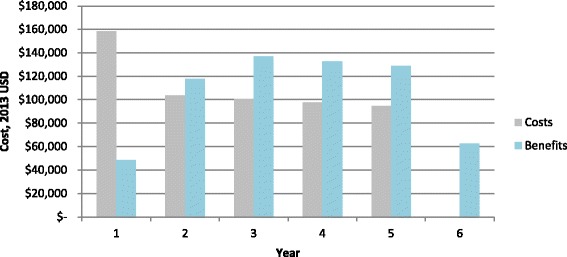
Fig. 1
Fig. 1
Costs and potential benefits accrued (in time-discounted 2013 USD). Figure 1 illustrates the monetary costs and potential benefits from a cognitive behavioral therapy which would be used to reduce alcohol abuse among 13,440 persons living with HIV in Kenya. Values of cost and benefits were discounted at a rate of 3% assuming that they occur at the end of each year, thus costs in year 1 were not discounted
Fig. 2
Fig. 2
One-way sensitivity analyses for input variables that most affect the base case results. In the figure above, “Rise in labor force participation” is a measure of the percentage rise in weekly hours worked after ARV treatment; “Alcohol-attributable HIV incidence” is the percentage of HIV incidence attributable to alcohol consumption; “Rise in ARV-adherence” is the Increase in the likelihood that an HIV+ patient which moves from non-abstinence to abstinence behavior will be ARV-adherent; “Rise in abstinence due to CBT” is the Difference between intervention and usual care in percentage of patients reporting abstinence at 90 day follow-up; “Monthly Min Wage” is a measure of the Average Monthly Minimum Wage in Kenya in USD; “12 Month tenofovir/3TC/EFV” is the cost of a 12 Month tenofovir/3TC/EFV drug regimen expressed in 2013 USD; “Rise in hours collecting water” is the increase in female hours spent collecting water in past week; “Costs of CBT” is the cost of the CBT rollout per participant; “Rise in hours spent collecting firewood” is the increase in female hours spent collecting firewood in past week; “House worker min wage” is the Average Hourly Minimum Wage for House Worker. The numbers in the parentheses represent the upper and lower bounds of the sensitivity analysis. The numbers listed at the left and right hand side of the bars represent the benefit to cost ratio which would result from the target variable taking on the corresponding max or min value. Note that the vertical axis is at 1.13, but that all cost-benefit ratios above 1.0 are cost-saving and thus most variables maintain that CBT is cost saving across the entire range of variables. Ratios rounded to nearest hundredth. Abbreviations: BCR, benefit-to-cost ratio; CBT, cognitive behavioral therapy. The vertical axis intersects the horizontal axis at approximately 1.13
Fig. 3
Fig. 3
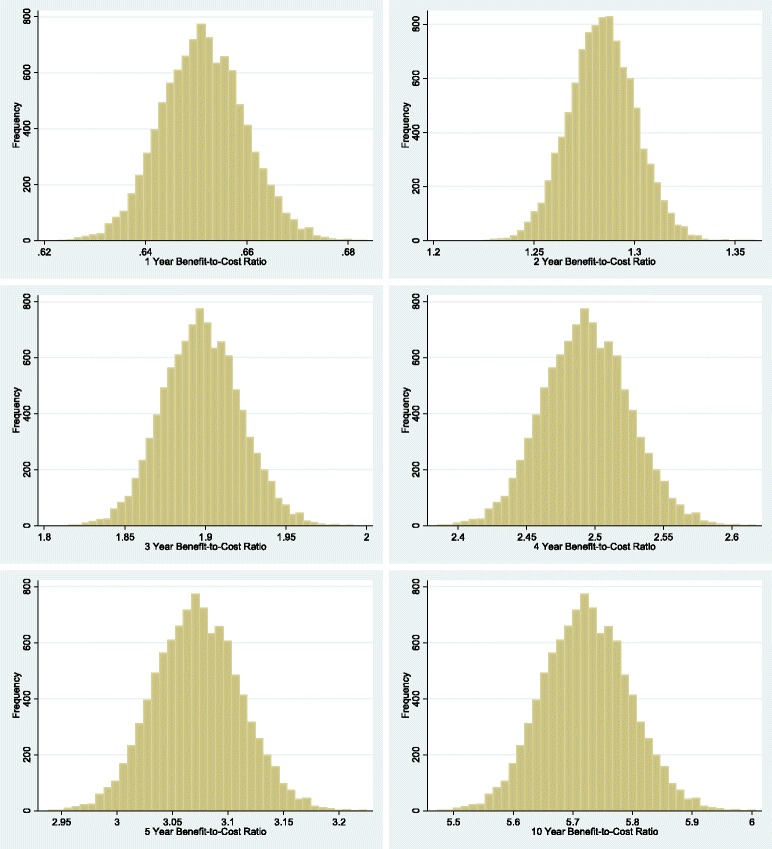
Distribution of benefit-to-cost ratios from Monte Carlo simulations. Figure 3 shows the results of our probabilistic sensitivity analysis with discounted net benefits. Separate sets of simulations were independently run for the assumption that program effect duration was 1, 2, 4, 5, or 10 years. Each set of simulations was made up of 10000 repetitions done across an independent sample of 13440 participants. Each set of simulations is also shown with a separate graph

References

    1. Rehm J, Mathers C, Popova S, Thavorncharoensap M, Teerawattananon Y, Patra J. Global burden of disease and injury and economic cost attributable to alcohol use and alcohol-use disorders. Lancet. 2009;373(9682):2223–2233. doi: 10.1016/S0140-6736(09)60746-7. - DOI - PubMed
    1. WHO . Global Status Report on Alcohol and Health 2014. Geneva: World Health Organization (WHO); 2014.
    1. Bass JK, Bornemann TH, Burkey M, Chehil S, Chen L, Copeland JR, Eaton WW, Ganju V, Hayward E, Hock RS, et al. A United Nations General Assembly Special Session for mental, neurological, and substance use disorders: the time has come. PLoS Med. 2012;9(1) doi: 10.1371/journal.pmed.1001159. - DOI - PMC - PubMed
    1. Collins PY, Insel TR, Chockalingam A, Daar A, Maddox YT. Grand challenges in global mental health: integration in research, policy, and practice. PLoS Med. 2013;10(4) doi: 10.1371/journal.pmed.1001434. - DOI - PMC - PubMed
    1. Collins PY, Patel V, Joestl SS, March D, Insel TR, Daar AS, Anderson W, Dhansay MA, Phillips A, Shurin S, et al. Grand challenges in global mental health. Nature. 2011;475(7354):27–30. doi: 10.1038/475027a. - DOI - PMC - PubMed

Publication types

Associated data