


Basal-like breast cancer: molecular profiles, clinical features and survival outcomes
- PMID: 28351365
- PMCID: PMC5370447
- DOI: 10.1186/s12920-017-0250-9
Basal-like breast cancer: molecular profiles, clinical features and survival outcomes
Abstract
Background: Basal-like constitutes an important molecular subtype of breast cancer characterised by an aggressive behaviour and a limited therapy response. The outcome of patients within this subtype is, however, divergent. Some individuals show an increased risk of dying in the first five years, and others a long-term survival of over ten years after the diagnosis. In this study, we aim at identifying markers associated with basal-like patients' survival and characterising subgroups with distinct disease outcome.
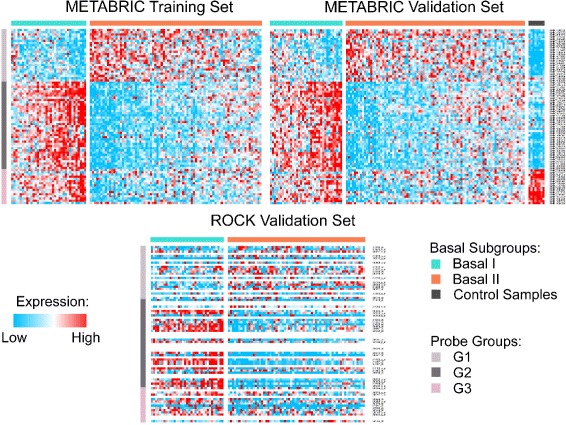
Methods: We explored the genomic and transcriptomic profiles of 351 basal-like samples from the METABRIC and ROCK data sets. Two selection methods, labelled Differential and Survival filters, were employed to determine genes/probes that are differentially expressed in tumour and control samples, and are associated with overall survival. These probes were further used to define molecular subgroups, which vary at the microRNA level and in DNA copy number.
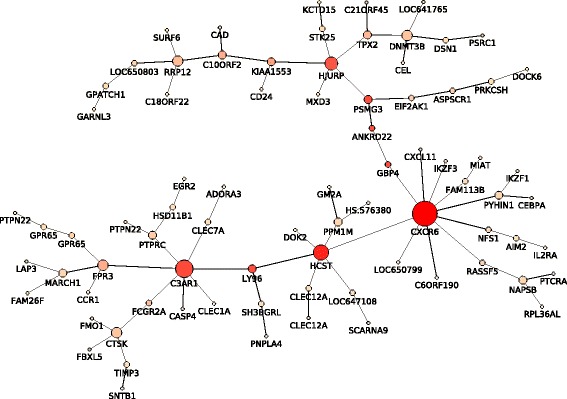
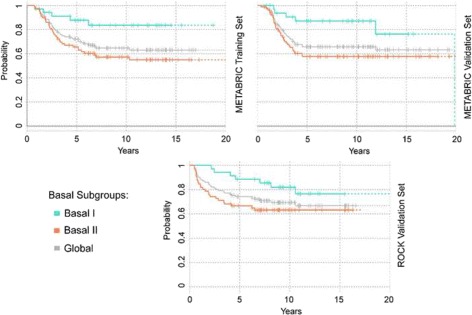
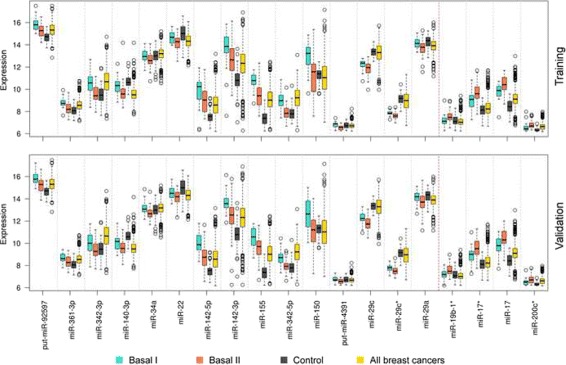
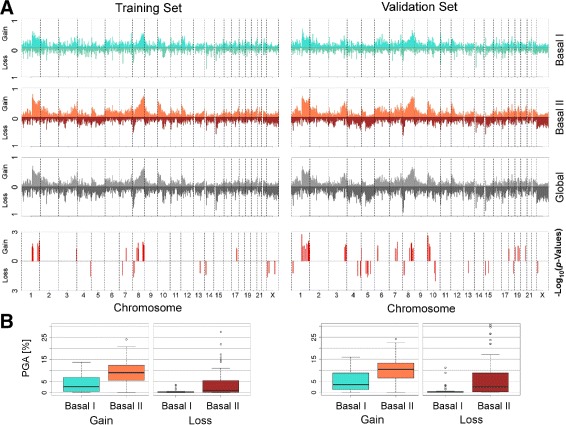
Results: We identified the expression signature of 80 probes that distinguishes between two basal-like subgroups with distinct clinical features and survival outcomes. Genes included in this list have been mainly linked to cancer immune response, epithelial-mesenchymal transition and cell cycle. In particular, high levels of CXCR6, HCST, C3AR1 and FPR3 were found in Basal I; whereas HJURP, RRP12 and DNMT3B appeared over-expressed in Basal II. These genes exhibited the highest betweenness centrality and node degree values and play a key role in the basal-like breast cancer differentiation. Further molecular analysis revealed 17 miRNAs correlated to the subgroups, including hsa-miR-342-5p, -150, -155, -200c and -17. Additionally, increased percentages of gains/amplifications were detected on chromosomes 1q, 3q, 8q, 10p and 17q, and losses/deletions on 4q, 5q, 8p and X, associated with reduced survival.
Conclusions: The proposed signature supports the existence of at least two subgroups of basal-like breast cancers with distinct disease outcome. The identification of patients at a low risk may impact the clinical decisions-making by reducing the prescription of high-dose chemotherapy and, consequently, avoiding adverse effects. The recognition of other aggressive features within this subtype may be also critical for improving individual care and for delineating more effective therapies for patients at high risk.
Keywords: Basal-like; Breast cancer; Copy number aberration; Gene expression; Intrinsic subtypes; MicroRNA; Molecular profile; Signature; Survival outcome; Triple-negative.
Figures
References
-
- Lund MJ, Trivers KF, Porter PL, Coates RJ, Leyland-Jones B, Brawley OW, Flagg EW, O’Regan RM, Gabram SG, Eley JW. Race and triple negative threats to breast cancer survival: a population-based study in atlanta, ga. Breast Cancer Res Treat. 2009;113(2):357–70. doi: 10.1007/s10549-008-9926-3. - DOI - PubMed
-
- Rody A, Karn T, Liedtke C, Pusztai L, Ruckhaeberle E, Hanker L, Gaetje R, Solbach C, Ahr A, Metzler D, Schmidt M, Müller V, Holtrich U, Kaufmann M. A clinically relevant gene signature in triple negative and basal-like breast cancer. Breast Cancer Res. 2011;13(5):97. doi: 10.1186/bcr3035. - DOI - PMC - PubMed
Publication types
MeSH terms
Substances
LinkOut - more resources
Full Text Sources
Other Literature Sources
Medical
Miscellaneous
