


Corticosteroids in septic shock: a systematic review and network meta-analysis
- PMID: 28351429
- PMCID: PMC5371269
- DOI: 10.1186/s13054-017-1659-4
Corticosteroids in septic shock: a systematic review and network meta-analysis
Abstract
Background: Multiple corticosteroids and treatment regimens have been used as adjuncts in the treatment of septic shock. Qualitative and quantitative differences exist at cellular and tissular levels between the different drugs and their patterns of delivery. The objective of this study was to elucidate any differences between the drugs and their treatment regimens regarding outcomes for corticosteroid use in adult patients with septic shock.
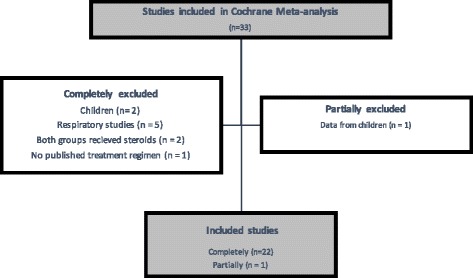
Methods: Network meta-analysis of the data used for the recently conducted Cochrane review was performed. Studies that included children and were designed to assess respiratory function in pneumonia and acute respiratory distress syndrome, as well as cross-over studies, were excluded. Network plots were created for each outcome, and all analyses were conducted using a frequentist approach assuming a random-effects model.
Results: Complete data from 22 studies and partial data from 1 study were included. Network meta-analysis provided no clear evidence that any intervention or treatment regimen is better than any other across the spectrum of outcomes. There was strong evidence of differential efficacy in only one area: shock reversal. Hydrocortisone boluses and infusions were more likely than methylprednisolone boluses and placebo to result in shock reversal.
Conclusions: There was no clear evidence that any one corticosteroid drug or treatment regimen is more likely to be effective in reducing mortality or reducing the incidence of gastrointestinal bleeding or superinfection in septic shock. Hydrocortisone delivered as a bolus or as an infusion was more likely than placebo and methylprednisolone to result in shock reversal.
Keywords: Adrenal; Critical care; Glucocorticoids; Sepsis; Septic shock; Steroids.
Figures


Comment in
-
Do Corticosteroids Improve Mortality or Shock Reversal in Patients With Septic Shock?Ann Emerg Med. 2018 Jan;71(1):34-36. doi: 10.1016/j.annemergmed.2017.05.025. Epub 2017 Jul 6. Ann Emerg Med. 2018. PMID: 28688770 No abstract available.
References
-
- Marik PE, Pastores SM, Annane D, Meduri GU, Sprung CL, Arlt W, et al. Recommendations for the diagnosis and management of corticosteroid insufficiency in critically ill adult patients: consensus statements from an international task force by the American College of Critical Care Medicine. Crit Care Med. 2008;36:1937–49. doi: 10.1097/CCM.0b013e31817603ba. - DOI - PubMed
Publication types
MeSH terms
Substances
Grants and funding
LinkOut - more resources
Full Text Sources
Other Literature Sources
Medical
