Ribociclib (LEE011): Mechanism of Action and Clinical Impact of This Selective Cyclin-Dependent Kinase 4/6 Inhibitor in Various Solid Tumors
- PMID: 28351928
- PMCID: PMC5727901
- DOI: 10.1158/1078-0432.CCR-16-3157
Ribociclib (LEE011): Mechanism of Action and Clinical Impact of This Selective Cyclin-Dependent Kinase 4/6 Inhibitor in Various Solid Tumors
Abstract
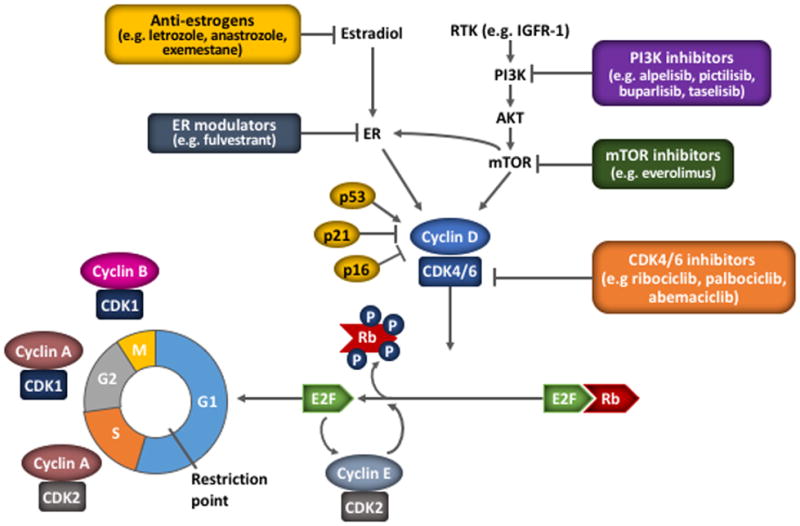
The cyclin D-cyclin-dependent kinase (CDK) 4/6-p16-retinoblastoma (Rb) pathway is commonly disrupted in cancer, leading to abnormal cell proliferation. Therapeutics targeting this pathway have demonstrated antitumor effects in preclinical and clinical studies. Ribociclib is a selective, orally bioavailable inhibitor of CDK4 and CDK6, which received FDA approval in March 2017 and is set to enter the treatment landscape alongside other CDK4/6 inhibitors, including palbociclib and abemaciclib. Here, we describe the mechanism of action of ribociclib and review preclinical and clinical data from phase I, II, and III trials of ribociclib across different tumor types, within the context of other selective CDK4/6 inhibitors. The pharmacokinetics, pharmacodynamics, safety, tolerability, and clinical responses with ribociclib as a single agent or in combination with other therapies are discussed, and an overview of the broad portfolio of ongoing clinical trials with ribociclib across a wide range of indications is presented. On the basis of the available data, ribociclib has a manageable tolerability profile and therapeutic potential for a variety of cancer types. Its high selectivity makes it an important partner drug for other targeted therapies, and it has been shown to enhance the clinical activity of existing anticancer therapies and delay the development of treatment resistance, without markedly increasing toxicity. Ongoing trials of doublet and triplet targeted therapies containing ribociclib seek to identify optimal CDK4/6-based targeted combination regimens for various tumor types and advance the field of precision therapeutics in oncology. Clin Cancer Res; 23(13); 3251-62. ©2017 AACR.
©2017 American Association for Cancer Research.
Conflict of interest statement
D Tripathy discloses clinical trial grants and editorial support funded by Novartis Pharmaceuticals Corporation in relation to this submitted work. He also discloses consultancy fees from Nektar Therapeutics outside the submitted work. A Bardia discloses participating in an advisory board for Novartis Pharmaceuticals Corporation. W Sellers was previously employed by, and owns shares in, Novartis Pharmaceuticals Corporation.
Figures
Comment in
-
Mechanism of Action and Clinical Impact of Ribociclib-Letter.Clin Cancer Res. 2017 Sep 15;23(18):5657. doi: 10.1158/1078-0432.CCR-17-1307. Clin Cancer Res. 2017. PMID: 28916618 No abstract available.
-
Mechanism of Action and Clinical Impact of Ribociclib-Response.Clin Cancer Res. 2017 Sep 15;23(18):5658. doi: 10.1158/1078-0432.CCR-17-1819. Clin Cancer Res. 2017. PMID: 28916619 No abstract available.
References
Publication types
MeSH terms
Substances
Grants and funding
LinkOut - more resources
Full Text Sources
Other Literature Sources