


Oral conditions and dysphagia in Japanese, community-dwelling middle- and older- aged adults, independent in daily living
- PMID: 28352164
- PMCID: PMC5358958
- DOI: 10.2147/CIA.S132637
Oral conditions and dysphagia in Japanese, community-dwelling middle- and older- aged adults, independent in daily living
Abstract
Purpose: Prevention, early detection and effective rehabilitation of dysphagia are important issues to be considered in an aging society. Previous studies have shown conflicting findings regarding the association between dysphagia and its potential risk factors, including age, malnutrition, oral conditions, lifestyle and medical history. Herein, we assessed the prevalence and association of dysphagia with potential risk factors in 50- to 79-year-old adults dwelling in a community in Japan.
Patients and methods: In this study, there were 532 participants (185 males and 347 females). Participants who responded positively to the question "Do you sometimes choke on drinks/food such as tea and soup?" or those who presented with abnormal repetitive saliva swallowing test findings were diagnosed with dysphagia. The data collected from these participants included the following: number of teeth, occurrence of oral dryness, age, body mass index, serum albumin concentration, smoking, drinking and exercise habits, presence of diseases, such as diabetes mellitus and hypertension, and questions from the Mini-Mental State Examination.
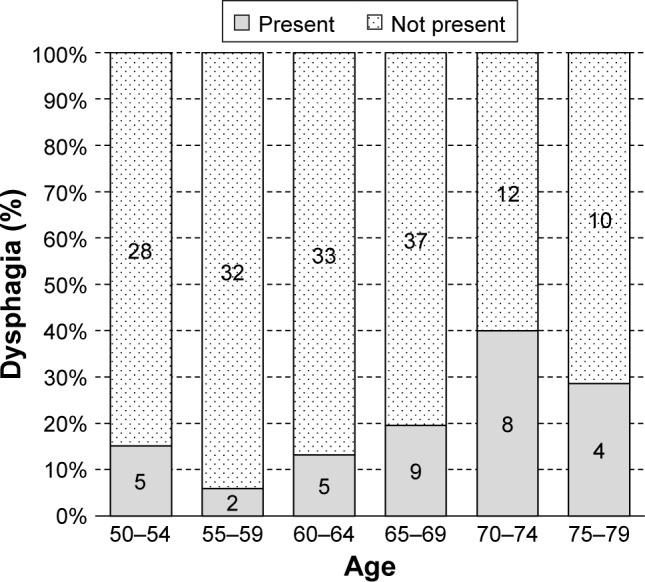
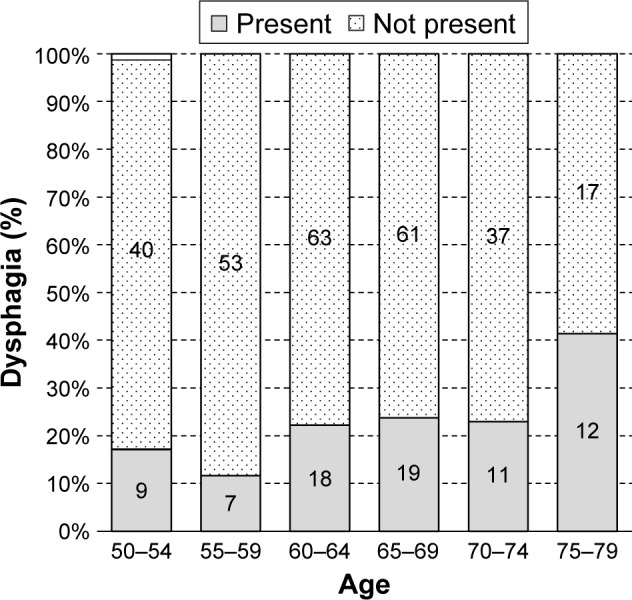
Results: Dysphagia was observed in 33 males (17.8%) and 76 females (21.9%). To explore the effect of the potential risk factors on the prevalence of dysphagia, a model was built by multivariate logistic regression analysis. Using the forced entry method, oral dryness (odds ratio [OR] =3.683 and P=0.003 in males; OR =1.797 and P=0.032 in females) and the number of teeth (OR =0.946 and P=0.038 in males) were found to be significantly related to dysphagia.
Conclusion: This cross-sectional study demonstrated associations between oral conditions and dysphagia. Factors such as oral dryness and number of teeth may contribute to dysphagia more so than aging, lifestyle and comorbidity in community-dwelling adults over the age of 50.
Keywords: lifestyle; number of teeth; nutrition; oral dryness; swallow.
Conflict of interest statement
Disclosure The authors report no conflicts of interest in this work.
Figures
References
-
- Serra-Prat M, Hinojosa G, López D, et al. Prevalence of oropharyngeal dysphagia and impaired safety and efficacy of swallow in independently living older persons. J Am Geriatr Society. 2011;59(1):186–187. - PubMed
-
- Okamoto N, Tomioka K, Saeki K, et al. Relationship between swallowing problems and tooth loss in community-dwelling independent elderly adults: the Fujiwara-Kyo study. J Am Geriatr Soc. 2012;60(5):849–853. - PubMed
-
- van der Maarel-Wierink CD, Meijers JM, De Visschere LM, de Baat C, Halfens RJ, Schols JM. Subjective dysphagia in older care home residents: a cross-sectional, multi-centre point prevalence measurement. Int J Nurs Stud. 2014;51(6):875–881. - PubMed
MeSH terms
LinkOut - more resources
Full Text Sources
Other Literature Sources
Medical
