


Clinical application value of impulse oscillometry in geriatric patients with COPD
- PMID: 28352170
- PMCID: PMC5358990
- DOI: 10.2147/COPD.S129974
Clinical application value of impulse oscillometry in geriatric patients with COPD
Abstract
Background: The diagnosis and assessment of COPD rely mainly on the use of spirometry, which is an effort-dependent test and requires good patient cooperation. Impulse oscillometry (IOS) is a non-volitional method that requires less effort and cooperation and presents advantages for geriatric patients. However, the clinical application value of IOS in geriatric patients with COPD remains unclear.
Aim: The aim of this study was to investigate the clinical application value of IOS in geriatric patients with COPD.
Subjects and methods: A total of 234 subjects were retrospectively enrolled in this study, including 133 patients with COPD and 101 healthy volunteers. All the participants underwent IOS and spirometry examination. The data were collected and analyzed in the overall group, the geriatric group (aged ≥65 years), and the advanced elderly group (aged ≥80 years).
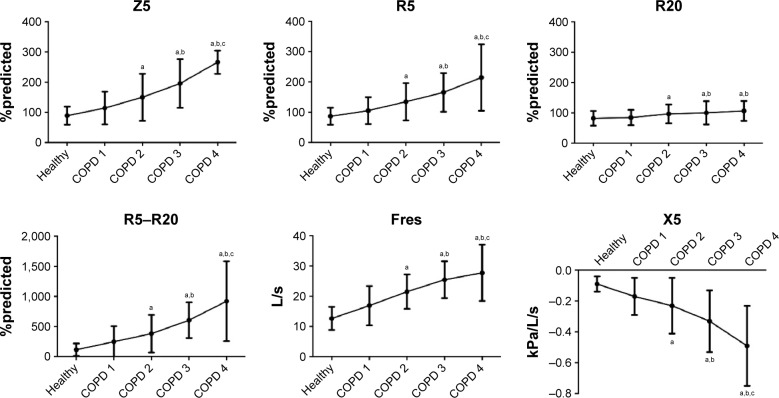
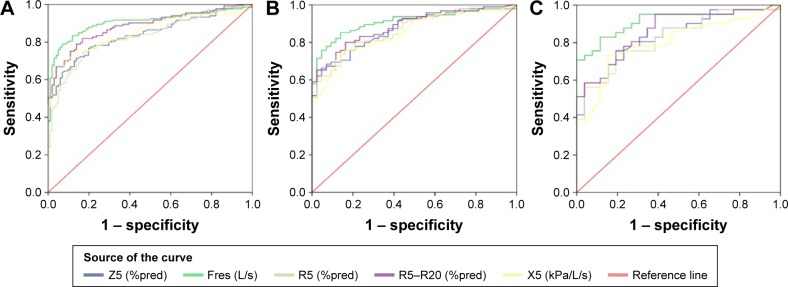
Results: 1) In COPD patients, a significant increase in respiratory impedance (Z5), resonant frequency (Fres), and respiratory resistance (R5, R20, R5-R20) and a decrease in respiratory reactance (X5) were observed in the overall group, the geriatric group, and the advanced elderly group compared with the healthy control subjects. 2) The IOS parameters correlated well with spirometry in COPD. In particular, R5-R20 showed the best correlation with forced expiratory volume in 1 second (FEV1) in the different age groups. 3) Fres and R5-R20 had the best diagnostic efficiency for COPD. The area under the curve (AUC) values for Fres, expressed by the receiver operating characteristic (ROC) curve, were 0.905, 0.909, and 0.914, for the different age groups, respectively. 4) The optimal cutoff values for Fres to diagnose airflow obstruction from ROC curves was 17.715 in the COPD patients. Its sensitivity and specificity were 0.789 and 0.931, respectively, and the cutoff values were similar in geriatric and advanced elderly patients.
Conclusion: IOS demonstrated good relevance compared with spirometry for geriatric patients with COPD. IOS may serve as an alternative method for spirometry in elderly subjects for the evaluation of the state of COPD.
Keywords: COPD; geriatric patients; impulse oscillometry; spirometry.
Conflict of interest statement
Disclosure The authors report no conflicts of interest in this work.
Figures
References
-
- The Global Strategy for the Diagnosis, Management and Prevention of COPD, Global Initiative for Chronic Obstructive Lung Disease (GOLD) 2016. [Accessed March 7, 2017]. Available from: http://goldcopd.org.
-
- Tomalak W, Czajkowska-Malinowska M, Radlinski J. Application of impulse oscillometry in respiratory system evaluation in elderly patients. Pneumonol Alergol Pol. 2014;82(4):330–335. - PubMed
-
- Czajkowska-Malinowska M, Tomalak W, Radlinski J. Quality of spirometry in the elderly. Pneumonol Alergol Pol. 2013;81(6):511–517. - PubMed
-
- Pezzoli L, Giardini G, Consonni S, et al. Quality of spirometric performance in older people. Age Ageing. 2003;32(1):43–46. - PubMed
Publication types
MeSH terms
LinkOut - more resources
Full Text Sources
Other Literature Sources
Medical
