


Attention-deficit hyperactivity disorder in elementary school students in Shantou, China: prevalence, subtypes, and influencing factors
- PMID: 28352178
- PMCID: PMC5359117
- DOI: 10.2147/NDT.S126100
Attention-deficit hyperactivity disorder in elementary school students in Shantou, China: prevalence, subtypes, and influencing factors
Abstract
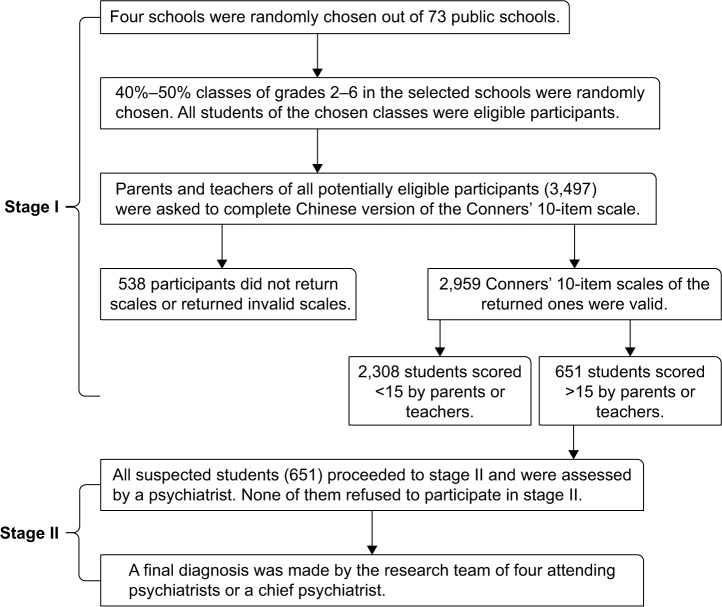
Attention-deficit hyperactivity disorder (ADHD) is a frequent childhood-onset psychiatric condition and categorized into three subtypes of predominantly inattentive (ADHD-I), hyperactive impulsive (ADHD-H), and combined (ADHD-C). The prevalence and subtypes of ADHD vary considerably. The primary aim of this study was to provide a prevalence estimate of ADHD in elementary school students living in Shantou, a district of China, and in addition to examine the influence of informants, age, and gender on the prevalence. A total of 3,497 students aged 7-12 years were enrolled by random and stratified sampling. In stage I, teachers and parents of all participating students in randomly selected schools were asked to complete Chinese versions of the Conners' 10-item scale. In stage II, students with high scores (>15) were interviewed by a psychiatrist for a diagnosis with or without ADHD. Parents rated many more students with high scores than teachers did in stage I. The prevalence of ADHD determined by Diagnostic and Statistical Manual of Mental Disorders, fifth edition (DSM-5) was 5.91% (5.27%-6.55%), which is comparable to the rates reported in previous studies with Chinese children. This hits the low border of the ADHD prevalence range from 5.9 to 7.1% worldwide, and is lower than that of Chinese children living in Hong Kong, suggesting an important influence of Chinese culture on the diagnosis of ADHD. The constituent ratios of ADHD-I, ADHD-C, and ADHD-H subtypes were 67.43, 24.57, and 8.00%, respectively. The rate of ADHD-H decreased with age, whereas that of ADHD-I remained at the highest levels in all age groups, suggesting that symptoms in the inattention domain are the most persistent and refractory.
Keywords: ADHD; Chinese culture; adolescents; informants; prevalence.
Conflict of interest statement
Disclosure The authors report no conflicts of interest in this work.
Figures
References
-
- Biederman J, Faraone SV. Attention-deficit hyperactivity disorder. Lancet. 2005;366(9841):237–248. - PubMed
-
- Polanczyk G, Jensen P. Epidemiologic considerations in attention deficit hyperactivity disorder: a review and update. Child Adolesc Psychiatr Clin N Am. 2008;17:245–260. - PubMed
-
- Polanczyk G, de Lima MS, Horta BL, Biederman J, Rohde LA. The worldwide prevalence of ADHD: a systematic review and meta-regression analysis. Am J Psychiatry. 2007;164(6):942–948. - PubMed
-
- Visser SN, Bitsko RH, Danielson ML, Perou R, Blumberg SJ. Increasing prevalence of parent-reported attention-deficit/hyperactivity disorder among children-United States, 2003 and 2007. Morb Mortal Wkly Rep. 2010;59:1439–1443. - PubMed
LinkOut - more resources
Full Text Sources
Other Literature Sources
