. 2017 Mar 14:8:403.
doi: 10.3389/fmicb.2017.00403. eCollection 2017.

Jumbo Bacteriophages: An Overview

Affiliations

Jumbo Bacteriophages: An Overview

Yihui Yuan et al. Front Microbiol. .

Abstract

Tailed bacteriophages with genomes larger than 200 kbp are classified as Jumbo phages, and are rarely isolated by conventional methods. These phages are designated "jumbo" owing to their most notable features of a large phage virion and large genome size. However, in addition to these, jumbo phages also exhibit several novel characteristics that have not been observed for phages with smaller genomes, which differentiate jumbo phages in terms of genome organization, virion structure, progeny propagation, and evolution. In this review, we summarize available reports on jumbo phages and discuss the differences between jumbo phages and small-genome phages. We also discuss data suggesting that jumbo phages might have evolved from phages with smaller genomes by acquiring additional functional genes, and that these additional genes reduce the dependence of the jumbo phages on the host bacteria.

Keywords: diversity; evolution; genome; jumbo bacteriophage; virion structure.


Figures
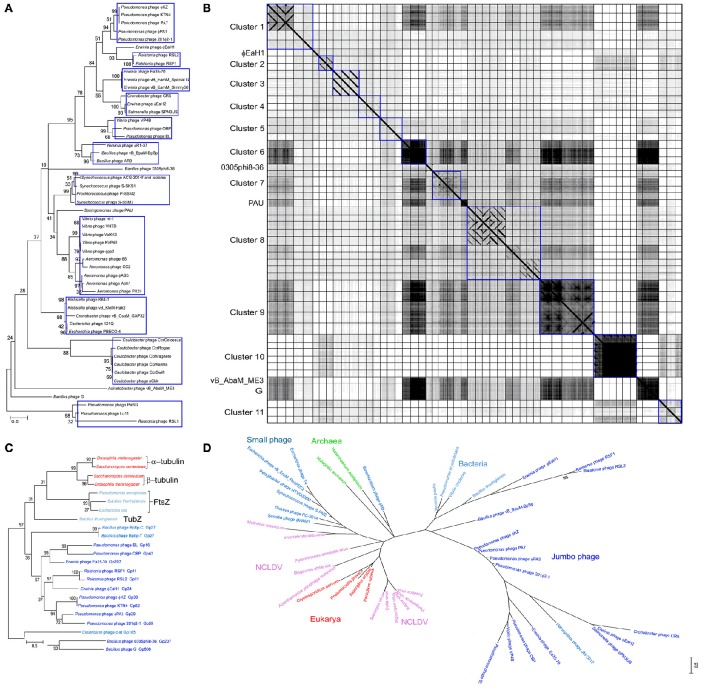
Figure 1
Figure 1
Phylogenic and comparative genomic analysis of Jumbo phages. The amino acid sequences of the terminase large subunit from 93 jumbo phages (A), the tubulin-like protein from Jumbo phage, bacteria, fungi, and phage with genome near 200 kbp (C), and the B-family DNA polymerase from jumbo phage, small phage, bacteria, archaea, eukarya, and NCLDVs (D), were used for phylogenetic analysis, respectively. The amino acid sequence were alignment by Muscle and the tree were constructed by Maximum Likelihood method with a bootstrap of 1,000 using Mega 6.0 (Tamura et al., 2013). (B) The genome of 52 Jumbo phage were compared by using Gepard (Krumsiek et al., 2007). The phage genome are arrangement in the same order as in Figure 1A. Phages belonging to different clusters are showed in rectangle boxes.

References

    1. Abbasifar R., Griffiths M. W., Sabour P. M., Ackermann H. W., Vandersteegen K., Lavigne R., et al. . (2014). Supersize me: cronobacter sakazakii phage GAP32. Virology 460, 138–146. 10.1016/j.virol.2014.05.003 - DOI - PubMed
    1. Ackermann H. W., Nguyen T. M. (1983). Sewage coliphages studied by electron-microscopy. Appl. Environ. Microbiol. 45, 1049–1059. - PMC - PubMed
    1. Adriaenssens E. M., Mattheus W., Cornelissen A., Shaburova O., Krylov V. N., Kropinski A. M., et al. . (2012). Complete genome sequence of the giant Pseudomonas Phage Lu11. J. Virol. 86, 6369–6370. 10.1128/JVI.00641-12 - DOI - PMC - PubMed
    1. Agirrezabala X., Martin-Benito J., Caston J. R., Miranda R., Valpuesta M., Carrascosa J. L. (2005). Maturation of phage T7 involves structural modification of both shell and inner core components. EMBO J. 24, 3820–3829. 10.1038/sj.emboj.7600840 - DOI - PMC - PubMed
    1. Bhunchoth A., Blanc-Mathieu R., Mihara T., Nishimura Y., Askora A., Phironrit N., et al. . (2016). Two asian jumbo phages, phi RSL2 and phi RSF1, infect Ralstonia solanacearum and show common features of phi KZ-related phages. Virology 494, 56–66. 10.1016/j.virol.2016.03.028 - DOI - PubMed
