. 2017 Feb;13(2):739-744.
doi: 10.3892/etm.2016.3994. Epub 2016 Dec 22.

Naringenin inhibits migration of lung cancer cells via the inhibition of matrix metalloproteinases-2 and -9

Affiliations

Naringenin inhibits migration of lung cancer cells via the inhibition of matrix metalloproteinases-2 and -9

Huai-Lu Chang et al. Exp Ther Med. 2017 Feb.

Abstract

Lung cancer is among the most common causes of cancer-related mortality. It has a high mortality rate and resistance to chemotherapy due to its high metastatic potential. Naringenin, a bioactive compound identified in several fruits, displays anti-inflammatory and antitumor effects. Furthermore, naringenin mitigates the migration of several human cancer cell types. However, the effects of naringenin on lung cancer remain unclear. The current study investigated the mechanisms of naringenin on the migration of lung cancer A549 cells. The results indicate that significant alteration in A549 cell proliferation was observed in response to naringenin (0-300 µM) treatment for 24 and 48 h. Furthermore, a dose-dependent migration inhibition of A549 in the presence of naringenin was observed by healing and transwell migration assays. In addition, a zymography assay revealed that naringenin exhibited a concentration-dependent inhibition of matrix metalloproteinase (MMP)-2 and -9 activities. Furthermore, naringenin also inhibited the activities of AKT in a dose-dependent manner. These observations indicated that naringenin inhibited the migration of lung cancer A549 cells through several mechanisms, including the inhibition of AKT activities and reduction of MMP-2 and -9 activities.

Keywords: lung cancer; migration; naringenin.


Figures
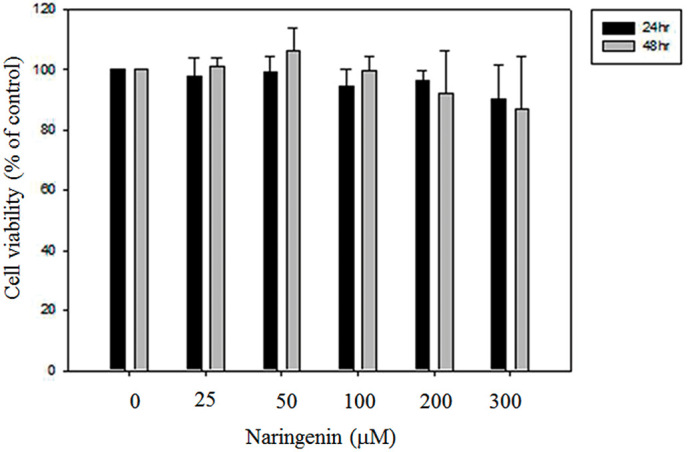
Figure 1.
Figure 1.
Effects of naringenin on the cell viability of lung A549 cells. A549 cells were treated with 0, 25, 50, 100, 200 and 300 µM naringenin for 24 or 48 h. The cell viability was then measured using an MTT assay. Data are presented as the mean ± standard deviation obtained from at least three independent experiments.
Figure 2.
Figure 2.
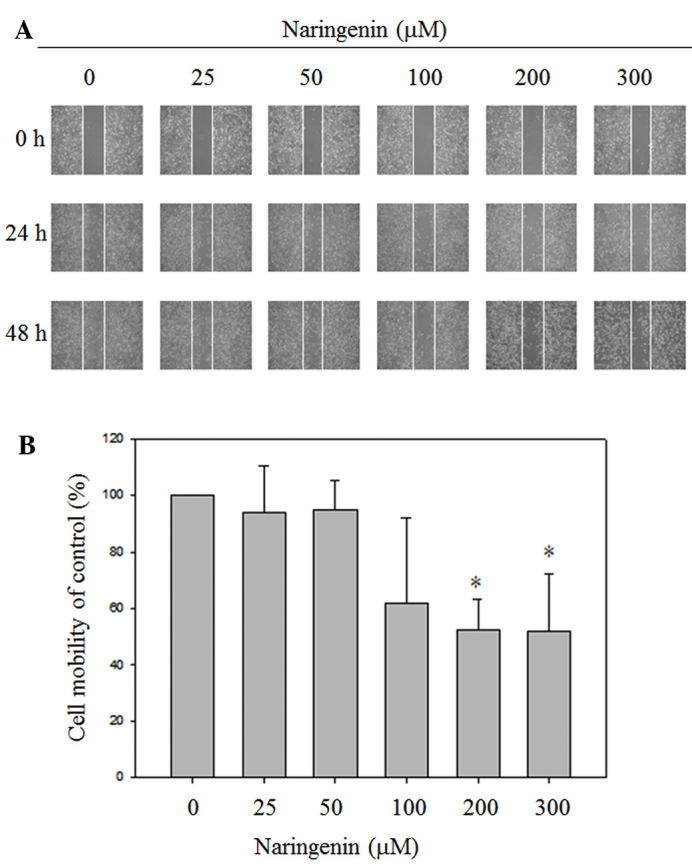
Naringenin inhibited the cell mobility of A549 cells in a dose-dependent manner. (A) For the wound healing assay, A549 monolayer cells were scratched by pipette tips, followed by treatment with the indicated concentration of naringenin for 24 and 48 h. The images were captured under a phase contract microscope (magnification, ×100). (B) Data are presented as the mean ± standard deviation obtained from at least three independent experiments. The cell mobility of the control was set to 100%. *P<0.05 vs. control group.
Figure 3.
Figure 3.
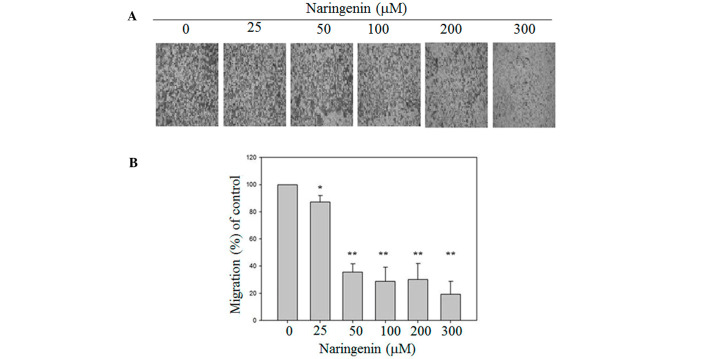
Naringenin reduced the migration of A549 cells. The cells were treated with different concentrations of naringenin as described in Materials and methods. (A) Migrated cells were stained with Giemsa and images were captured under a phase contract microscope (magnification, ×100). (B) Data are represented as the mean ± standard deviation obtained from at least three independent experiments. The migration of the control was set to 100%. *P<0.05 and **P<0.001 vs. control group.
Figure 4.
Figure 4.
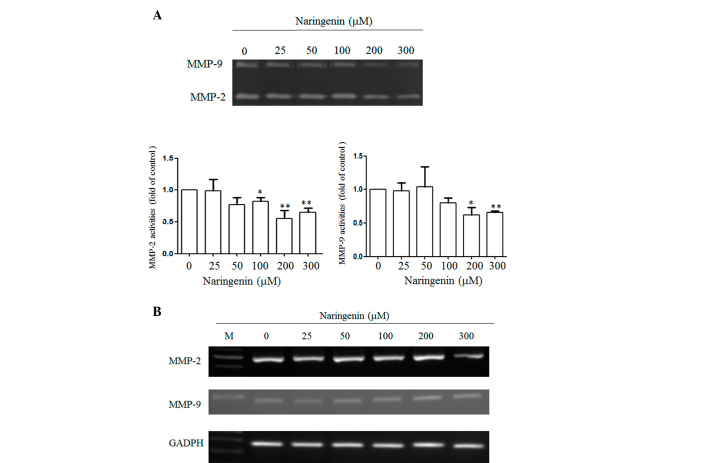
Effect of naringenin on the MMP-2/MMP-9 activity and the expression of A549 cells. (A) A549 cells were treated with the indicated concentration of naringenin for 24 h. Conditional mediums were collected and MMP-2 and −9 activities were determined by gelatin zymography analysis. Lower panel: Data are presented as the mean ± standard deviation obtained from at least three independent experiments. The activity of the control was set to 1. *P<0.05 and **P<0.001 vs. control group (0 µM naringen). (B) RT-PCR analysis of MMP-2 and −9 expression. A549 cells were treated with naringenin for 24 h and the total RNA was extracted. The expression of MMP-2 and −9 was detected using a PCR assay using a 100 bp marker (in lane M). MMP, matrix metalloproteinase; GAPDH, glyceraldehyde 3-phosphate dehydrogenase; RT-PCR, reverse transcription-polymerase chain reaction.
Figure 5.
Figure 5.
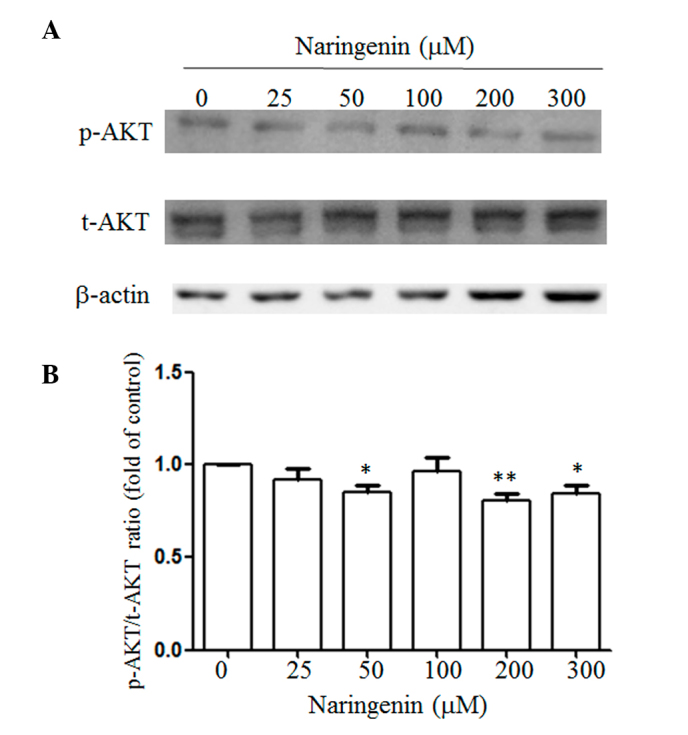
Naringenin attenuated AKT activities of A549 cells. (A) Total cell lysates obtained from cells were treated with the indicated concentration of naringenin for 48 h and were subjected to western blot analysis using the antibody indicated. β-actin was included as an internal control. (B) Data are presented as the mean ± standard deviation obtained from at least three independent experiments. The ratio of the control was set to 1. *P<0.05 and **P<0.001 vs. control group. P, phospho; t, total.

References

    1. Kotecha R, Takami A, Espinoza JL. Dietary phytochemicals and cancer chemoprevention: A review of the clinical evidence. Oncotarget. 2016 May 25; (Epub ahead of print). doi: 10.18632/oncotarget.9593. - PMC - PubMed
    1. Stagos D, Amoutzias GD, Matakos A, Spyrou A, Tsatsakis AM, Kouretas D. Chemoprevention of liver cancer by plant polyphenols. Food Chem Toxicol. 2012;50:2155–2170. doi: 10.1016/j.fct.2012.04.002. - DOI - PubMed
    1. Zhang L, Chen W, Li X. A novel anticancer effect of butein: Inhibition of invasion through the ERK1/2 and NF-kappa B signaling pathways in bladder cancer cells. FEBS Lett. 2008;582:1821–1828. doi: 10.1016/j.febslet.2008.04.046. - DOI - PubMed
    1. Chen YH, Yeh CW, Lo HC, Su SL, Hseu YC, Hsu LS. Generation of reactive oxygen species mediates butein-induced apoptosis in neuroblastoma cells. Oncol Rep. 2012;27:1233–1237. - PMC - PubMed
    1. Cho SG, Woo SM, Ko SG. Butein suppresses breast cancer growth by reducing a production of intracellular reactive oxygen species. J Exp Clin Cancer Res. 2014;33:51. doi: 10.1186/1756-9966-33-51. - DOI - PMC - PubMed