Soft Tissue Reconstruction of Complete Circumferential Defects of the Upper Extremity
- PMID: 28352600
- PMCID: PMC5366518
- DOI: 10.5999/aps.2017.44.2.117
Soft Tissue Reconstruction of Complete Circumferential Defects of the Upper Extremity
Abstract
Background: Upper extremity soft tissue defects with complete circumferential involvement are not common. Coupled with the unique anatomy of the upper extremity, the underlying etiology of such circumferential soft tissue defects represent additional reconstructive challenges that require treatment to be tailored to both the patient and the wound. The aim of this study is to review the various options for soft tissue reconstruction of complete circumferential defects in the upper extremity.
Methods: A literature review of PubMed and MEDLINE up to December 2016 was performed. The current study focuses on forearm and arm defects from the level at or proximal to the wrist and were assessed based on Tajima's classification (J Trauma 1974). Data reviewed for analysis included patient demographics, causality, defect size, reconstructive technique(s) employed, and postoperative follow-up and functional outcomes (when available).
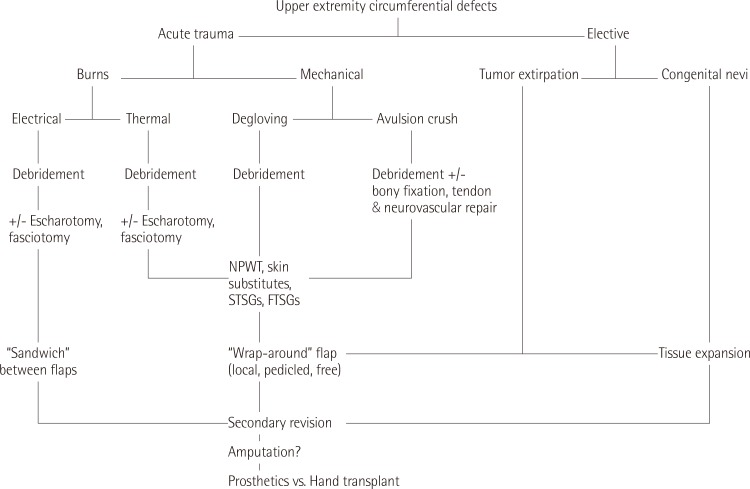
Results: In accordance with the Preferred Reporting Items for Systematic Reviews and Meta-Analyses guidelines, 14 unique articles were identified for a total of 50 patients (mean=28.1 years). Underlying etiologies varied from extensive thermal or electrical burns to high impact trauma leading to degloving or avulsion, crush injuries, or even occur iatrogenically after tumor extirpation or extensive debridement. Treatment options ranged from the application of negative pressure wound dressings to the opposite end of the spectrum in hand transplantation.
Conclusions: With the evolution of reconstructive techniques over time, the extent of functional and aesthetic rehabilitation of these complex upper extremity injuries has also improved. The proposed management algorithm comprehensively addresses the inherent challenges associated with these complex cases.
Keywords: Reconstructive surgical procedures; Soft tissue injuries; Upper extremity.
Conflict of interest statement
No potential conflict of interest relevant to this article was reported.
Figures
References
-
- Tajima T. Treatment of open crushing type of industrial injuries of the hand and forearm: degloving, open circumferential, heat-press, and nail-bed injuries. J Trauma. 1974;14:995–1011. - PubMed
-
- Waikakul S. Revascularization of degloving injuries of the limbs. Injury. 1997;28:271–274. - PubMed
-
- Lo S, Lin YT, Lin CH, et al. A new classification to aid the selection of revascularization techniques in major degloving injuries of the upper limb. Injury. 2013;44:331–335. - PubMed
-
- Harrison BL, Lakhiani C, Lee MR, et al. Timing of traumatic upper extremity free flap reconstruction: a systematic review and progress report. Plast Reconstr Surg. 2013;132:591–596. - PubMed
-
- Parrett BM, Matros E, Pribaz JJ, et al. Lower extremity trauma: trends in the management of soft-tissue reconstruction of open tibia-fibula fractures. Plast Reconstr Surg. 2006;117:1315–1322. - PubMed
LinkOut - more resources
Full Text Sources
Other Literature Sources