


Correlation between CTLA-4 gene rs221775A>G single nucleotide polymorphism and multiple sclerosis susceptibility. A meta-analysis
- PMID: 28352806
- PMCID: PMC5329839
- DOI: 10.1515/med-2016-0052
Correlation between CTLA-4 gene rs221775A>G single nucleotide polymorphism and multiple sclerosis susceptibility. A meta-analysis
Abstract
Objective: The aim of this meta-analysis was to undertake a meta-analysis to evaluate the correlation between cytotoxic T-lymphocyte-associated protein 4 (CTLA-4) gene rs221775 A>G single nucleotide polymorphism and the susceptibility of multiple sclerosis (MS) susceptibility.
Method: Published manuscripts about CTLA-4 gene rs221775A>G single nucleotide polymorphism and multiple sclerosis susceptibility were searched in the computerized bibliographic searches of Pubmed Embase and China National Knowledge Infrastructure (CNKI). Potential studies were screened and data for 5025 MS patients and 4706 controls from 20 publications were included. The association between CTLA-4 gene rs221775A>G single nucleotide polymorphism and multiple sclerosis susceptibility were demonstrated by odds ratio (OR) and 95% confidence interval (95%CI).
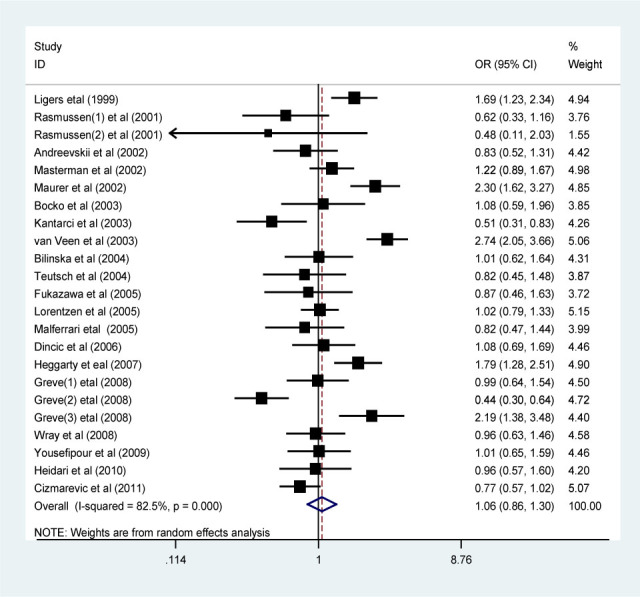
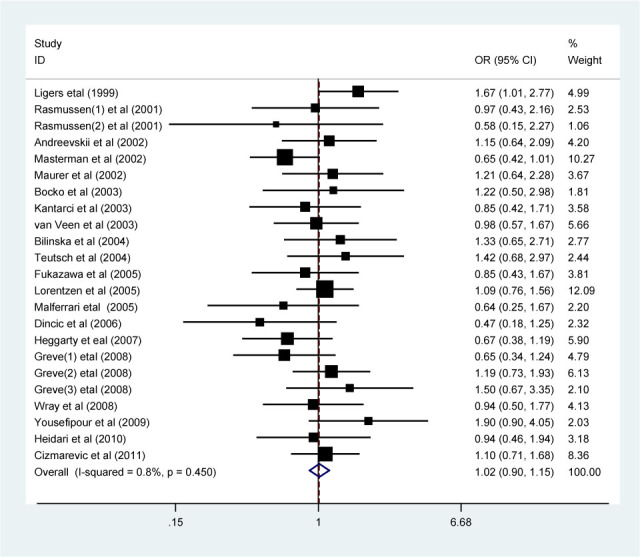
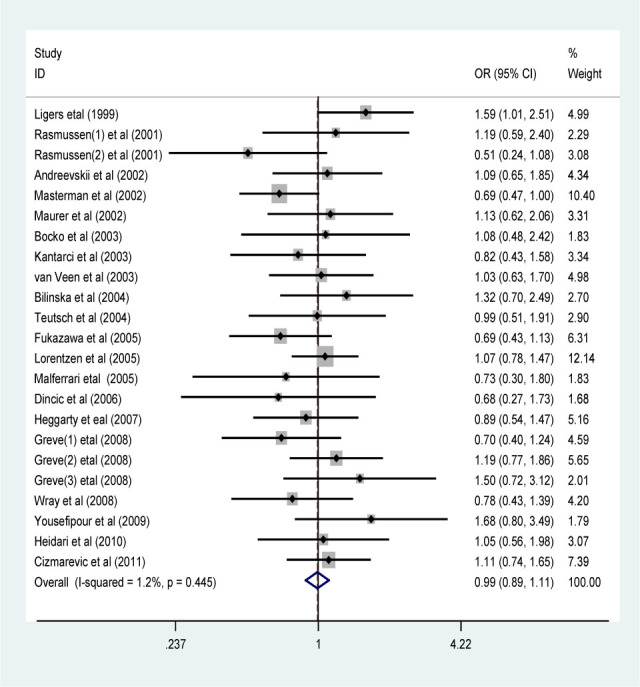
Results: The pooled results showed no significant association between CTLA-4 gene rs221775A>G single nucleotide polymorphism and multiple sclerosis susceptibility for dominant genetic model [OR=1.02, 95%CI:0.90~1.05, (P=0.80)], homozygous genetic model [OR=0.85,95%CI:0.71 ~1.03,(P=0.10)] and recessive genetic model [OR=0.99,95% CI:0.89~1.10,(P=0.90)].
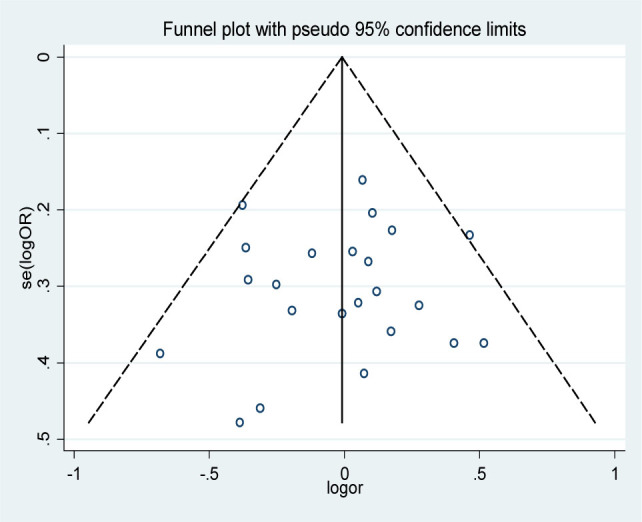
Conclusion: With current evidence, CTLA-4 gene rs221775A>G single nucleotide polymorphism had no association with the susceptibility of multiple sclerosis.
Keywords: CTLA-4 gene; Meta-analysis; Multiple sclerosis; Polymorphism; Susceptibility.
Figures
References
-
- Yousefipour G, Erfani N, Momtahan M, Moghaddasi H, Ghaderi A. CTLA4 exon 1 and promoter polymorphisms in patients with multiple sclerosis. Acta Neurol Scand. 2009;120(6):424–429. - PubMed
-
- Kampman MT, Eriksen EF, Holmoy T. Multiple sclerosis, a cause of secondary osteoporosis? What is the evidence and what are the clinical implications. Acta Neurol Scand Suppl. 2011;191:44–49. - PubMed
-
- MacLean HJ, Freedman MS. Multiple sclerosis: following clues from cause to cure. The Lancet Neurology. 2009;8(1):6–8. - PubMed
-
- Ligers A, Xu C, Saarinen S, Hillert J, Olerup O. The CTLA-4 gene is associated with multiple sclerosis. J Neuroimmunol. 1999;97(1-2):182–190. - PubMed
-
- Maurer M, Ponath A, Kruse N, Rieckmann P. CTLA4 exon 1 dimorphism is associated with primary progressive multiple sclerosis. J Neuroimmunol. 2002;131(1-2):213–215. - PubMed
LinkOut - more resources
Full Text Sources
Other Literature Sources