


Effect of dyad training on medical students' cardiopulmonary resuscitation performance
- PMID: 28353555
- PMCID: PMC5380239
- DOI: 10.1097/MD.0000000000004079
Effect of dyad training on medical students' cardiopulmonary resuscitation performance
Abstract
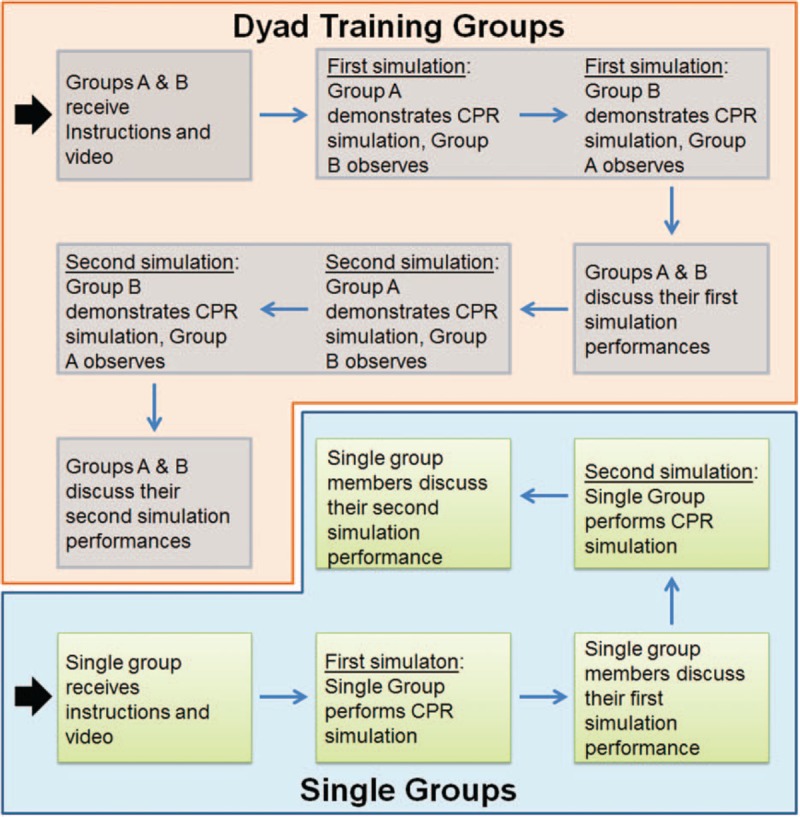
We investigated the effects of dyadic training on medical students' resuscitation performance during cardiopulmonary resuscitation (CPR) training.We provided students with a 2-hour training session on CPR for simulated cardiac arrest. Student teams were split into double groups (Dyad training groups: Groups A and B) or Single Groups. All groups received 2 CPR simulation rounds. CPR simulation training began with peer demonstration for Group A, and peer observation for Group B. Then the 2 groups switched roles. Single Groups completed CPR simulation without peer observation or demonstration. Teams were then evaluated based on leadership, teamwork, and team member skills.Group B had the highest first simulation round scores overall (P = 0.004) and in teamwork (P = 0.001) and team member skills (P = 0.031). Group B also had the highest second simulation round scores overall (P < 0.001) and in leadership (P = 0.033), teamwork (P < 0.001), and team member skills (P < 0.001). In the first simulation, there were no differences between Dyad training groups with those of Single Groups in overall scores, leadership scores, teamwork scores, and team member scores. In the second simulation, Dyad training groups scored higher in overall scores (P = 0.002), leadership scores (P = 0.044), teamwork scores (P = 0.005), and team member scores (P = 0.008). Dyad training groups also displayed higher improvement in overall scores (P = 0.010) and team member scores (P = 0.022).Dyad training was effective for CPR training. Both peer observation and demonstration for peers in dyad training can improve student resuscitation performance.
Conflict of interest statement
The authors report no conflicts of interest.
References
-
- Johnson NJ, Salhi RA, Abella BS, et al. Emergency department factors associated with survival after sudden cardiac arrest. Resuscitation 2013;84:292–7. - PubMed
-
- Ali B, Zafari AM. Narrative review: cardiopulmonary resuscitation and emergency cardiovascular care: review of the current guidelines. Ann Intern Med 2007;147:171–9. - PubMed
-
- Meaney PA, Bobrow BJ, Mancini ME, et al. CPR Quality Summit Investigators, the American Heart Association Emergency Cardiovascular Care Committee, and the Council on Cardiopulmonary, Critical Care, Perioperative and Resuscitation. Cardiopulmonary resuscitation quality: improving cardiac resuscitation outcomes both inside and outside the hospital: a consensus statement from the American Heart Association. Circulation 2013;128:417–35. - PubMed
-
- Talikowska M, Tohira H, Finn J. Cardiopulmonary resuscitation quality and patient survival outcome in cardiac arrest: A systematic review and meta-analysis. Resuscitation 2015;96:66–77. - PubMed
-
- Yannopoulos D, Aufderheide TP, Abella BS, et al. Quality of CPR: an important effect modifier in cardiac arrest clinical outcomes and intervention effectiveness trials. Resuscitation 2015;94:106–13. - PubMed
MeSH terms
LinkOut - more resources
Full Text Sources
Other Literature Sources
Medical
