


A General Approach to Test for Interaction Among Mixtures of Insecticidal Proteins Which Target Different Orders of Insect Pests
- PMID: 28355479
- PMCID: PMC5416900
- DOI: 10.1093/jisesa/iex003
A General Approach to Test for Interaction Among Mixtures of Insecticidal Proteins Which Target Different Orders of Insect Pests
Erratum in
-
Corrigendum to: "A General Approach to Test for Interaction Among Mixtures of Insecticidal Proteins Which Target Different Orders of Insect Pests".J Insect Sci. 2018 Mar 1;18(2):22. doi: 10.1093/jisesa/iey004. J Insect Sci. 2018. PMID: 29718484 Free PMC article. No abstract available.
Abstract
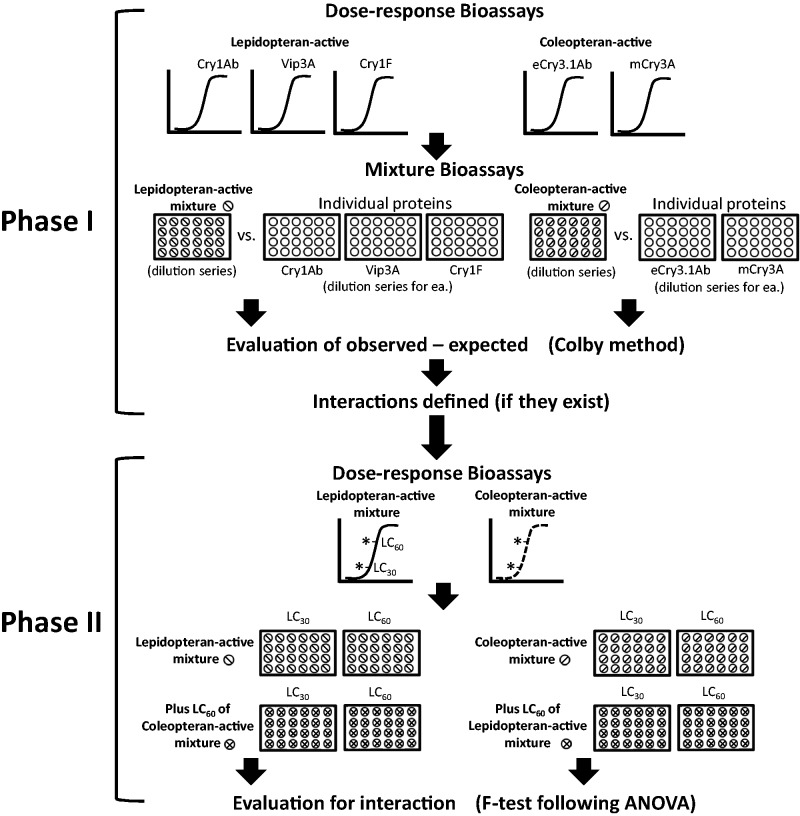
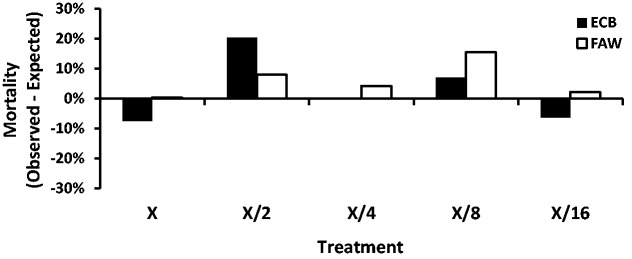
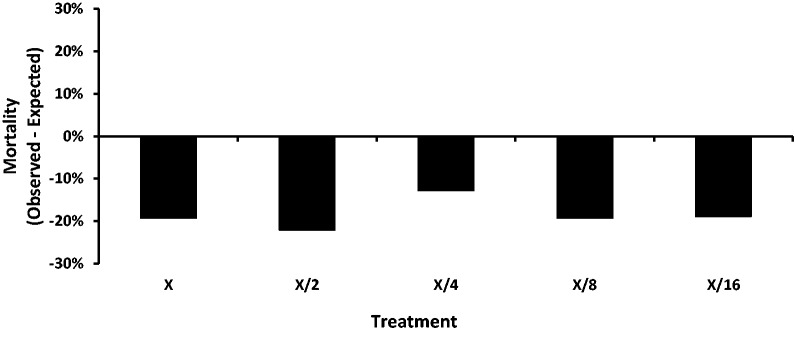
A shift toward transgenic crops which produce combinations of insecticidal proteins has increased the interest (Syngenta Seeds, Inc., Minnetonka, MN) in studying the potential for interactions amongst those proteins. We present a general testing method which accommodates proteins with nonoverlapping spectrums of activity. Our sequential testing approach first investigates groups of the proteins with overlapping activity; e.g., proteins active against Lepidoptera or Coleoptera, respectively. The Colby method is used to test for interactions within each respective group. Subsequently, the mixture of proteins within each group is regarded as a single entity and tests for interactions between the groups (when combined) is conducted using analysis of variance. We illustrate the method using Cry1Ab, Vip3Aa20, and Cry1F (a mixture of proteins active against Lepidoptera), and mCry3A and eCry3.1Ab (a mixture of proteins active against Coleoptera). These insecticidal proteins are produced by Bt11 × MIR162 × TC1507 × MIR604 × 5307 maize. We detected no interactions between Cry1Ab, Vip3Aa20, and Cry1F in tests using larvae of two different lepidopteran species, and possible slight antagonism between mCry3A and eCry3.1Ab with a coleopteran test species. We detected no effect of (eCry3.1Ab + mCry3A) on the potency of (Cry1Ab + Vip3Aa20 + Cry1F) to lepidopteran larvae, and no effect of (Cry1Ab + Vip3Aa20 + Cry1F) on the potency of (mCry3A + eCry3.1Ab) to coleopteran larvae. We discuss implications of these results for characterization of Bt11 × MIR162 × TC1507 × MIR604 × 5307 maize, and the value of the method for characterizing other transgenic crops that produce several insecticidal proteins.
Keywords: Bacillus thuringiensis; Cry; stacked; synergism; trait.
© The Authors 2017. Published by Oxford University Press on behalf of Entomological Society of America.
Figures
References
-
- Abbott W. S. 1925. A method for computing the effectiveness of an insecticide. J. Econ. Entomol. 18: 265–267.
-
- Carrière Y., Crickmore N., Tabashnik B. E. 2015. Optimizing pyramided transgenic Bt crops for sustainable pest management. Nat. Biotech. 33: 161–168. - PubMed
-
- Chestukhina G. G., Kostina L. I., Mikhailova A. L., Tyurin S. A., Klepikova F. S., Stepanov V. M. 1982. The main features of Bacillus thuringiensis delta-endotoxin molecular structure. Arch. Microbiol. 132: 159–162.
-
- Colby S. R. 1967. Calculating synergistic and antagonistic response of herbicide combinations. Weeds 15: 20–22.
MeSH terms
Substances
LinkOut - more resources
Full Text Sources
Other Literature Sources
Molecular Biology Databases
