Limb Symmetry Indexes Can Overestimate Knee Function After Anterior Cruciate Ligament Injury
- PMID: 28355978
- PMCID: PMC5483854
- DOI: 10.2519/jospt.2017.7285
Limb Symmetry Indexes Can Overestimate Knee Function After Anterior Cruciate Ligament Injury
Abstract
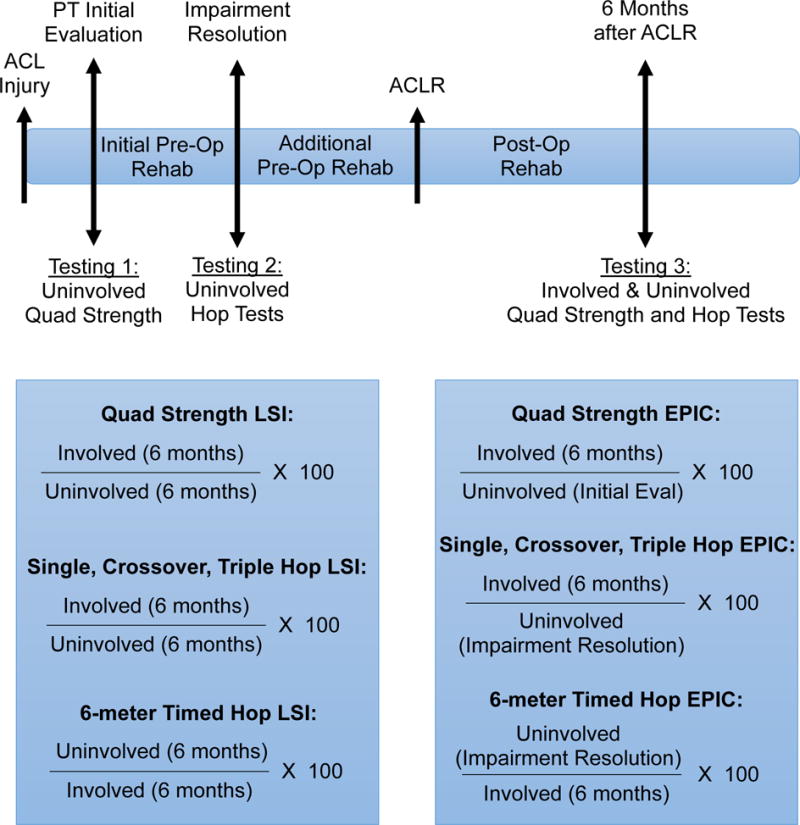
Study Design Prospective cohort. Background The high risk of second anterior cruciate ligament (ACL) injuries after return to sport highlights the importance of return-to-sport decision making. Objective return-to-sport criteria frequently use limb symmetry indexes (LSIs) to quantify quadriceps strength and hop scores. Whether using the uninvolved limb in LSIs is optimal is unknown. Objectives To evaluate the uninvolved limb as a reference standard for LSIs utilized in return-to-sport testing and its relationship with second ACL injury rates. Methods Seventy athletes completed quadriceps strength and 4 single-leg hop tests before anterior cruciate ligament reconstruction (ACLR) and 6 months after ACLR. Limb symmetry indexes for each test compared involved-limb measures at 6 months to uninvolved-limb measures at 6 months. Estimated preinjury capacity (EPIC) levels for each test compared involved-limb measures at 6 months to uninvolved-limb measures before ACLR. Second ACL injuries were tracked for a minimum follow-up of 2 years after ACLR. Results Forty (57.1%) patients achieved 90% LSIs for quadriceps strength and all hop tests. Only 20 (28.6%) patients met 90% EPIC levels (comparing the involved limb at 6 months after ACLR to the uninvolved limb before ACLR) for quadriceps strength and all hop tests. Twenty-four (34.3%) patients who achieved 90% LSIs for all measures 6 months after ACLR did not achieve 90% EPIC levels for all measures. Estimated preinjury capacity levels were more sensitive than LSIs in predicting second ACL injuries (LSIs, 0.273; 95% confidence interval [CI]: 0.010, 0.566 and EPIC, 0.818; 95% CI: 0.523, 0.949). Conclusion Limb symmetry indexes frequently overestimate knee function after ACLR and may be related to second ACL injury risk. These findings raise concern about whether the variable ACL return-to-sport criteria utilized in current clinical practice are stringent enough to achieve safe and successful return to sport. Level of Evidence Prognosis, 2b. J Orthop Sports Phys Ther 2017;47(5):334-338. Epub 29 Mar 2017. doi:10.2519/jospt.2017.7285.
Keywords: ACL; anterior cruciate ligament; rehabilitation; return to sport; symmetry.
Conflict of interest statement
I affirm that I have no financial affiliation (including research funding) or involvement with any commercial organization that has a direct financial interest in any matter included in this manuscript.
Figures
References
-
- Ardern CL, Taylor NF, Feller JA, Webster KE. Fifty-five per cent return to competitive sport following anterior cruciate ligament reconstruction surgery: an updated systematic review and meta-analysis including aspects of physical functioning and contextual factors. Br J Sport Med. 2014;48(21):1543–52. - PubMed
-
- Barber-Westin SD, Noyes FR. Factors used to determine return to unrestricted sports activities after anterior cruciate ligament reconstruction. Arthroscopy. 2011;27(12):1697–1705. - PubMed
-
- Daniel DM, Stone ML, Dobson BE, Fithian DC, Rossman DJ, Kaufman KR. Fate of the ACL-injured patient. A prospective outcome study. Am J Sport Med. 1994;22(5):632–644. - PubMed
-
- DeCarlo M, Sell K. Normative data for range of motion and single‐leg hop in high school athletes. J Sport Rehabil. 1997;6:246–255.
MeSH terms
Grants and funding
LinkOut - more resources
Full Text Sources
Other Literature Sources
Medical
Miscellaneous