. 2017 Mar 29;9(1):32.
doi: 10.1186/s13073-017-0421-5.

Ethnic and diet-related differences in the healthy infant microbiome

Affiliations

Ethnic and diet-related differences in the healthy infant microbiome

Jennifer C Stearns et al. Genome Med. .

Abstract

Background: The infant gut is rapidly colonized by microorganisms soon after birth, and the composition of the microbiota is dynamic in the first year of life. Although a stable microbiome may not be established until 1 to 3 years after birth, the infant gut microbiota appears to be an important predictor of health outcomes in later life.

Methods: We obtained stool at one year of age from 173 white Caucasian and 182 South Asian infants from two Canadian birth cohorts to gain insight into how maternal and early infancy exposures influence the development of the gut microbiota. We investigated whether the infant gut microbiota differed by ethnicity (referring to groups of people who have certain racial, cultural, religious, or other traits in common) and by breastfeeding status, while accounting for variations in maternal and infant exposures (such as maternal antibiotic use, gestational diabetes, vegetarianism, infant milk diet, time of introduction of solid food, infant birth weight, and weight gain in the first year).

Results: We demonstrate that ethnicity and infant feeding practices independently influence the infant gut microbiome at 1 year, and that ethnic differences can be mapped to alpha diversity as well as a higher abundance of lactic acid bacteria in South Asians and a higher abundance of genera within the order Clostridiales in white Caucasians.

Conclusions: The infant gut microbiome is influenced by ethnicity and breastfeeding in the first year of life. Ethnic differences in the gut microbiome may reflect maternal/infant dietary differences and whether these differences are associated with future cardiometabolic outcomes can only be determined after prospective follow-up.

Keywords: Breastfeeding; Diet; Ethnicity; Infant gut microbiome.


Figures
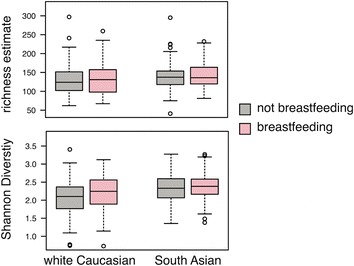
Fig. 1
Fig. 1
Alpha diversity measures within white Caucasians and South Asians, split by breastfeeding status at the time of sample collection. Whiskers extend to the most extreme data values up to 1.5× the interquartile range; data outside this range are shown as circles
Fig. 2
Fig. 2
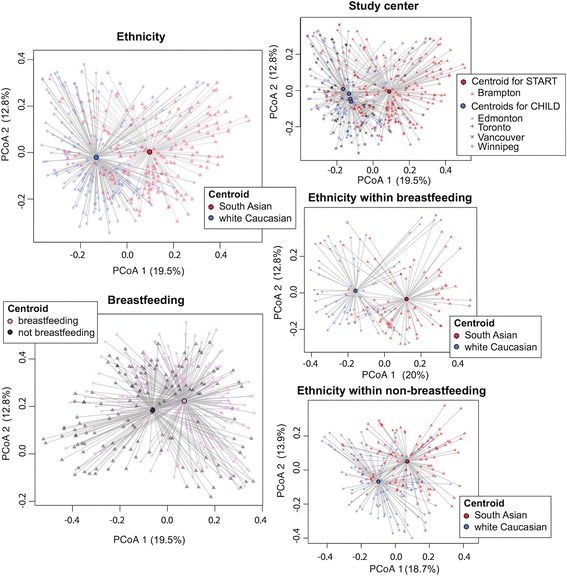
Principal coordinate analyses (PCoA) of Bray–Curtis dissimilarities. Centroids for ethnicity, breastfeeding status at time of collection, and study center are shown as circles with lines radiating to samples
Fig. 3
Fig. 3
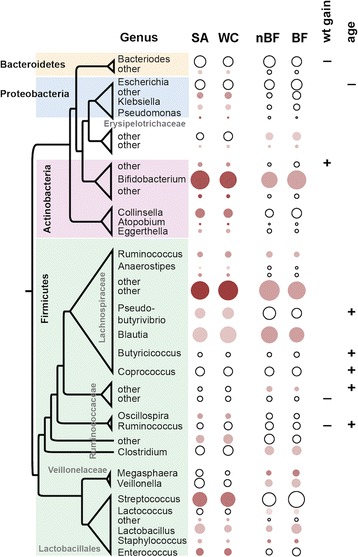
Genera differentially associated with ethnicity (white Caucasian (WC) and South Asian (SA)), breastfeeding (breastfeeding (BF) and not breastfeeding (nBF)), infant age, or infant weight gain in the first year (wt gain), through the multivariate boosted additive model tool Maaslin. Bacterial relative abundance means across each category shown as the size and significance as the shade of each circle (darker = smaller p value; Additional file 2: Table S1). Significant association of the microbiome with the continuous variables weight gain or age is shown with symbols (positively (+) or negatively () associated; Additional file 2: Table S1). Genera sorted taxonomically with subgroups within the Firmicutes labeled in grey

References

    1. Falk PG, Hooper LV, Midtvedt T, Gordon JI. Creating and maintaining the gastrointestinal ecosystem: what we know and need to know from gnotobiology. Microbiol Mol Biol Rev. 1998;62:1157–70. - PMC - PubMed
    1. Guarner F, Malagelada J-R. Gut flora in health and disease. Lancet. 2003;361:512–9. doi: 10.1016/S0140-6736(03)12489-0. - DOI - PubMed
    1. Newburg DS, Walker WA. Protection of the neonate by the innate immune system of developing gut and of human milk. Pediatr Res. 2007;61:2–8. doi: 10.1203/01.pdr.0000250274.68571.18. - DOI - PubMed
    1. Yatsunenko T, Rey FE, Manary MJ, Trehan I, Dominguez-Bello MG, Contreras M, et al. Human gut microbiome viewed across age and geography. Nature. 2012;486:222–7. - PMC - PubMed
    1. Li Y, Oosting M, Deelen P, Ricaño-Ponce I, Smeekens S, Jaeger M, et al. Inter-individual variability and genetic influences on cytokine responses to bacteria and fungi. Nat Med. 2016;22:952–60. doi: 10.1038/nm.4139. - DOI - PMC - PubMed