. 2017 Mar 29;18(1):60.
doi: 10.1186/s13059-017-1190-6.

Genomic history of the origin and domestication of common bean unveils its closest sister species

Affiliations

Genomic history of the origin and domestication of common bean unveils its closest sister species

Martha Rendón-Anaya et al. Genome Biol. .

Abstract

Background: Modern civilization depends on only a few plant species for its nourishment. These crops were derived via several thousands of years of human selection that transformed wild ancestors into high-yielding domesticated descendants. Among cultivated plants, common bean (Phaseolus vulgaris L.) is the most important grain legume. Yet, our understanding of the origins and concurrent shaping of the genome of this crop plant is limited.

Results: We sequenced the genomes of 29 accessions representing 12 Phaseolus species. Single nucleotide polymorphism-based phylogenomic analyses, using both the nuclear and chloroplast genomes, allowed us to detect a speciation event, a finding further supported by metabolite profiling. In addition, we identified ~1200 protein coding genes (PCGs) and ~100 long non-coding RNAs with domestication-associated haplotypes. Finally, we describe asymmetric introgression events occurring among common bean subpopulations in Mesoamerica and across hemispheres.

Conclusions: We uncover an unpredicted speciation event in the tropical Andes that gave rise to a sibling species, formerly considered the "wild ancestor" of P. vulgaris, which diverged before the split of the Mesoamerican and Andean P. vulgaris gene pools. Further, we identify haplotypes strongly associated with genes underlying the emergence of domestication traits. Our findings also reveal the capacity of a predominantly autogamous plant to outcross and fix loci from different populations, even from distant species, which led to the acquisition by domesticated beans of adaptive traits from wild relatives. The occurrence of such adaptive introgressions should be exploited to accelerate breeding programs in the near future.

Keywords: Adaptive traits; Common bean; Domestication; Genomic introgression; Speciation.


Figures
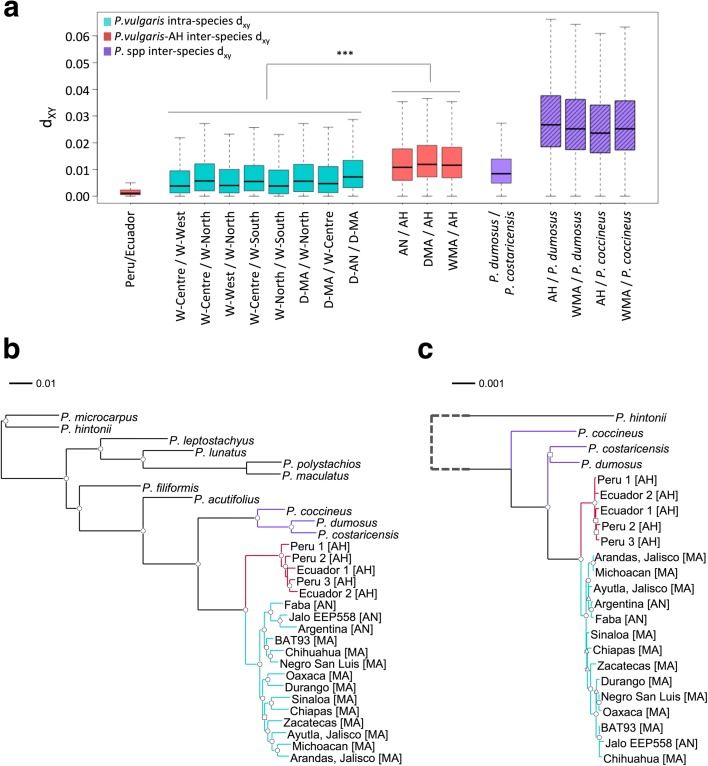
Fig. 1
Fig. 1
Species definition within the Vulgaris group according to their phylogenomic profile. a Absolute genetic divergence between Phaseolus subpopulations, showing inter-species and intra-species divergence comparisons. The difference of dXY values (Kruskal-Wallis p value = 0.014) calculated within P. vulgaris subpopulations and between P. vulgaris and the AH subpopulation, is highlighted with (***). b ML tree with non-parametric SH branch support based on 460,000 single nucleotide polymorphisms randomly chosen across the genome. c ML tree with non-parametric SH branch support based on 55 Kb of the chloroplast genome. The long branch length separating P. hintonii from the Vulgaris species is graphically represented with a dotted line. Branch support: SH-aLRT = [0.75;0.85], triangles; SH-aLRT = [0.85;0.95], squares; SH-aLRT > 0.95, circles. In both tree topologies and the box plot, P. vulgaris accessions are highlighted in cyan, P. pseudovulgaris in red and Phaseolus species from the Vulgaris groups in purple
Fig. 2
Fig. 2
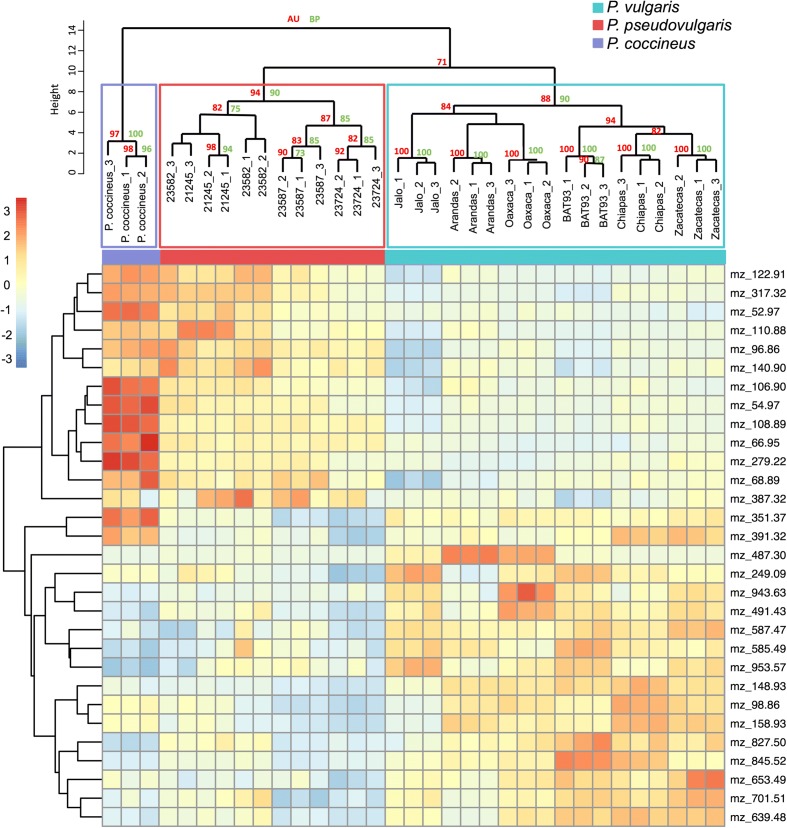
Metabolomic profiles of Phaseolus species. The heatmap shows the 30 most informative mass signals from extracts of young trifoliate leaves that explain inter-species differences between P. vulgaris, P. pseudovulgaris, and P. coccineus. The associated horizontal dendrogram reproduces the phylogeny of the accessions, while the vertical dendrogram clusters mass signals according to their abundance. Approximately unbiased probabilities (AU) and bootstrap support (BP) ≥ 70 are displayed in the horizontal dendrogram
Fig. 3
Fig. 3
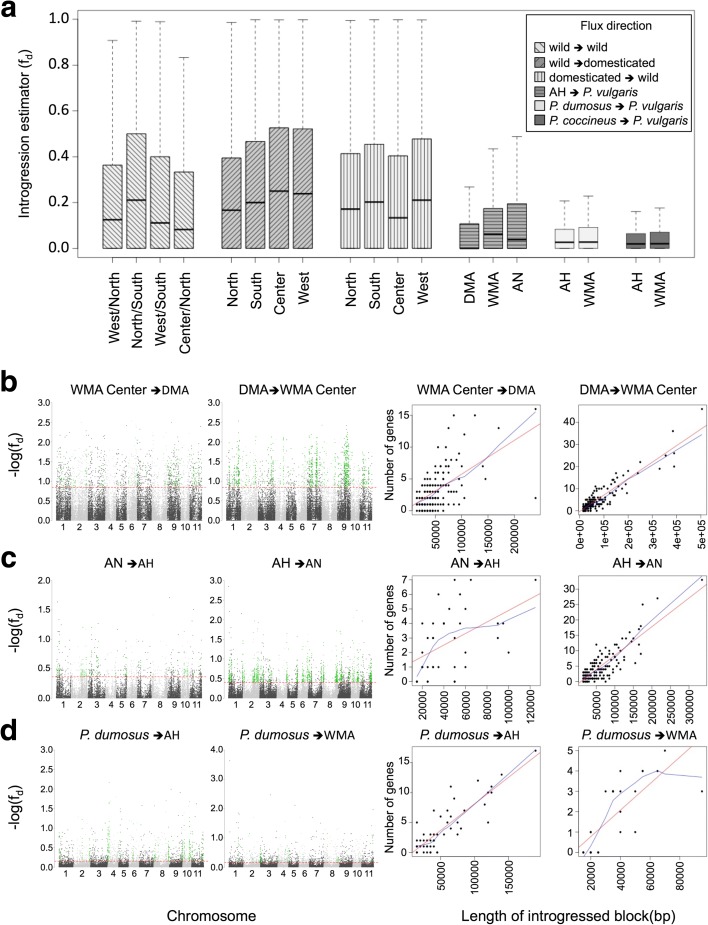
Introgression rate (fd) depends on phylogenetic distance between subpopulations. a Global fd estimations for different triads of Phaseolus subpopulations. bd Introgression signal across the linkage groups divided into 5-Kb non-overlapping windows is represented in Manhattan plots (left panels); the red threshold lines show the top 5% fd outliers in each comparison, and strong signals of introgression (fd + dXY) are highlighted in green. The number of genes encoded in each introgressed block is represented in scatterplots (right panelscolored lines: linear [red] and local [blue] regressions). In (d), the donor subpopulation is conformed by P. dumosus and P. costaricensis
Fig. 4
Fig. 4
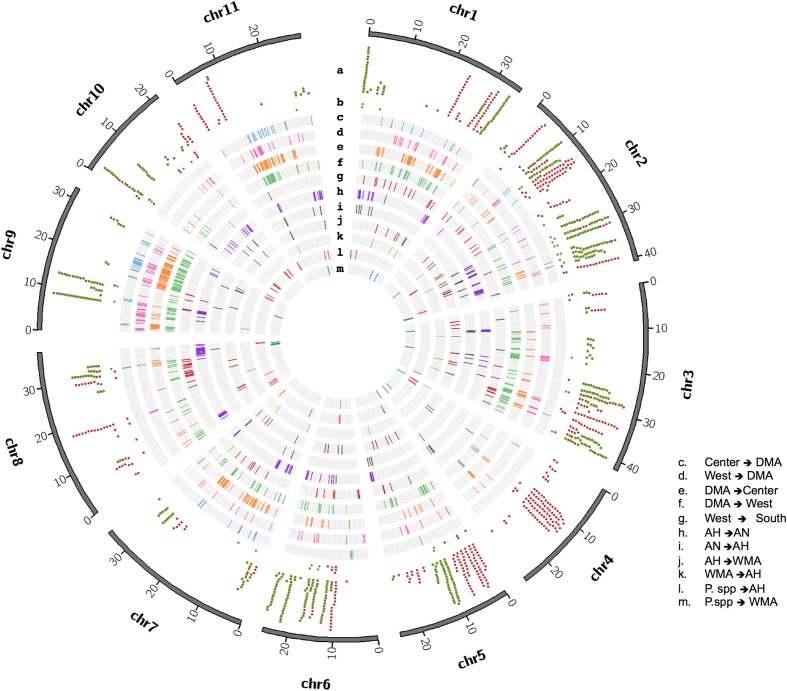
Introgression and domestication signals across P. vulgaris linkage groups. a Domestication genes; green: common to both COD; red: MA-specific. b lncRNAs domestication haplotypes (same colors as (a)). ck Introgressed blocks: (c, d) wild ⇐ domesticated; (e, f) domesticated ⇐ wild; (g) wild ⇐ wild; (hk) AH ⇐ P. vulgaris; (l, m) P. dumosus/P. costaricenses ⇐ P. vulgaris
Fig. 5
Fig. 5
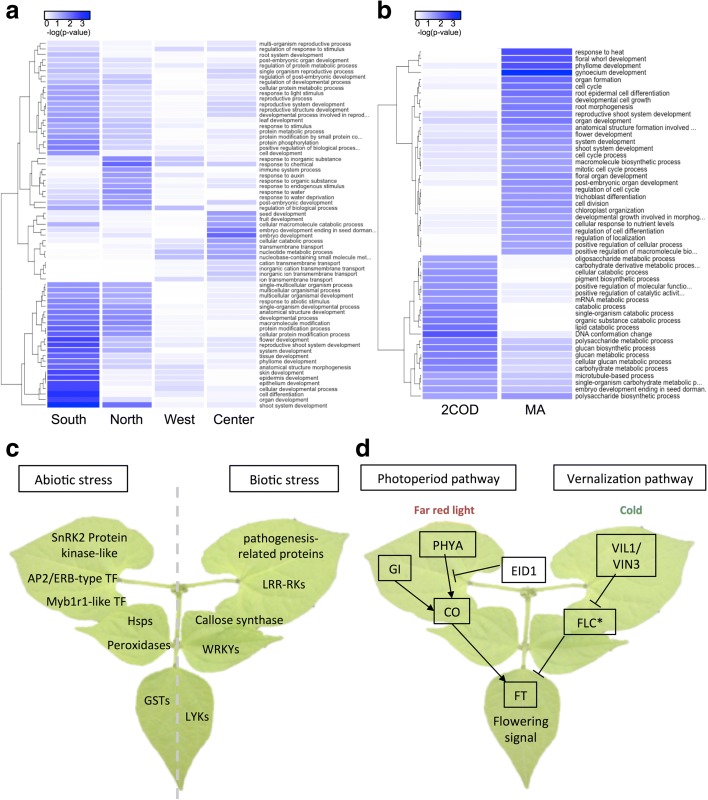
Functional description of domestication vs. introgression genes and pathways. Heatmaps show GO enrichments from genes within genomic blocks introgressed from wild MA subpopulations into domesticated MA accessions (a) or with domestication-associated haplotypes (b). c Examples of stress response genes that were mobilized by hybridization events from wild into domesticated individuals. d Photoperiod sensitivity and vernalization pathways, which confer a key domestication trait, are depicted. All genes except for those marked with an asterisk (*) share haplotypes in both centers of domestication that differentiate them from wild individuals
Fig. 6
Fig. 6
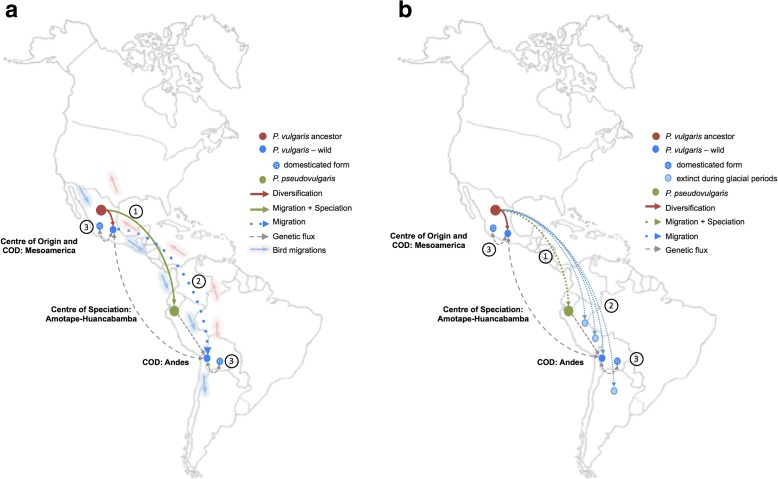
Spatio-temporal models of common bean migrations and lineage divergence in America. a Two-waved model of migration mediated by bird migrations. b Diversity extinction in the Southern hemisphere caused by glacial periods. Under both models, migration from the MA to AH region, followed by speciation (1) predates the split of P. vulgaris lineages (2); domestication corresponds to the most recent evolutionary event (3)

References

    1. Larson G, Piperno DR, Allaby RG, Purugganan MD, Andersson L, Arroyo-Kalin M, et al. Current perspectives and the future of domestication studies. Proc Natl Acad Sci U S A. 2014;111:6139–6146. doi: 10.1073/pnas.1323964111. - DOI - PMC - PubMed
    1. Gepts P. The contribution of genetic and genomic approaches to plant domestication studies. Curr Opin Plant Biol. 2014;18:51–59. doi: 10.1016/j.pbi.2014.02.001. - DOI - PubMed
    1. Kwak M, Toro O, Debouck D, Gepts P. Multiple origins of the determinate growth habit in domesticated common bean (Phaseolus vulgaris L.) Ann Bot. 2012;110:1573–1580. doi: 10.1093/aob/mcs207. - DOI - PMC - PubMed
    1. Ramos-Madrigal J, Smith BD, Moreno-Mayar JV, Gopalakrishnan S, Ross-Ibarra J, Gilbert MT, et al. Genome sequence of a 5,310-year-old maize cob provides insights into the early stages of maize domestication. Curr Biol. 2016;26:3195–3201. doi: 10.1016/j.cub.2016.09.036. - DOI - PubMed
    1. Xue S, Bradbury PJ, Casstevens T, Holland JB. Genetic architecture of domestication-related traits in maize. Genetics. 2016;204:99–113. doi: 10.1534/genetics.116.191106. - DOI - PMC - PubMed

Publication types