Review
. 2017 Mar 29;81(2):e00066-16.
doi: 10.1128/MMBR.00066-16. Print 2017 Jun.

Effectors of Filamentous Plant Pathogens: Commonalities amid Diversity

Affiliations
Review

Effectors of Filamentous Plant Pathogens: Commonalities amid Diversity

Marina Franceschetti et al. Microbiol Mol Biol Rev. .

Abstract

Fungi and oomycetes are filamentous microorganisms that include a diversity of highly developed pathogens of plants. These are sophisticated modulators of plant processes that secrete an arsenal of effector proteins to target multiple host cell compartments and enable parasitic infection. Genome sequencing revealed complex catalogues of effectors of filamentous pathogens, with some species harboring hundreds of effector genes. Although a large fraction of these effector genes encode secreted proteins with weak or no sequence similarity to known proteins, structural studies have revealed unexpected similarities amid the diversity. This article reviews progress in our understanding of effector structure and function in light of these new insights. We conclude that there is emerging evidence for multiple pathways of evolution of effectors of filamentous plant pathogens but that some families have probably expanded from a common ancestor by duplication and diversification. Conserved folds, such as the oomycete WY and the fungal MAX domains, are not predictive of the precise function of the effectors but serve as a chassis to support protein structural integrity while providing enough plasticity for the effectors to bind different host proteins and evolve unrelated activities inside host cells. Further effector evolution and diversification arise via short linear motifs, domain integration and duplications, and oligomerization.

Keywords: plant pathology.


Figures

FIG 1
FIG 1
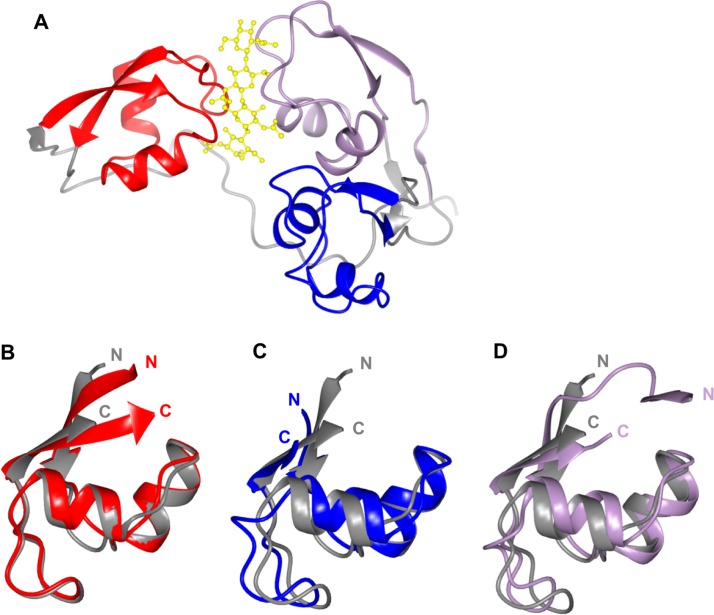
The crystal structure of the LysM effector Ecp6 shows how modularity can be used by effectors to generate new functions (the three LysM domains are shown in red, blue, and lilac, respectively). (A) Two Ecp6 LysM domains combine to bind to a chitin oligomer (shown in yellow). (B to D) Superposition of the Ecp6 LysM domains on the plant (rice) LysM receptor protein MoCVNH3 (in gray) (LysM domains are colored as described above). The amino (N) and carboxyl (C) termini of the proteins are labeled.
FIG 2
FIG 2
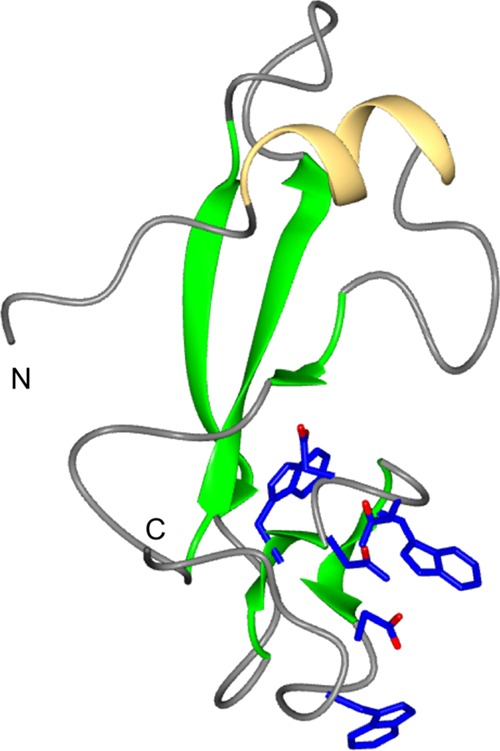
CBM14 family structure of P. fuligena Avr4. The structures comprise an alpha helix (yellow) and five beta strands (green). The residues predicted to be involved in the interaction with chitin are shown in blue.
FIG 3
FIG 3
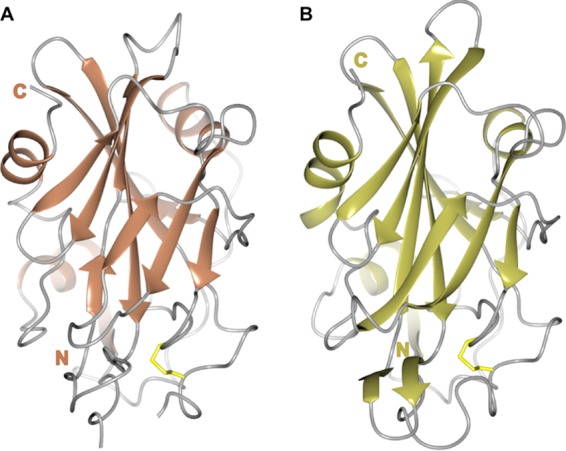
Crystal structures of the NLP family members NLPPya (A) and MpNEP2 (B), showing the central β-sandwich surrounded by 3 helices. The conserved structural elements are shown in a cartoon representation, with residues contributing to disulfide bridges shown as sticks (in yellow) and loops shown in gray.
FIG 4
FIG 4
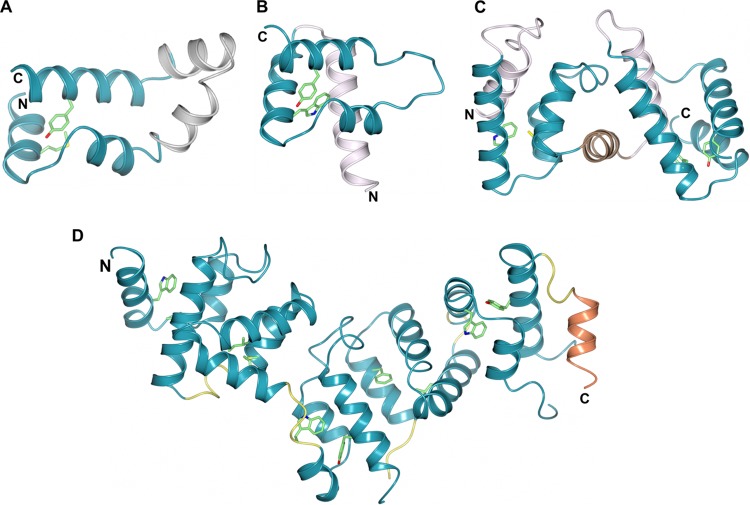
The structures of oomycete WY domain effectors reveal how modularity and domain repeats give rise to different overall structures. For each panel, the region of the protein comprising the WY domain fold is shown in blue, and the residues at the W and Y positions are shown as sticks (green carbon atoms). Shown are PexRD2 (monomer) (A), Avr3a11 (Avr3a4 is essentially identical and not shown) (B), ATR1 (the region toward the N terminus that does not form a WY domain is not shown) (C), and PexRD54 (D), with amino (N) and carboxyl (C) termini labeled. Avr3a11/4 and ATR1 carry an additional N-terminal helix (pink). The tandem WY domains of ATR1 and PexRD54 are separated by a helix (brown) in ATR1 and loops (yellow) in PexRD54. PexRD54 carries a short helix (coral) at the C-terminal end prior to the ATG8-interacting motif (AIM) (not shown, as it was disordered in the crystals). All structure figures were prepared with ccp4 mg (111).
FIG 5
FIG 5
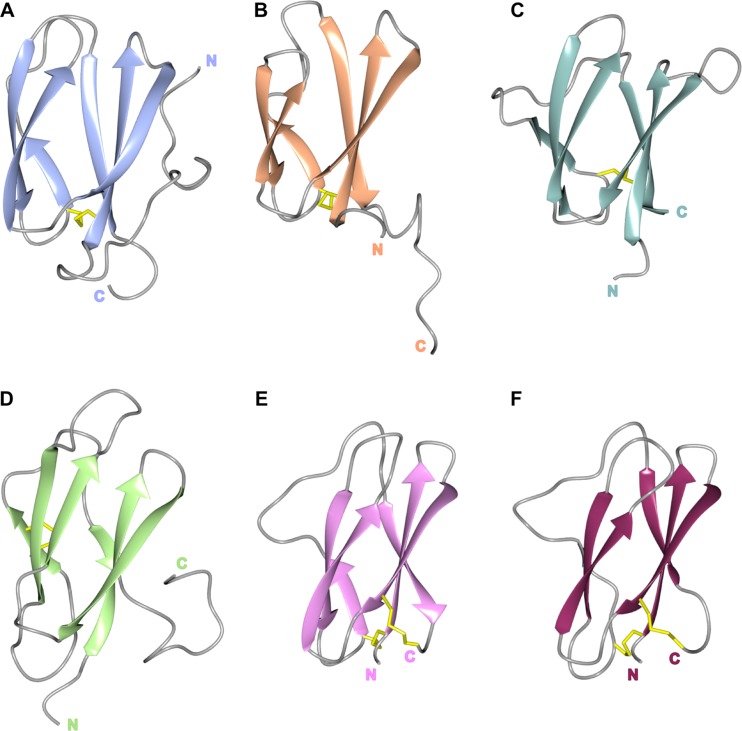
The structures of MAX effectors reveal the shared β-sandwich fold. The conserved β-strands are shown in a cartoon representation for each protein, with residues contributing to disulfide bridges shown as sticks (in yellow) and loops in gray. Shown are AVR-PikD (A), AVR1-CO39 (B), AVR-Pia (C), AVR-Pizt (D), ToxB (E), and toxb (F), with amino (N) and carboxyl (C) termini labeled.
FIG 6
FIG 6
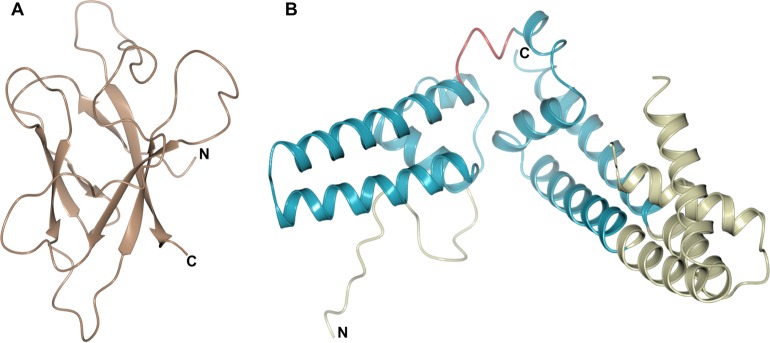
Divergent structures obtained for flax rust effectors. (A) Cartoon representation of AvrL567-A (the D allele is essentially identical and not shown), showing the β-sandwich fold. (B) Cartoon diagram of avrM, where the helical repeats, which have some resemblance to the oomycete WY domain fold, are shown in blue and separated by a loop (red). The amino (N) and carboxyl (C) termini of the proteins are labeled.

References

    1. Pennisi E. 2010. Armed and dangerous. Science 327:804–805. doi: 10.1126/science.327.5967.804. - DOI - PubMed
    1. Fisher MC, Henk DA, Briggs CJ, Brownstein JS, Madoff LC, McCraw SL, Gurr SJ. 2012. Emerging fungal threats to animal, plant and ecosystem health. Nature 484:186–194. doi: 10.1038/nature10947. - DOI - PMC - PubMed
    1. Meyer V, Andersen MR, Brakhage AA, Braus GH, Caddick MX, Cairns TC, de Vries RP, Haarmann T, Hansen K, Hertz-Fowler C, Krappmann S, Mortensen UH, Peñalva MA, Ram AFJ, Head RM. 2016. Current challenges of research on filamentous fungi in relation to human welfare and a sustainable bio-economy: a white paper. Fungal Biol Biotechnol 3:6. doi: 10.1186/s40694-016-0024-8. - DOI - PMC - PubMed
    1. Erwin DC, Ribeiro OK. 1996. Phytophthora diseases worldwide. APS Press, St Paul, MN.
    1. Fry WE, Goodwin SB. 1997. Re-emergence of potato and tomato late blight in the United States. Plant Dis 81:1349–1357. doi: 10.1094/PDIS.1997.81.12.1349. - DOI - PubMed

Publication types