Review
. 2017 Jun;174(2):624-638.
doi: 10.1104/pp.17.00183. Epub 2017 Mar 29.

Origins and Evolution of Stomatal Development

Affiliations
Review

Origins and Evolution of Stomatal Development

Caspar C C Chater et al. Plant Physiol. 2017 Jun.

Abstract

The fossil record suggests stomata-like pores were present on the surfaces of land plants over 400 million years ago. Whether stomata arose once or whether they arose independently across newly evolving land plant lineages has long been a matter of debate. In Arabidopsis, a genetic toolbox has been identified that tightly controls stomatal development and patterning. This includes the basic helix-loop-helix (bHLH) transcription factors SPEECHLESS (SPCH), MUTE, FAMA, and ICE/SCREAMs (SCRMs), which promote stomatal formation. These factors are regulated via a signaling cascade, which includes mobile EPIDERMAL PATTERNING FACTOR (EPF) peptides to enforce stomatal spacing. Mosses and hornworts, the most ancient extant lineages to possess stomata, possess orthologs of these Arabidopsis (Arabidopsis thaliana) stomatal toolbox genes, and manipulation in the model bryophyte Physcomitrella patens has shown that the bHLH and EPF components are also required for moss stomatal development and patterning. This supports an ancient and tightly conserved genetic origin of stomata. Here, we review recent discoveries and, by interrogating newly available plant genomes, we advance the story of stomatal development and patterning across land plant evolution. Furthermore, we identify potential orthologs of the key toolbox genes in a hornwort, further supporting a single ancient genetic origin of stomata in the ancestor to all stomatous land plants.


Figures

Figure 1.
Figure 1.
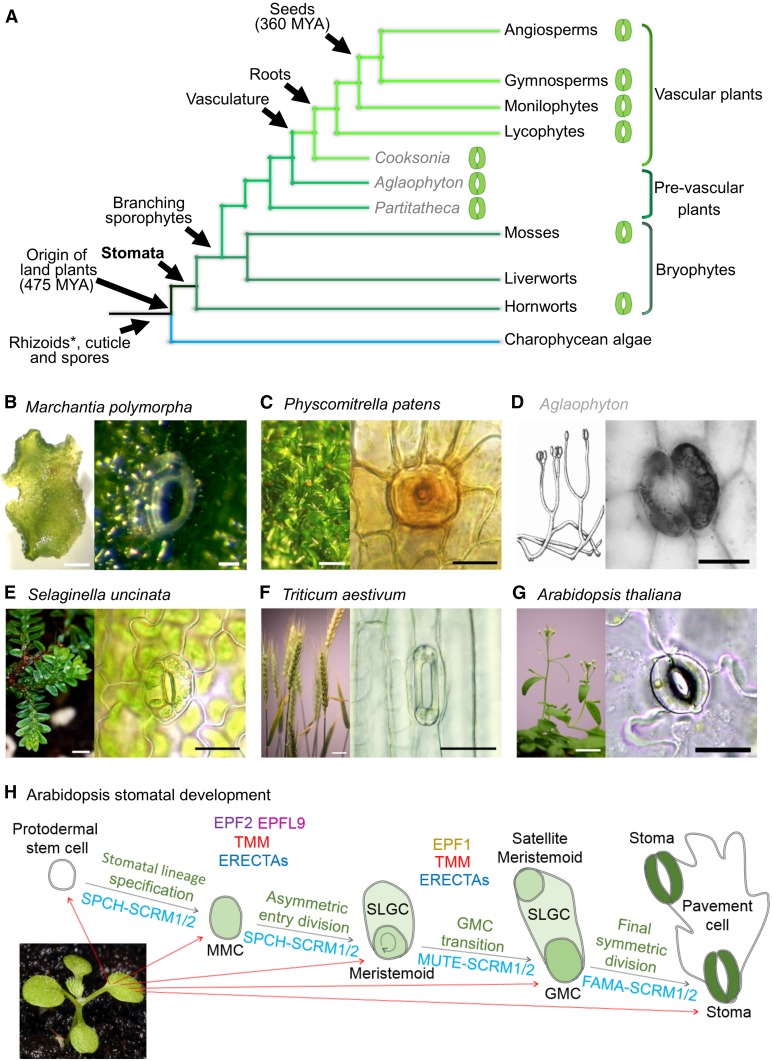
The evolution and origin of stomata in land plants. A, Recently proposed land plant phylogeny including extinct early land plant representatives (labeled gray) based on Wickett et al. (2014), Edwards et al. (2014), and Chen et al. (2017). Lineages that have stoma-bearing representatives are marked with an adjacent stomatal image. Rhizoids are marked with an asterisk, as the evolution of these structures is still debated (Tam et al., 2015). B to G, Representatives of nonvascular and vascular land plant species with images of pore (B) or stomata (C–G). In extant plants, stomata are found on the sporophyte. Left image in D reproduced with permission of the Linnean Society of London. Right image in D is reproduced from Edwards and Kerp, Stomata in early land plants: An anatomical and ecophysiological approach, 1998, 49, 255–278, with permission of Oxford University Press. G, Diagram to illustrate the control of stomatal developmental transitions in the angiosperm Arabidopsis (seedling image). A subset of protodermal cells enters the stomatal lineage and take on MMC identity. MMCs undergo an asymmetric cell division producing a smaller meristemoid and a larger SLGC, through the actions of the bHLH transcription factors SPCH and ICE1/SCRM or SCRM/2. EPF2 and EPFL9 compete for the binding of a number of ERECTA plasma membrane receptors. These interactions are modulated via the membrane protein TMM. After the asymmetric division, the larger SLGC either exits the stomatal lineage and takes on a pavement cell identity or undergoes a further division to form a satellite meristemoid (not shown). Meristemoids differentiate in to a GMC via the activity of heterodimeric bHLH MUTE and SCRM/2. EPF1 peptide signals extracellularly via ERECTAs (preferentially ER-like1), again modulated by TMM, to restrict GMC formation. GMCs undergo a symmetric division induced by FAMA and SCRM/2 activity to form a pair of guard cells. Scale bars: B, left and right 100 µm; C, left 200 µm, right 20 µm; D, right 50 µm; E, left 200 µm, right 20 µm; F, left 20 mm, right 50 µm; G, left 20 mm, 20 µm; H, 250 µm.
Figure 2.
Figure 2.
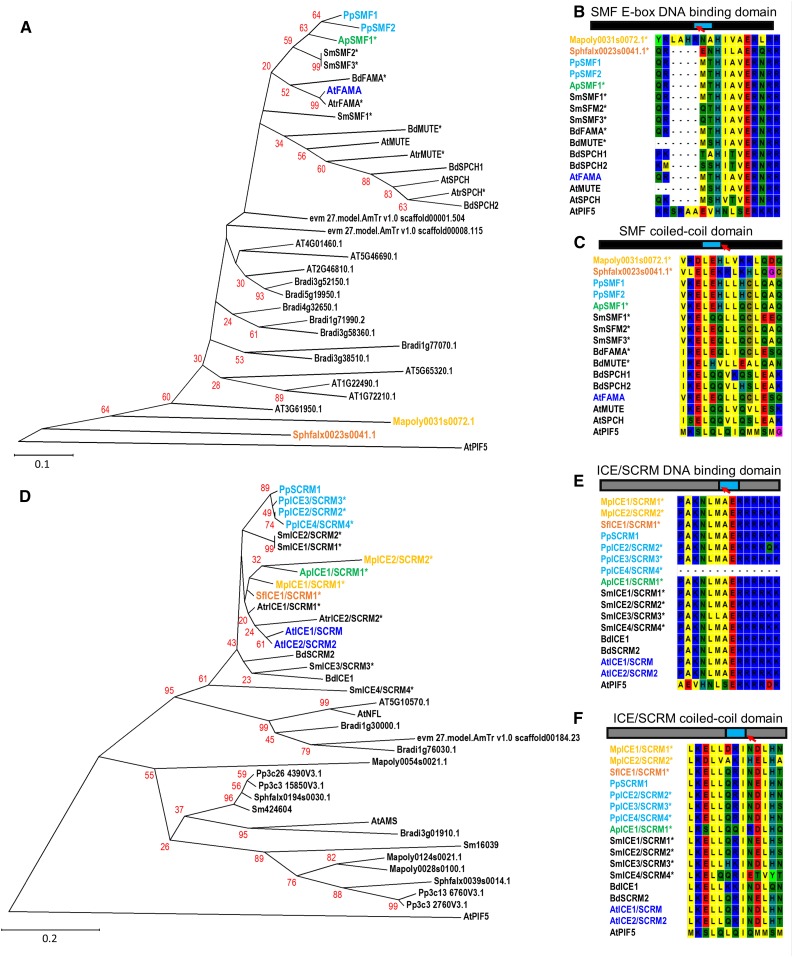
Phylogenies and domain sequence alignments of the bHLH transcription factors implicated in stomatal development for both stomata- and non-stomata-bearing land plants. A, Phylogeny of SPCH, MUTE, and FAMA orthologs and closest related SMF peptide sequences encoded by genes from the liverwort M. polymorpha (yellow), the mosses S. fallax (orange) and P. patens (light blue), the hornwort A. punctatus (green), and the angiosperm Arabidopsis (dark blue). Color-marked identifiers illustrate in which early taxa bHLHs associated stomatal development may be present. The developmental role of starred peptides and their associated genes (*) has not yet been experimentally confirmed. B, Conservation of SMF E-box DNA-binding domain, and C, coiled-coil domains in SPCH, MUTE, and FAMA sequences of stomata-bearing land plants based on alignments performed for A. D, Phylogeny representing ICE/SCRM and ICE2/SCRM2 orthologs and related genes utilizing peptide sequences from equivalent species to A. Color coding and nomenclature follows A. E, Conservation of ICE/SCRM DNA binding domain, and F, coiled-coil domains based on alignments performed for D. Sequences used to construct phylogenies in A and D were obtained by BLAST comparisons of the sequences of PpSMF1 and PpSCRM1 against the genomes of Mapoly, M. polymorpha; Sphfalx, S. fallax, Pp, P. patens; Sm: Selaginella moellendorffii; Atr, Amborella trichopoda (accession identifier evm); Bradi, Brachypodium distachyon; and AT: Arabidopsis using Phytozome V11 (Goodstein et al., 2012). Retrieved blast sequences of equal to or higher than 80 (PpSMF1 analysis) or 95 (PpSCRM1) were used for sequence alignments. The A. punctatus sequences (ApSMF1 and ApSCRM1) are partial sequences based on the recently publication of this species genome (Szövényi et al., 2015). The SmSMF3 peptide sequence was obtained based on previous analysis by MacAlister and Bergmann (2011). For SmSMF1, SmSMF3, and SmSCRM1-4 gene models were predicted using http://www.softberry.com/berry.phtml?topic=fgenesh&group=programs&subgroup=gfind (Solovyev et al., 2006). For both analyses, identified peptide sequences were aligned using the MUSCLE algorithm (Edgar, 2004) and evolutionary history inferred using the Neighbor-Joining method (Saitou and Nei, 1987). The percentage of replicate trees in which the associated taxa clustered together in the bootstrap test (1000 replicates) is shown next to the branches. The tree is to scale, with branch lengths in the same units as those of the evolutionary distances used to infer the phylogenetic tree. The evolutionary distances were computed using the Poisson correction method (Zuckerkandl and Pauling, 1965) and are in the units of the number of amino acid substitutions per site. Positions of gaps and missing data were removed. Evolutionary analyses were conducted in MEGA6 (Tamura et al., 2013). See Supplemental Table S1 for protein accession IDs and the sequences used for A. punctatos and S. moellendorffii. The Arabidopsis bHLH PIF5 was included as an outgroup for rooting the trees.
Figure 3.
Figure 3.
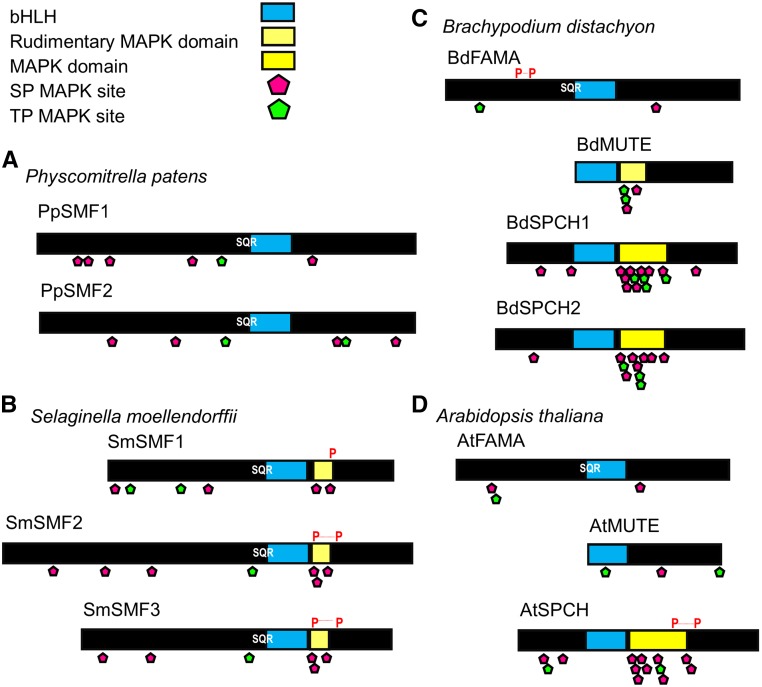
Comparison of SMF bHLH protein domains and motifs from four representative land plant species. A, Schematic of moss P. patens PpSMF1 and PpSMF2 proteins which contain bHLH domains (light blue) with limited evidence for a downstream MAPK phosphorylation domain. Putative SP (pink diamond) and TP (green diamond) MAPK phosphorylation sites are present, mostly to the N-terminal side of the bHLH region, which could serve as points of regulation. Both PpSMF1 and 2 contain an SQR motif, a potential protein kinase C phosphorylation site. B, Lycophyte S. moellendorffii SmSMF1, SmSMF2, and SmSMF3 sequences contain bHLH and potential MAPK target domains (light yellow) and several SP motifs. Similarly to PpSMF1/2 also contain proximal SP/TP MAPK target sites. An SQR motif is conserved in all three SmSMF sequences immediately upstream of the bHLH domain. Potential PEST domains are present in these sequences (marked with P). C, Grass B. distachyon BdFAMA, BdMUTE, and BdSPCH1, and BdSPCH2 proteins are shorter relative to P. patens and S. moellendorffii proteins, due to a reduced N-terminal region. The MAPK target domain in both BdSPCH1 and BdSPCH2 contains several SP and TP motifs. BdMUTE contains SP and TP motifs within a putative MAPK domain. The SQR motif is present only in BdFAMA. PEST domain identity is weak and therefore excluded omitted from the diagram. D, Dicot Arabidopsis AtFAMA, AtMUTE, and AtSPCH proteins. As with BdSPCH1 and BdSPCH2, AtSPCH has a well-conserved MAPK target domain and additionally contains a potential PEST domain. Protein kinase C sites and PEST domains were predicted using the tools available at http://myhits.isb-sib.ch/cgi-bin/motif_scan with http://emboss.bioinformatics.nl/cgibin/emboss/epestfind.
Figure 4.
Figure 4.
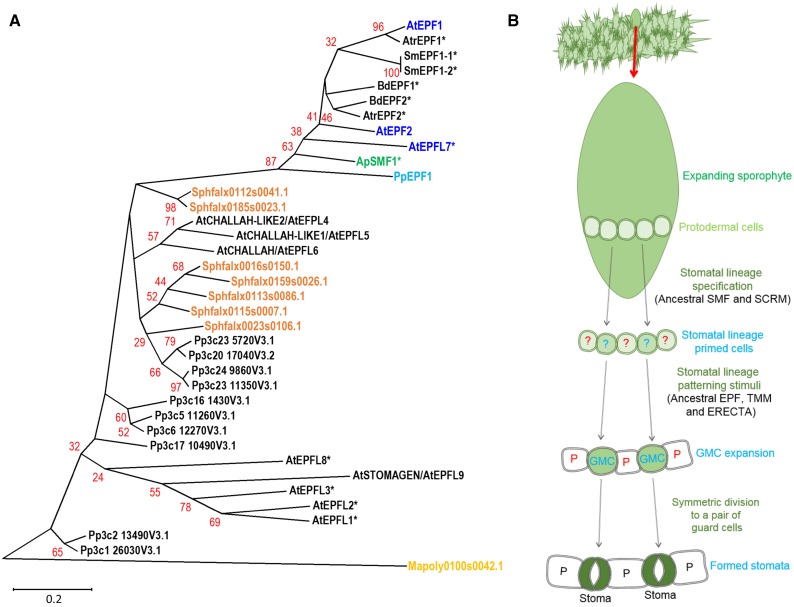
EPF phylogeny of stomata- and non-stomata-bearing land plants and a model for stomatal development in the ancestor of stomata-bearing land plants. A, Phylogeny of EPF peptide sequences across the land plant kingdom. Stomatal and putative stomatal genes or closest equivalents in the liverwort M. polymorpha (yellow), the mosses S. fallax (orange) and P. patens (light blue), the hornwort A. punctatus (green), and the angiosperm Arabidopsis (dark blue) are marked to illustrate in which of these taxa the EPF stomatal patterning gene may be present. Starred genes (*) have not had their functions experimentally determined. The majority of sequences used to construct the phylogeny were obtained by BLAST comparison of the PpEPF1 amino acid sequence against the genomes of Mapoly, M. polymorpha; Sphfalx, S. fallax; Pp, P. patens; Sm, S. moellendorffii; Atr, Amborella trichopoda; Bradi, Brachypodium distachyon; and AT, Arabidopsis. Additional P. patens genes with more limited homology were added based on Caine et al. (2016). For simplicity, non-stomata-associated EPFs from vascular land plants have been omitted from the tree. The A. punctatus ApEPF1 partial sequence is based on Szövényi et al. (2015). Alignment and phylogenetic trees were prepared as described for Figure 2. Arabidopsis EPFL1-6 and 8-9 are included to highlight sequence relationships identified in (Caine et al., 2016). B, A model for stomatal development on the sporophyte of early evolving plants. Stomata precursors may have been specified via activity of an ancestral SMF-SCRM heterodimer. To ensure appropriate spacing of GMCs, cell signaling occurred via an ancestral patterning module (EPF, TMM, and ERECTA), followed by a final symmetric division leading to the formation of mature stomata.
None
None

References

    1. Assmann SM, Jegla T (2016) Guard cell sensory systems: Recent insights on stomatal responses to light, abscisic acid, and CO2. Curr Opin Plant Biol 33: 157–167 - PubMed
    1. Baars C, Edwards D (2008) Effects of elevated atmospheric CO2 on spore capsules of the moss Leptobryum pyriforme. J Bryol 30: 36–40
    1. Berry JA, Beerling DJ, Franks PJ (2010) Stomata: Key players in the earth system, past and present. Curr Opin Plant Biol 13: 233–240 - PubMed
    1. Bowman JL. (2011) Stomata: Active portals for flourishing on land. Curr Biol 21: R540–R541 - PubMed
    1. Caine RS, Chater CC, Kamisugi Y, Cuming AC, Beerling DJ, Gray JE, Fleming AJ (2016) An ancestral stomatal patterning module revealed in the non-vascular land plant Physcomitrella patens. Development 143: 3306–3314 - PMC - PubMed