Review
. 2017 Mar 29;90(1):73-86.
eCollection 2017 Mar.

Exploiting Long Noncoding RNAs as Pharmacological Targets to Modulate Epigenetic Diseases

Affiliations
Review

Exploiting Long Noncoding RNAs as Pharmacological Targets to Modulate Epigenetic Diseases

Bindu Prabhakar et al. Yale J Biol Med. .

Abstract

Long non-coding RNAs (lncRNAs) constitute the largest class of non-coding transcripts in the human genome. Results from next-generation sequencing and bioinformatics advances indicate that the human genome contains more non-coding RNA genes than protein-coding genes. Validated functions of lncRNAs suggest that they are master regulators of gene expression and often exert their influences via epigenetic mechanisms by modulating chromatin structure. Specific lncRNAs can regulate transcription in gene clusters. Since the functions of protein-coding genes in clusters are often tied to specific pathways, lncRNAs constitute attractive pharmacological targets. Here we review the current knowledge of lncRNA functions in human cells and their roles in disease processes. We also present forward-looking perspectives on how they might be manipulated pharmacologically for the treatment of a variety of human diseases, in which regulation of gene expression by epigenetic mechanisms plays a major role.

Keywords: drug target; epigenetics; gene expression; lncRNA; pharmacology.


Figures
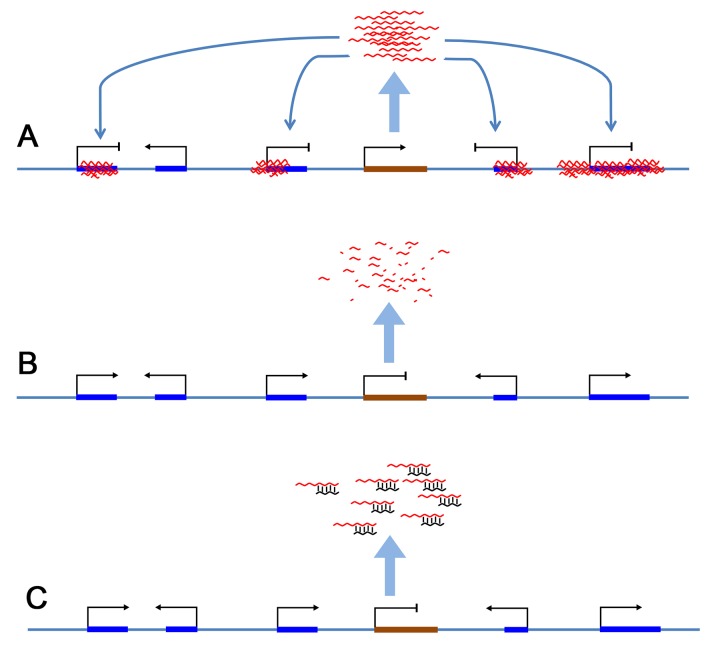
Figure 1
Figure 1
An Overview of pharmacological strategies to modulate lncRNA functions. A. A diagram of a typical gene cluster regulated by a lncRNA. lncRNA genes produce a pool of lncRNAs, which then interact with nearby genes. Since a gene cluster often contains genes that function in the same pathways, a single lncRNA can coordinately regulate the locus and consequently a pathway of interest. B. Pharmacological targeting strategies can be designed whose mode of action is the direct destruction of lncRNAs. Examples include antisense oligonucleotides, siRNA approaches, and ribozymes. C. Pharmacological strategies can also be devised whose mode of action is the competitive inhibition of interactions between lncRNAs and their target genes or interacting ribonucleoproteins. Examples include small molecule inhibitors and synthetic stabilized oligonucleotides.

References

    1. Waddington CH. The Epigenotype. Int J Epidemiol. 2012;41(1):10–13. - PubMed
    1. Goldberg AD, Allis CD, Bernstein E. Epigenetics: A landscape takes shape. Cell. 2007;128(4):635–638. - PubMed
    1. Wapinski O, Chang HY. Long noncoding RNAs and human disease. Trends Cell Biol. 2011;21(6):354–361. - PubMed
    1. Karapetyan AR, Buiting C, Kuiper RA. et al. Regulatory roles for long ncRNA and mRNA. Cancers (Basel) 2013;5(2):462–490. - PMC - PubMed
    1. Koerner MV, Pauler MV, Huang R. et al. The function of non-coding RNAs in genomic imprinting. Development. 2009;136(11):1771–1783. - PMC - PubMed

Publication types

Substances

LinkOut - more resources