. 2017 Feb;13(2):681-685.
doi: 10.3892/ol.2016.5490. Epub 2016 Dec 12.

Ginsenoside Rh2 enhances the antitumor immunological response of a melanoma mice model

Affiliations

Ginsenoside Rh2 enhances the antitumor immunological response of a melanoma mice model

Meng Wang et al. Oncol Lett. 2017 Feb.

Abstract

The treatment of malignant tumors following surgery is important in preventing relapse. Among all the post-surgery treatments, immunomodulators have demonstrated satisfactory effects on preventing recurrence according to recent studies. Ginsenoside is a compound isolated from panax ginseng, which is a famous traditional Chinese medicine. Ginsenoside aids in killing tumor cells through numerous processes, including the antitumor processes of ginsenoside Rh2 and Rg1, and also affects the inflammatory processes of the immune system. However, the role that ginsenoside serves in antitumor immunological activity remains to be elucidated. Therefore, the present study aimed to analyze the effect of ginsenoside Rh2 on the antitumor immunological response. With a melanoma mice model, ginsenoside Rh2 was demonstrated to inhibit tumor growth and improved the survival time of the mice. Ginsenoside Rh2 enhanced T-lymphocyte infiltration in the tumor and triggered cytotoxicity in spleen lymphocytes. In addition, the immunological response triggered by ginsenoside Rh2 could be transferred to other mice. In conclusion, the present study provides evidence that ginsenoside Rh2 treatment enhanced the antitumor immunological response, which may be a potential therapy for melanoma.

Keywords: animals; cytotoxic T lymphocytes; ginsenoside Rh2 (GRh2); immunotherapy; melanoma; mice; tumor.


Figures
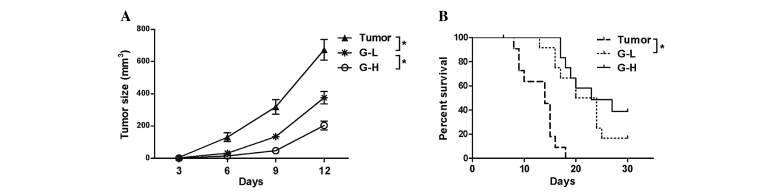
Figure 1.
Figure 1.
Effect of ginsenoside Rh2 treatment. (A) Tumor sizes in G-L group and G-H group were reduced compared with the tumor group (P<0.05). The antitumor effect of ginsenoside Rh2 was greater in the G-H group than in G-L group (P<0.05). (B) Kaplan-Meier survival ratio demonstrated that mice from the G-L group and G-H group had improved survival rates compared with the tumor group (P<0.05). The survival rate in the G-H group was longer compared with the G-L group (P<0.05). *P<0.05. G-L, low dose of ginsenoside Rh2; G-H, high dose of ginsenoside Rh2.
Figure 2.
Figure 2.
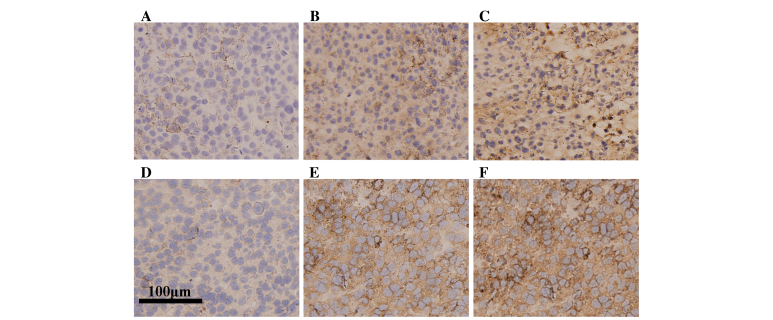
Immunohistochemical staining of CD8a and CD4. CD8a immunostaining of tumors from (A) tumor group, (B) G-L group and (C) G-H group. CD4 staining of tumors from (D) tumor group, (E) G-L group and (F) G-H group. G-L group and G-H group exhibited a greater level of CD4+ or CD8a+ lymphocyte infiltration compared with the tumor group, and compared with the G-L group, the G-H group exhibited greater infiltration levels (magnification 1,000x; bar: 100 µm). G-L, low dose of ginsenoside Rh2; G-H, high dose of ginsenoside Rh2.
Figure 3.
Figure 3.
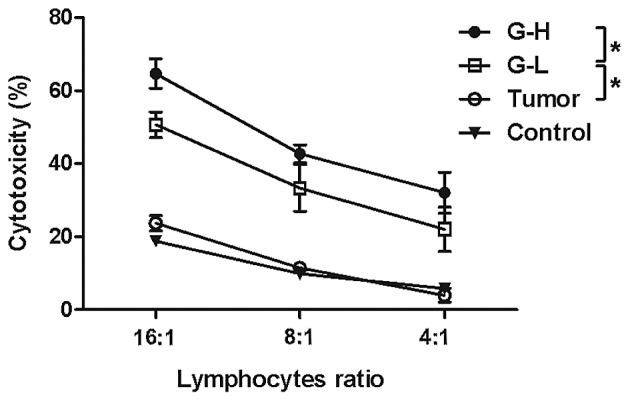
Cytotoxicity of spleen lymphocytes from control group, tumor group, G-L group and G-H group. Mice treated with ginsenoside Rh2 demonstrated increased lymphocyte cytotoxicity compared with control group and tumor group (P<0.05). Cytotoxicity was higher in the G-H group compared to the G-L group (P<0.05). *P<0.05. G-L, low dose of ginsenoside Rh2; G-H, high dose of ginsenoside Rh2.
Figure 4.
Figure 4.
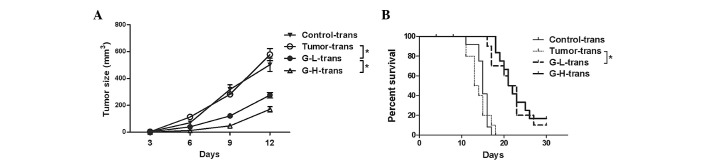
Tumor growth and survival from lymphocytes adoptive transferred groups. The recipient naïve mice receiving lymphocytes from tumor group, G-L group, G-H group and control group were named as tumor-trans group, G-L-trans group, G-H-trans group and control-trans group, respectively. (A) Tumor sizes in G-L-trans group and G-H-trans group were smaller than in control-trans group and tumor-trans group (P<0.05). The antitumor effect of lymphocytes transferred was greater in the G-H-trans group than in the G-L-trans group (P<0.05). (B) Kaplan-Meier survival ratio demonstrated that mice from the G-L-trans group and G-H-trans group survived longer than the control-trans group and tumor-trans group (P<0.05). *P<0.05.

References

    1. Chu KF, Dupuy DE. Thermal ablation of tumours: Biological mechanisms and advances in therapy. Nat Rev Cancer. 2014;14:199–208. doi: 10.1038/nrc3672. - DOI - PubMed
    1. Robinson RD, Knudtson JF. Fertility preservation in patients receiving chemotherapy or radiotherapy. Mo Med. 2014;111:434–438. - PMC - PubMed
    1. Killion JJ, Fidler IJ. Therapy of cancer metastasis by tumoricidal activation of tissue macrophages using liposome-encapsulated immunomodulators. Pharmacol Ther. 1998;78:141–154. doi: 10.1016/S0163-7258(98)00004-7. - DOI - PubMed
    1. Sheridan C. Industry pursues co-stimulatory receptor immunomodulators to treat cancer. Nat Biotechnol. 2013;31:181–183. doi: 10.1038/nbt0313-181. - DOI - PubMed
    1. Berinstein NL. Enhancing cancer vaccines with immunomodulators. Vaccine. 2007;25:B72–B88. doi: 10.1016/j.vaccine.2007.06.043. (Suppl 2) - DOI - PubMed