. 2017 Feb;6(2):139-153.
doi: 10.3892/mco.2017.1129. Epub 2017 Jan 10.

The role of peroxiredoxins in cancer

Affiliations

The role of peroxiredoxins in cancer

Arianna Nicolussi et al. Mol Clin Oncol. 2017 Feb.

Abstract

Peroxiredoxins (PRDXs) are a ubiquitously expressed family of small (22-27 kDa) non-seleno peroxidases that catalyze the peroxide reduction of H2O2, organic hydroperoxides and peroxynitrite. They are highly involved in the control of various physiological functions, including cell growth, differentiation, apoptosis, embryonic development, lipid metabolism, the immune response, as well as cellular homeostasis. Although the protective role of PRDXs in cardiovascular and neurological diseases is well established, their role in cancer remains controversial. Increasing evidence suggests the involvement of PRDXs in carcinogenesis and in the development of drug resistance. Numerous types of cancer cells, in fact, are characterized by an increase in reactive oxygen species (ROS) production, and often exhibit an altered redox environment compared with normal cells. The present review focuses on the complex association between oxidant balance and cancer, and it provides a brief account of the involvement of PRDXs in tumorigenesis and in the development of chemoresistance.

Keywords: chemoresistance; chemosensitization; oxidative stress; peroxiredoxins; tumorigenesis.


Figures
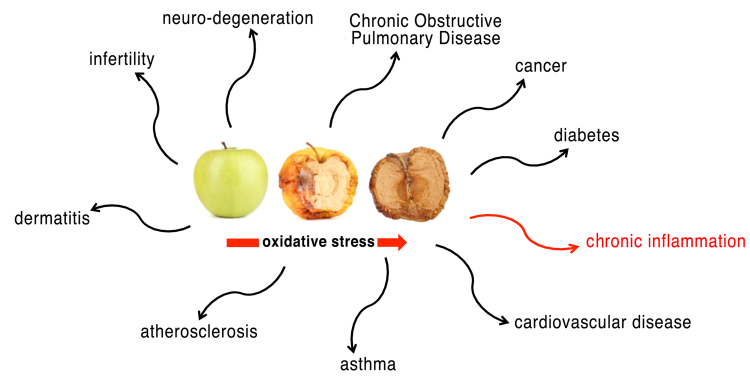
Figure 1.
Figure 1.
Oxidative stress and human diseases. Oxidative stress plays a role in many pathological processes.
Figure 2.
Figure 2.
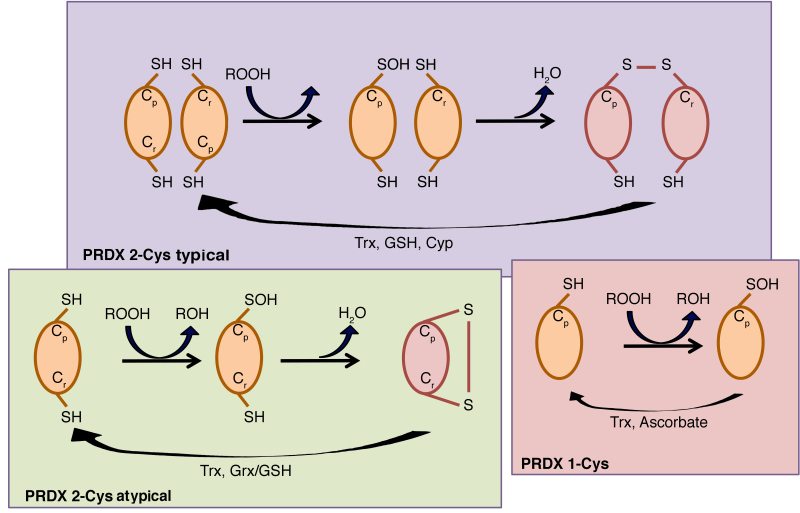
Mechanisms of the three PRDX subtypes. In typical 2-Cys PRDXs, the main cysteine residue (Cp) reacts with the residue Cr on the second subunit of the dimer. In atypical 2-Cys PRDXs, the oxidized Cp reacts with the Cr residue located in the same molecule. In 1-Cys PRDXs, the Cp residue generates sulfenic acid and is regenerated directly through donation of an electron to the thiol form in presence of ascorbate. Cyp, cyclophilin; Grx, glutaredoxin; GSH, reduced glutathione; ROOH, peroxide; Cp, peroxidatic Cys; Cr, resolving cysteine; Trx, thioredoxin.
Figure 3.
Figure 3.
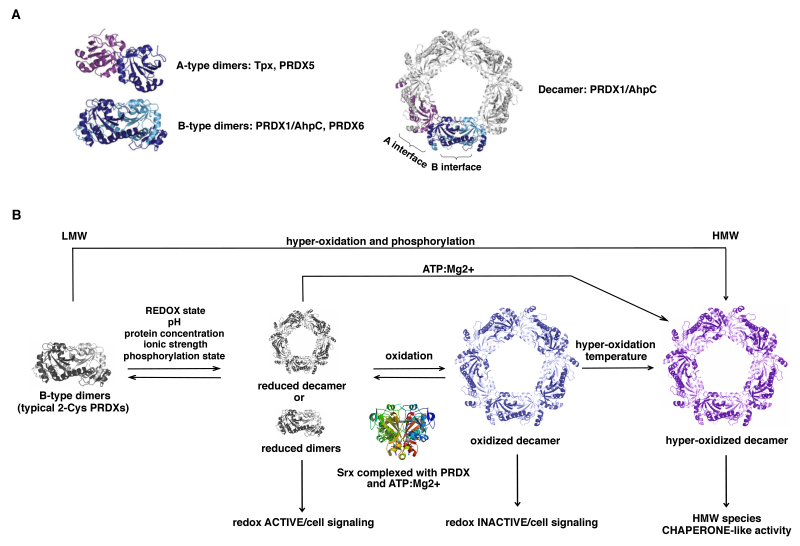
Quaternary structure of PRDXs. (A) A-type dimers or B-type dimers. Certain components of the PRDX1 and PRDX6 subfamilies form a decameric structure through the interaction of five B-type dimers via the A-type dimer interface (A-type dimer colored in purple/blue; B-type dimer colored in blue/light blue). (B) The model of typical 2-Cys PRDX oligomerization and function: Different factors induce oligomerization of the dimers to hexa-, octa-, decamers or higher-order aggregates that are able to function as a peroxidase. Oxidation leads to the breakdown of the decamers, whereas hyperoxidation stabilizes the oligomer. Oxidized decamers can be reversed by sulfiredoxin (Srx) reduction (167). Hyperoxidized decamers are stable HMW complexes with chaperone-like activity. LMW, low molecular weight; HMW, high-molecular-weight; PRDX, peroxiredoxin.
Figure 4.
Figure 4.
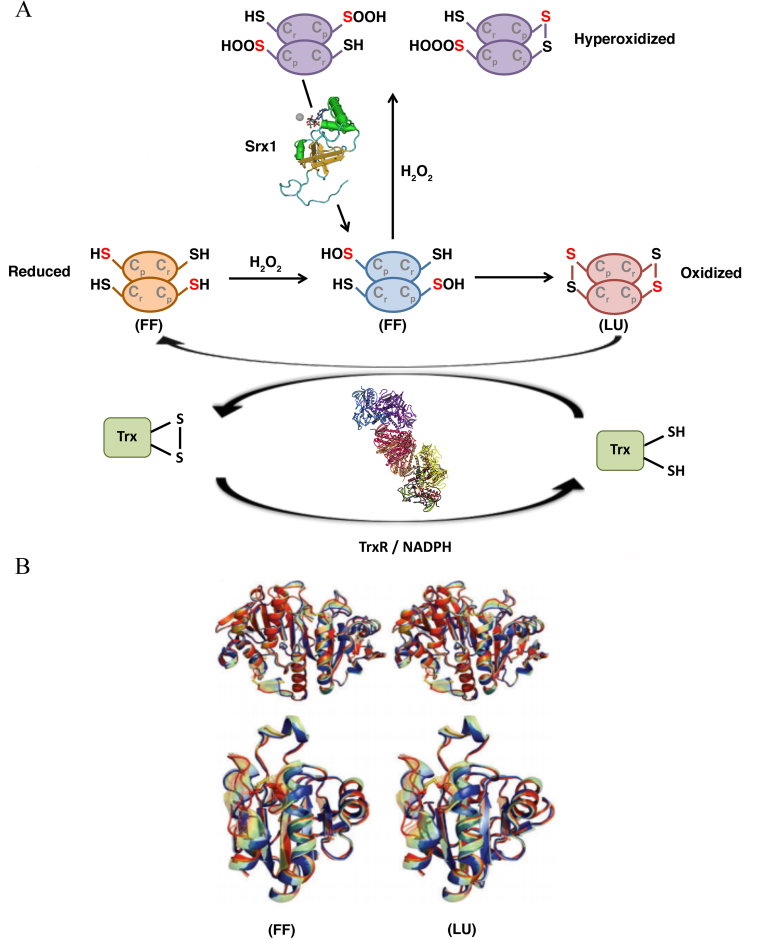
Catalytic mechanism of typical 2-Cys PRDXa. (A) PRDXs switch from an FF conformation, in which Cp reacts with the peroxide, to an LU conformation, in which the Cp is exposed and forms a disulfide bridge with the Cr residue. The thiol groups are converted into sulfenic acid (−S-OH) and form disulfide bonds with other thiol groups (−SS-) (oxidized status-LU conformation). At high peroxide concentrations, the sulfenic acid intermediate is overoxidized to sulfinic acid (−SOOH) or even sulfonic acid (−SOOOH), causing the inactivation of the enzyme (hyperoxidized status). (B) Stereo-view of the interpolated structural changes shown in rainbow colors between the FF (blue) and LU (red) conformations for a representative of Prx1 subfamily (upper) and Prx5 subfamily (lower). PRDX, peroxiredoxin; Srx1 sulfiredoxin 1, Trx, thioredoxin; TrxR, thioredoxin reductase; FF, fully folded; LU, locally unfolded.
Figure 5.
Figure 5.
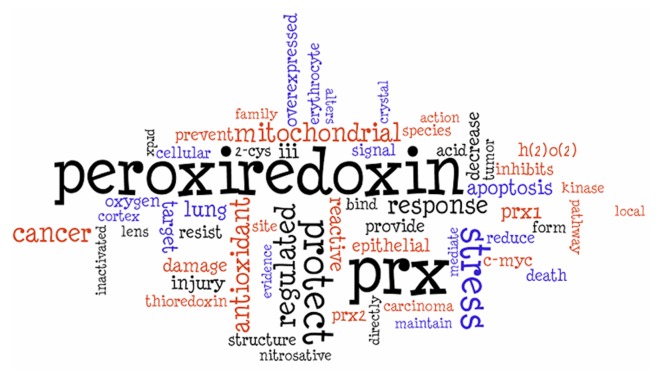
WordCloud for PRDXs. The WordCloud representation shows the majority information about the PRDX family (see http://www.maayanlab.net/G2W/help.php). PRDX, peroxiredoxin.
Figure 6.
Figure 6.
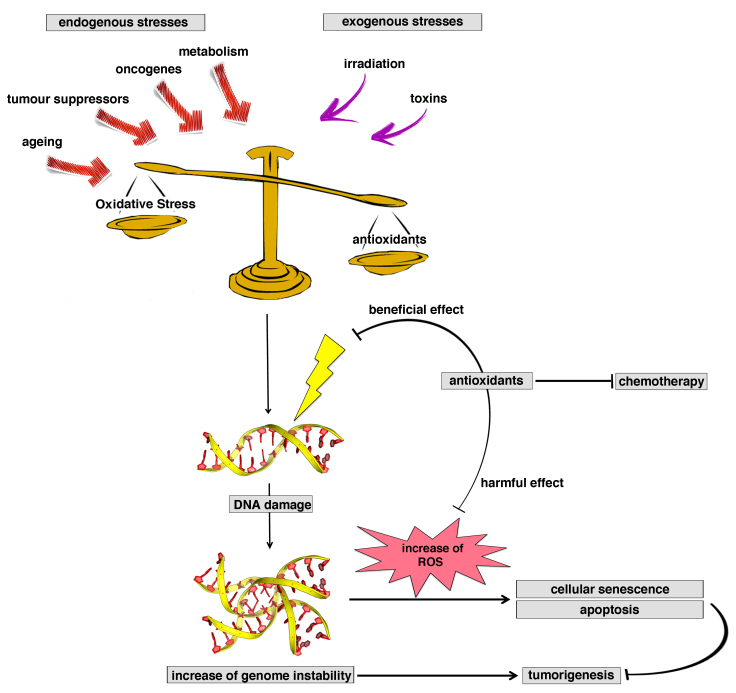
Antioxidants: a ‘double-edged sword’ in tumorigenesis. Antioxidants are a double-edged sword in tumorigenesis, and may be involved in reduction of the levels or reactive oxygen species (beneficial effect) or in accelerating tumor formation, inhibiting senescence or apoptotic processes (harmful effects).

References

    1. Valko M, Leibfritz D, Moncol J, Cronin MT, Mazur M, Telser J. Free radicals and antioxidants in normal physiological functions and human disease. Int J Biochem Cell Biol. 2007;39:44–84. doi: 10.1016/j.biocel.2006.07.001. - DOI - PubMed
    1. Duracková Z. Some current insights into oxidative stress. Physiol Res. 2010;59:459–469. - PubMed
    1. Xing M. Oxidative stress: A new risk factor for thyroid cancer. Endocr Relat Cancer. 2012;19:C7–C11. doi: 10.1530/ERC-11-0360. - DOI - PMC - PubMed
    1. Dröge W. Free radicals in the physiological control of cell function. Physiol Rev. 2002;82:47–95. doi: 10.1152/physrev.00018.2001. - DOI - PubMed
    1. Giorgio M, Trinei M, Migliaccio E, Pelicci PG. Hydrogen peroxide: A metabolic by-product or a common mediator of ageing signals? Nat Rev Mol Cell Biol. 2007;8:722–728. doi: 10.1038/nrm2240. - DOI - PubMed