Review
. 2014 Mar 1;1(3):70-80.
doi: 10.15698/mic2014.01.132.

Genome-wide studies of telomere biology in budding yeast

Affiliations
Review

Genome-wide studies of telomere biology in budding yeast

Yaniv Harari et al. Microb Cell. .

Abstract

Telomeres are specialized DNA-protein structures at the ends of eukaryotic chromosomes. Telomeres are essential for chromosomal stability and integrity, as they prevent chromosome ends from being recognized as double strand breaks. In rapidly proliferating cells, telomeric DNA is synthesized by the enzyme telomerase, which copies a short template sequence within its own RNA moiety, thus helping to solve the "end-replication problem", in which information is lost at the ends of chromosomes with each DNA replication cycle. The basic mechanisms of telomere length, structure and function maintenance are conserved among eukaryotes. Studies in the yeast Saccharomyces cerevisiae have been instrumental in deciphering the basic aspects of telomere biology. In the last decade, technical advances, such as the availability of mutant collections, have allowed carrying out systematic genome-wide screens for mutants affecting various aspects of telomere biology. In this review we summarize these efforts, and the insights that this Systems Biology approach has produced so far.

Keywords: aging; cancer; genome stability; systems biology; telomeres; yeast.


Conflict of interest statement

Conflict of interest: The authors declare no conflict of interest.

Figures
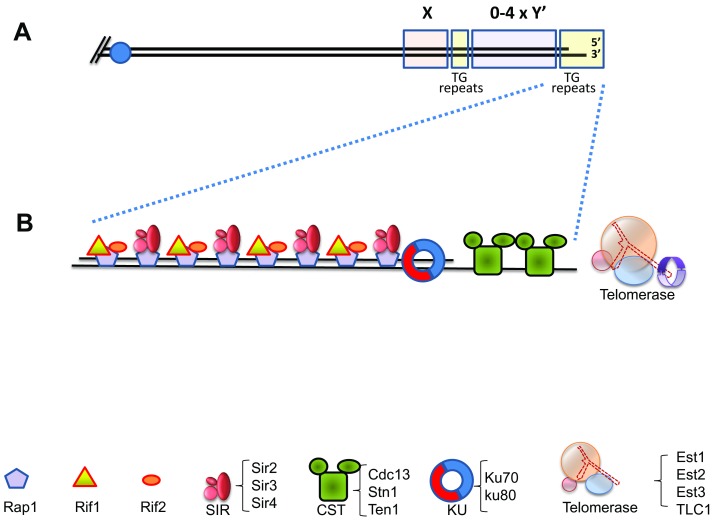
Figure 1
Figure 1. FIGURE 1: Structure of the yeast telomere.
(A) Schematic representation of a yeast telomere. All yeast chromosomes carry subtelomeric repeats called X elements, and between 0 and 4 copies of another sub-telomeric element, the Y’ sequences. Telomeric repeats are composed of variations of the T(G1-3) formula. The TG-rich strand (with its 3’ OH) is longer than the complementary strand (TG overhangs). (B) Schematic representation of the telomeric chromatin, with representative proteins. Rap1 binds the telomeric repeats, and Rif1, Rif2 and the SIR proteins bind to Rap1. The Ku heterodimer binds to telomeric dsDNA and the CST complex binds the terminal ssDNA end. Telomerase is recruited to telomeres present in an “extensible” configuration by interactions with the CST.
Figure 2
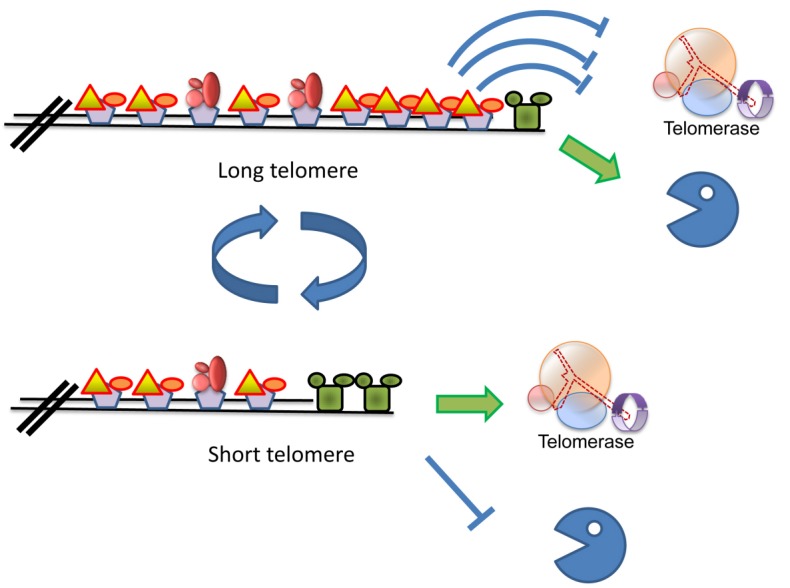
Figure 2. FIGURE 2: Schematic model of the mechanism(s) that keep telomere length homeostasis.
Long telomeres carry many copies of the Rap1 protein, and its associated Rif1 and Rif2 proteins, which prevent recruitment of telomerase. Telomeres in this state are said to be in a “non-extendable” configuration . Telomeres shorten as a consequence of the “end replication problem” or by the action of exonucleases (Pacman). It is still unclear what circumstances allow recruitment of nucleases. Short telomeres carry a low number of Rap1/Rif units, and the CST is able to recruit telomerase, thus elongating the telomere. It is assumed that the presence of an active telomerase prevents recruitment of shortening nucleases.

References

    1. Dewar JM, Lydall D. Similarities and differences between "uncapped" telomeres and DNA double-strand breaks. Chromosoma. 2012;121(2):117–130. doi: 10.1007/s00412-011-0357-2. - DOI - PubMed
    1. Griffith JD, Comeau L, Rosenfield S, Stansel RM, Bianchi A, Moss H, de Lange T. Mammalian telomeres end in a large duplex loop. Cell. 1999;97(4):503–514. doi: 10.1016/S0092-8674(00)80760-6. - DOI - PubMed
    1. Poschke H, Dees M, Chang M, Amberkar S, Kaderali L, Rothstein R, Luke B. Rif2 promotes a telomere fold-back structure through Rpd3L recruitment in budding yeast. PLoS Genet. 2012;8(9):e1002960. doi: 10.1371/journal.pgen.1002960. - DOI - PMC - PubMed
    1. Olovnikov AM. Principle of marginotomy in template synthesis of polynucleotides. Doklady Akademii nauk SSSR. 1971;201(6):1496–1499. - PubMed
    1. Watson JD. Origin of concatemeric T7 DNA. Nature: New biology. 1972;239(94):197–201. doi: 10.1038/newbio239197a0. - DOI - PubMed

LinkOut - more resources