


Glucose Plus Fructose Ingestion for Post-Exercise Recovery-Greater than the Sum of Its Parts?
- PMID: 28358334
- PMCID: PMC5409683
- DOI: 10.3390/nu9040344
Glucose Plus Fructose Ingestion for Post-Exercise Recovery-Greater than the Sum of Its Parts?
Abstract
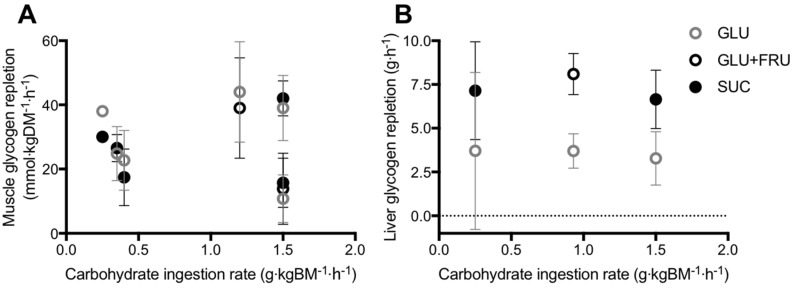
Carbohydrate availability in the form of muscle and liver glycogen is an important determinant of performance during prolonged bouts of moderate- to high-intensity exercise. Therefore, when effective endurance performance is an objective on multiple occasions within a 24-h period, the restoration of endogenous glycogen stores is the principal factor determining recovery. This review considers the role of glucose-fructose co-ingestion on liver and muscle glycogen repletion following prolonged exercise. Glucose and fructose are primarily absorbed by different intestinal transport proteins; by combining the ingestion of glucose with fructose, both transport pathways are utilised, which increases the total capacity for carbohydrate absorption. Moreover, the addition of glucose to fructose ingestion facilitates intestinal fructose absorption via a currently unidentified mechanism. The co-ingestion of glucose and fructose therefore provides faster rates of carbohydrate absorption than the sum of glucose and fructose absorption rates alone. Similar metabolic effects can be achieved via the ingestion of sucrose (a disaccharide of glucose and fructose) because intestinal absorption is unlikely to be limited by sucrose hydrolysis. Carbohydrate ingestion at a rate of ≥1.2 g carbohydrate per kg body mass per hour appears to maximise post-exercise muscle glycogen repletion rates. Providing these carbohydrates in the form of glucose-fructose (sucrose) mixtures does not further enhance muscle glycogen repletion rates over glucose (polymer) ingestion alone. In contrast, liver glycogen repletion rates are approximately doubled with ingestion of glucose-fructose (sucrose) mixtures over isocaloric ingestion of glucose (polymers) alone. Furthermore, glucose plus fructose (sucrose) ingestion alleviates gastrointestinal distress when the ingestion rate approaches or exceeds the capacity for intestinal glucose absorption (~1.2 g/min). Accordingly, when rapid recovery of endogenous glycogen stores is a priority, ingesting glucose-fructose mixtures (or sucrose) at a rate of ≥1.2 g·kg body mass-1·h-1 can enhance glycogen repletion rates whilst also minimising gastrointestinal distress.
Keywords: carbohydrates; glycogen; liver; metabolism; muscle; resynthesis; sports nutrition; sucrose.
Conflict of interest statement
The authors declare no conflicts of interest.
Figures


References
-
- Romijn J.A., Coyle E.F., Sidossis L.S., Gastaldelli A., Horowitz J.F., Endert E., Wolfe R.R. Regulation of endogenous fat and carbohydrate metabolism in relation to exercise intensity and duration. Am. J. Physiol. 1993;265:E380–E391. - PubMed
-
- Van Loon L.J., Jeukendrup A.E., Saris W.H., Wagenmakers A.J. Effect of training status on fuel selection during submaximal exercise with glucose ingestion. J. Appl. Physiol. 1999;87:1413–1420. - PubMed
Publication types
MeSH terms
Substances
LinkOut - more resources
Full Text Sources
Other Literature Sources
Medical
