. 2017 May;15(5):2991-3000.
doi: 10.3892/mmr.2017.6411. Epub 2017 Mar 30.

Expression levels of transcription factors c-Fos and c-Jun and transmembrane protein HAb18G/CD147 in urothelial carcinoma of the bladder

Affiliations

Expression levels of transcription factors c-Fos and c-Jun and transmembrane protein HAb18G/CD147 in urothelial carcinoma of the bladder

Muren Huhe et al. Mol Med Rep. 2017 May.

Abstract

The aim of the present study was to investigate the prognostic significance of the expression of transcription factors, c-Fos, c-Jun and transmembrane protein CD147, in urothelial carcinoma of the bladder (UCB). The current study investigated the clinical significance of these factors in the development, progression and survival analysis of UCB. Immunohistochemistry was employed to analyze c‑Fos, c‑Jun and CD147 expression in 41 UCB cases and 34 non‑cancerous human bladder tissues. These results were scored in a semi‑quantitative manner based on the intensity and percentage of tumor cells that presented immunoreactivity. Protein levels of CD147, c‑Fos and c‑Jun expression were upregulated in 22 (53.7%), 10 (24.4%) and 9 (22.0%) UCB cases, respectively. High levels of c‑Jun correlated with the AJCC cancer staging manual (7th edition; P=0.038). Univariate analysis revealed that upregulated CD147 (P=0.038) or c‑Jun (P=0.008) was associated with poor overall survival (OS), respectively. Further analysis revealed that either CD147‑c‑Fos‑c‑Jun co‑expression (P=0.004), or CD147‑c‑Jun co‑expression (P=0.037) and c‑Fos‑c‑Jun co‑expression (P<0.001) were associated with poor OS. Multivariate analysis suggested that either upregulation of CD147, c‑Jun or c‑Fos were independent risk indicators for death in UCB patients. Increased expression of c‑Jun or CD147, as well as co‑expression of CD147‑c‑Jun, c‑Jun‑c‑Fos or CD147‑c‑Jun‑c‑Fos has prognostic significance for UCB patients. Therefore, high CD147 and c‑Jun expression may serve roles in tumor progression and may be diagnostic and therapeutic targets in UCB whether alone or in combination.


Figures
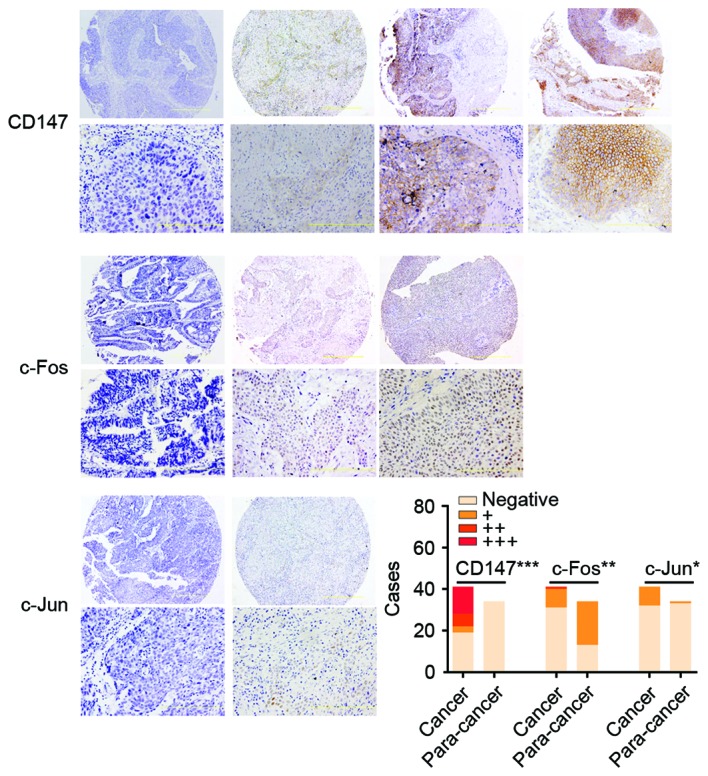
Figure 1.
Figure 1.
The immunohistochemical staining of CD147, c-Fos and c-Jun in UCB. The expression of c-Jun, c-Fos and CD147 was scored as negative, absence; +, weak; ++, moderate; and +++, strong. The images were ×100 (upper row) and ×400 magnification (bottom row). The histogram presents the number of cases with CD147, c-Fos and c-Jun expression in UCB tissues and para-cancer normal tissues. The distribution of 41 cases of UCB and 34 cases of para-cancer tissues is presented in the bar graph. CD147 (negative, 19; +, 3; ++, 6; and +++, 13 in UCB. negative, 34 in para-cancer), c-Fos (negative, 31; +, 9; and ++, 1 in UCB. negative, 13; and +, 21 in para-cancer) and c-Jun (negative, 32; +, 9; in UCB. Negative, 33; and +, 1 in para-cancer), respectively. ***P<0.001, **P<0.01 and *P<0.05 vs. para-cancer. UCB, urothelial carcinoma of the bladder.
Figure 2.
Figure 2.
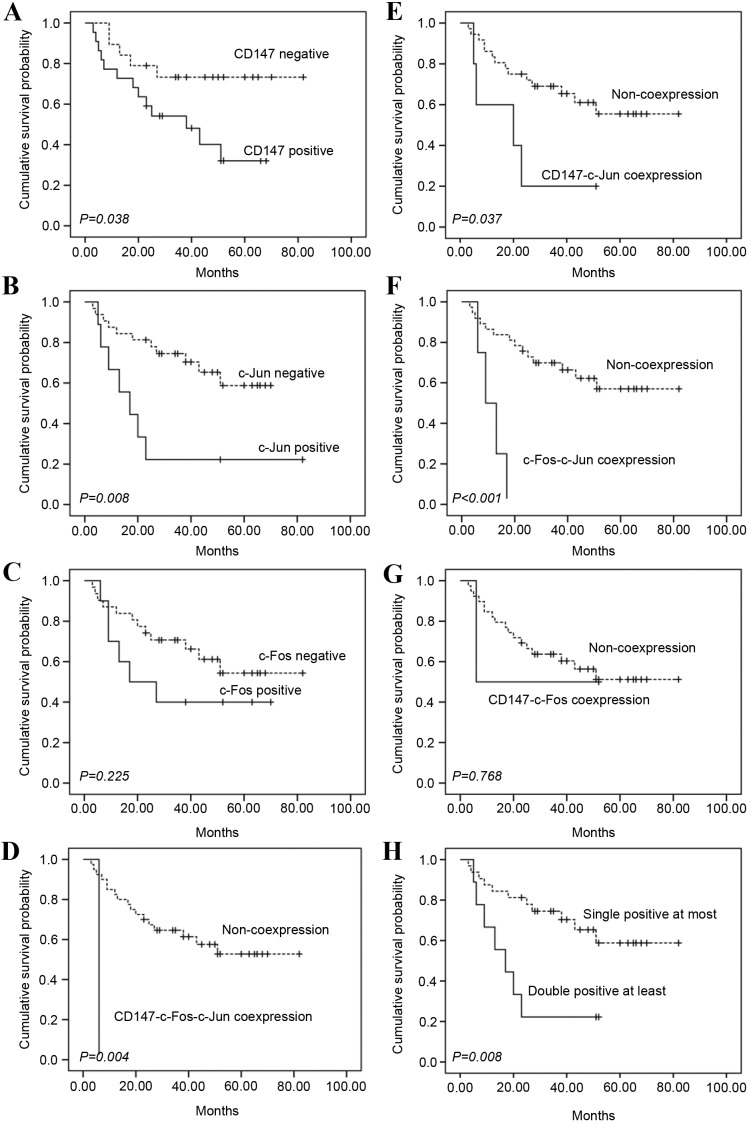
OS analysis of c-Fos, c-Jun and CD147 expression in 41 patients with urothelial carcinoma of the bladder. (A) Patients with CD147 positive expression (+, ++, +++) had poorer overall survival rate than those with CD147 negative expression (log-rank test, P=0.038). (B) Patients with c-Jun positive expression (+) had poorer overall survival rate than those with c-Jun negative expression (log-rank test, P=0.008). (C) c-Fos positive expression (+, ++) did not significantly correlate with poor OS (log-rank test, P=0.225). (D) Patients with all the three proteins co-expressed (CD147-c-Fos-c-Jun co-expression) had poorer overall survival rate than the others (log-rank test, P=0.004). (E) Patients with CD147-c-Jun co-expression had poorer overall survival rate than the others (log-rank test, P=0.037). (F) Patients with c-Fos-c-Jun co-expression had poorer overall survival rate than the others (log-rank test, P<0.001). (G) CD147-c-Fos co-expression did not significantly correlate with poor OS (log-rank test, P=0.768). (H) OS was better in patients who had c-Fos, c-Jun and CD147 all negative, or single-protein positive expression than in those who had double-protein positive or triple-protein positive expression (log-rank test, P=0.008). OS, overall survival.

References

    1. Sharma S, Ksheersagar P, Sharma P. Diagnosis and treatment of bladder cancer. Am Fam Physician. 2009;80:717–723. - PubMed
    1. Siegel RL, Miller KD, Jemal A. Cancer statistics, 2015. CA Cancer J Clin. 2015;65:5–29. doi: 10.3322/caac.21254. - DOI - PubMed
    1. Van Tilborg AA, Bangma CH, Zwarthoff EC. Bladder cancer biomarkers and their role in surveillance and screening. Int J Urol. 2009;16:23–30. doi: 10.1111/j.1442-2042.2008.02174.x. - DOI - PubMed
    1. Giuliani L, Giberti C, Martorana G, Bonamini A, Natta GD, Rovida S. Results of radical cystectomy for primary bladder cancer. Retrospective study of more than 200 cases. Urology. 1985;26:243–248. doi: 10.1016/0090-4295(85)90119-0. - DOI - PubMed
    1. Pagano F, Bassi P, Galetti TP, Meneghini A, Milani C, Artibani W, Garbeglio A. Results of contemporary radical cystectomy for invasive bladder cancer: A clinicopathological study with an emphasis on the inadequacy of the tumor, nodes and metastases classification. The J Urol. 1991;145:45–50. - PubMed

MeSH terms