. 2017 Mar 31;17(1):233.
doi: 10.1186/s12885-017-3221-9.

Congenic rats with higher arylamine N-acetyltransferase 2 activity exhibit greater carcinogen-induced mammary tumor susceptibility independent of carcinogen metabolism

Affiliations

Congenic rats with higher arylamine N-acetyltransferase 2 activity exhibit greater carcinogen-induced mammary tumor susceptibility independent of carcinogen metabolism

Marcus W Stepp et al. BMC Cancer. .

Abstract

Background: Recent investigations suggest role(s) of human arylamine N-acetyltransferase 1 (NAT1) in breast cancer. Rat NAT2 is orthologous to human NAT1 and the gene products are functional homologs. We conducted in vivo studies using F344.WKY-Nat2 rapid/slow rats, congenic at rat Nat2 for high (rapid) and low (slow) arylamine N-acetyltransferase activity, to assess a possible role for rat NAT2 in mammary tumor susceptibility.

Methods: Mammary carcinogens, methylnitrosourea (MNU) and 7,12-dimethylbenzanthracene (DMBA) neither of which is metabolized by N-acetyltransferase, were administered to assess mammary tumors. MNU was administered at 3 or 8 weeks of age. DMBA was administered at 8 weeks of age. NAT2 enzymatic activity and endogenous acetyl-coenzyme A (AcCoA) levels were measured in tissue samples and embryonic fibroblasts isolated from the congenic rats.

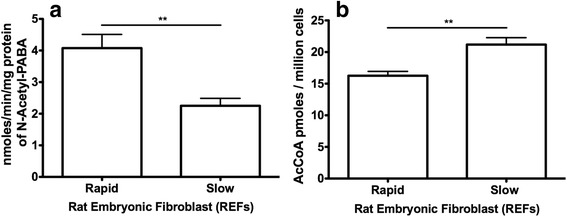
Results: Tumor latency was shorter in rapid NAT2 rats compared to slow NAT2 rats, with statistical significance for MNU administered at 3 and 8 weeks of age (p = 0.009 and 0.050, respectively). Tumor multiplicity and incidence were higher in rapid NAT2 rats compared to slow NAT2 rats administered MNU or DMBA at 8 weeks of age (MNU, p = 0.050 and 0.035; DMBA, p = 0.004 and 0.027, respectively). Recombinant rat rapid-NAT2, as well as tissue samples and embryonic fibroblasts derived from rapid NAT2 rats, catalyzed p-aminobenzoic acid N-acetyl transfer and folate-dependent acetyl-coenzyme A (AcCoA) hydrolysis at higher rates than those derived from rat slow-NAT2. Embryonic fibroblasts isolated from rapid NAT2 rats displayed lower levels of cellular AcCoA than slow NAT2 rats (p < 0.01).

Conclusions: A novel role for rat NAT2 in mammary cancer was discovered unrelated to carcinogen metabolism, suggesting a role for human NAT1 in breast cancer.

Keywords: 7,12-dimethylbenzanthracene (DMBA); Acetyl-coenzyme A (AcCoA); Chemically-induced tumorigenesis; Human arylamine N-acetyltransferase 1 (NAT1); Methylnitrosourea (MNU); Rat arylamine N-acetyltransferase 2 (NAT2).


Figures
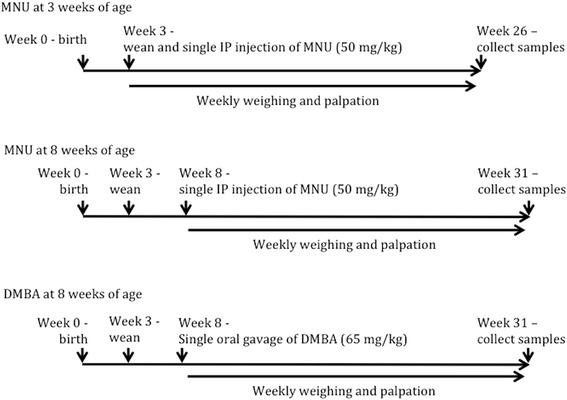
Fig. 1
Fig. 1
Experimental design for chemical-induced tumor experiments. Top shows the dosing of MNU at 3 weeks of age. The middle displays the dosing of MNU at 8 weeks of age. The bottom depicts the dosing of DMBA at 8 weeks of age
Fig. 2
Fig. 2
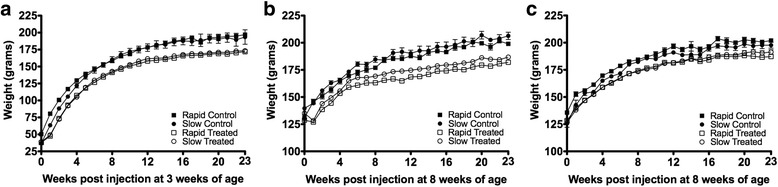
Weekly body mass (mean grams ± SEM) of rapid and slow acetylator Nat2 congenic rats post administration of specified carcinogen or vehicle control. In all three panels squares represent rapid acetylator and circles represent slow acetylator congenic rats. Filled-shapes represent vehicle-treated and unfilled-shapes represent. MNU or DMBA-treated. a Weights for rats treated with MNU at 3 weeks of age. The difference between weights of the vehicle-treated and MNU-treated is statistically significant by two-way ANOVA with Bonferroni post hoc test (p < 0.05). b Weights for rats treated with MNU at 8 weeks of age. The weights of the vehicle-treated and MNU treated rats were statistically significant by two-way ANOVA with Bonferroni post hoc test (p < 0.05). c Weights for rats administrated DMBA at 8 weeks of age. The weights of the vehicle-treated and DMBA-treated rats were not statistically significant by two-way ANOVA with Bonferroni post hoc test (p > 0.05). In all panels, weights of MNU/DMBA-treated rats were not significantly different between rapid and slow NAT2 acetylator rat strains
Fig. 3
Fig. 3
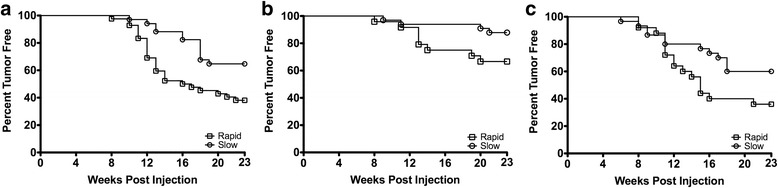
Kaplan-Meier plot of palpable mammary tumors in congenic rats. Onset of tumors in rats exposed to a MNU at 3 weeks of age, b MNU at 8 weeks of age, and c DMBA at 8 weeks of age. Squares illustrate rapid and circles illustrate slow acetylator Nat2 congenic rats. Rapid acetylator congenic rats had a significantly (p<0.05) shorter latency for development of first palpable mammary tumor compared to slow acetylator congenic rats after MNU administration at either 3 or 8 weeks of age. Similar findings were obtained after DMBA administration at 8 weeks of age although the difference was not significant (p=0.065)
Fig. 4
Fig. 4
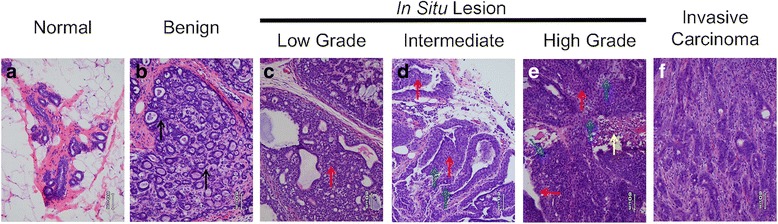
Photomicrographs of H&E stained slides depicting the criteria utilized to classify tumors. a Normal mammary tissue. b Benign tumor showing proliferative disease with no cytologic atypia and minimal to no overgrowth of the epithelial or myoepithelial component (black arrows). ce CIS lesions with overgrowth of the epithelial and/or myoepithelial component (red arrows). c Low grade CIS lesion with low grade cytologic atypia and occasional mitoses or single cell apoptosis. d Intermediate grade CIS lesion with intermediate to high grade cytologic atypia with increased mitoses (blue arrows) or single cell apoptosis. e High grade CIS lesion with intermediate to high grade cytologic atypia with tumor necrosis (yellow dashed arrow) and increased mitoses (blue arrows). f Invasive carcinoma with glands or single cells infiltrating through stroma
Fig. 5
Fig. 5
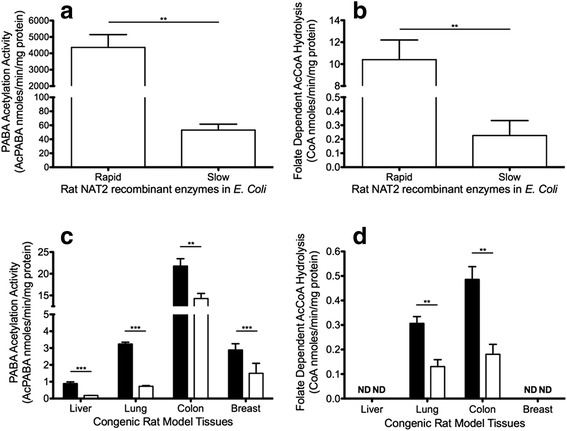
Rat NAT2 PABA acetylation and folate-dependent AcCoA hydrolysis activity. a, c PABA acetylation activity. b, d Folate-dependent AcCoA hydrolytic activity. a, b Triplicates from the same recombinant lysates. c, d Lysates of individual tissues collected from 5 rapid (closed bars) or 5 slow (open bars) acetylator NAT2 F344 congenic rats. “ND” = not detectable. Differences between rapid and slow acetylator rats differed significantly ***p < 0.001; **p < 0.01
Fig. 6
Fig. 6
NAT2 activity and AcCoA level measured in rat embryonic fibroblasts (REFs) from rapid and slow rats. a Rapid NAT2 REFs (N = 7) have a higher level of PABA acetylation activity than slow NAT2 REFs (N = 9). b The amount of AcCoA per million cells is lower in rapid NAT2 REFs (N = 8) than in slow NAT2 REFs (N = 10). **Differs significantly between rapid and slow acetylators (p < 0.01)

References

    1. Hein DW, Doll MA, Fretland AJ, Leff MA, Webb SJ, Xiao GH, Devanoboyina US, Nangju NA, Feng Y. Molecular genetics and epidemiology of the NAT1 and NAT2 acetylation polymorphisms. Cancer Epidemiol Biomark Prev. 2000;9(1):29–42. - PubMed
    1. Boukouvala S, Sim E. Structural analysis of the genes for human arylamine N-acetyltransferases and characterisation of alternative transcripts. Basic Clin Pharmacol Toxicol. 2005;96(5):343–351. doi: 10.1111/j.1742-7843.2005.pto_02.x. - DOI - PubMed
    1. Pacifici GM, Bencini C, Rane A. Acetyltransferase in humans - development and tissue distribution. Pharmacology. 1986;32(5):283–291. doi: 10.1159/000138181. - DOI - PubMed
    1. Millner LM, Doll MA, Cai J, States JC, Hein DW. Phenotype of the most common “slow acetylator” arylamine N-acetyltransferase 1 genetic variant (NAT1*14B) is substrate-dependent. Drug Metab Dispos. 2011;40(1):198–204. doi: 10.1124/dmd.111.041855. - DOI - PMC - PubMed
    1. Adam PJ, Berry J, Loader JA, Tyson KL, Craggs G, Smith P, De Belin J, Steers G, Pezzella F, Sachsenmeir KF, et al. Arylamine N-Acetyltransferase-1 is highly expressed in breast cancers and conveys enhanced growth and resistance to etoposide in vitro. Mol Cancer Res. 2003;1(11):826–835. - PubMed

Publication types

MeSH terms

LinkOut - more resources