Relative effectiveness of insulin pump treatment over multiple daily injections and structured education during flexible intensive insulin treatment for type 1 diabetes: cluster randomised trial (REPOSE)
- PMID: 28360027
- PMCID: PMC6276869
- DOI: 10.1136/bmj.j1285
Relative effectiveness of insulin pump treatment over multiple daily injections and structured education during flexible intensive insulin treatment for type 1 diabetes: cluster randomised trial (REPOSE)
Abstract
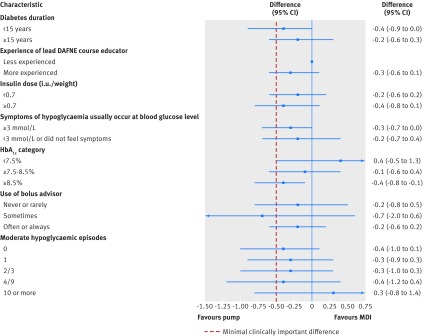
Objective To compare the effectiveness of insulin pumps with multiple daily injections for adults with type 1 diabetes, with both groups receiving equivalent training in flexible insulin treatment.Design Pragmatic, multicentre, open label, parallel group, cluster randomised controlled trial (Relative Effectiveness of Pumps Over MDI and Structured Education (REPOSE) trial).Setting Eight secondary care centres in England and Scotland.Participants Adults with type 1 diabetes who were willing to undertake intensive insulin treatment, with no preference for pumps or multiple daily injections. Participants were allocated a place on established group training courses that taught flexible intensive insulin treatment ("dose adjustment for normal eating," DAFNE). The course groups (the clusters) were then randomly allocated in pairs to either pump or multiple daily injections.Interventions Participants attended training in flexible insulin treatment (using insulin analogues) structured around the use of pump or injections, followed for two years.Main outcome measures The primary outcomes were a change in glycated haemoglobin (HbA1c) values (%) at two years in participants with baseline HbA1c value of ≥7.5% (58 mmol/mol), and the proportion of participants achieving an HbA1c value of <7.5%. Secondary outcomes included body weight, insulin dose, and episodes of moderate and severe hypoglycaemia. Ancillary outcomes included quality of life and treatment satisfaction.Results 317 participants (46 courses) were randomised (156 pump and 161 injections). 267 attended courses and 260 were included in the intention to treat analysis, of which 235 (119 pump and 116 injection) had baseline HbA1c values of ≥7.5%. Glycaemic control and rates of severe hypoglycaemia improved in both groups. The mean change in HbA1c at two years was -0.85% with pump treatment and -0.42% with multiple daily injections. Adjusting for course, centre, age, sex, and accounting for missing values, the difference was -0.24% (-2.7 mmol/mol) in favour of pump users (95% confidence interval -0.53 to 0.05, P=0.10). Most psychosocial measures showed no difference, but pump users showed greater improvement in treatment satisfaction and some quality of life domains (dietary freedom and daily hassle) at 12 and 24 months.Conclusions Both groups showed clinically relevant and long lasting decreases in HbA1c, rates of severe hypoglycaemia, and improved psychological measures, although few participants achieved glucose levels currently recommended by national and international guidelines. Adding pump treatment to structured training in flexible intensive insulin treatment did not substantially enhance educational benefits on glycaemic control, hypoglycaemia, or psychosocial outcomes in adults with type 1 diabetes. These results do not support a policy of providing insulin pumps to adults with poor glycaemic control until the effects of training on participants' level of engagement in intensive self management have been determined.Trial registration Current Controlled Trials ISRCTN61215213.
Published by the BMJ Publishing Group Limited. For permission to use (where not already granted under a licence) please go to http://group.bmj.com/group/rights-licensing/permissions.
Conflict of interest statement
Competing interests: All members of the writing committee have completed the ICMJE uniform disclosure form at
Figures


Comment in
-
REPOSE: repositioning insulin pump therapy in Type 1 diabetes.Diabet Med. 2017 Dec;34(12):1656-1657. doi: 10.1111/dme.13449. Diabet Med. 2017. PMID: 28799221 No abstract available.
-
In type 1 diabetes, education with either insulin pumps or daily injections did not differ for HbA1c at 2 y.Ann Intern Med. 2017 Aug 15;167(4):JC15. doi: 10.7326/ACPJC-2017-167-4-015. Ann Intern Med. 2017. PMID: 28806796 No abstract available.
References
-
- The Diabetes Control and Complications Trial Research Group. The effect of intensive treatment of diabetes on the development and progression of long-term complications in insulin-dependent diabetes mellitus. N Engl J Med 1993;329:977-86. 10.1056/NEJM199309303291401 pmid:8366922. - DOI - PubMed
-
- DAFNE Study Group. Training in flexible, intensive insulin management to enable dietary freedom in people with type 1 diabetes: dose adjustment for normal eating (DAFNE) randomised controlled trial. BMJ 2002;325:746-9. 10.1136/bmj.325.7367.746 pmid:12364302. - DOI - PMC - PubMed
-
- Mühlhauser I, Bruckner I, Berger M, et al. Evaluation of an intensified insulin treatment and teaching programme as routine management of type 1 (insulin-dependent) diabetes. The Bucharest-Düsseldorf Study. Diabetologia 1987;30:681-90. 10.1007/BF00296989 pmid:3123298. - DOI - PubMed
-
- Nathan DM, Cleary PA, Backlund JY, et al. Diabetes Control and Complications Trial/Epidemiology of Diabetes Interventions and Complications (DCCT/EDIC) Study Research Group. Intensive diabetes treatment and cardiovascular disease in patients with type 1 diabetes. N Engl J Med 2005;353:2643-53. 10.1056/NEJMoa052187 pmid:16371630. - DOI - PMC - PubMed
-
- Tamborlane WV, Bonfig W, Boland E. Recent advances in treatment of youth with Type 1 diabetes: better care through technology. Diabet Med 2001;18:864-70. 10.1046/j.1464-5491.2001.00626.x pmid:11703429. - DOI - PubMed
Grants and funding
LinkOut - more resources
Full Text Sources
Other Literature Sources
Medical