. 2017 May;48(5):1369-1375.
doi: 10.1161/STROKEAHA.117.016850. Epub 2017 Mar 30.

CD163 Expression in Neurons After Experimental Intracerebral Hemorrhage

Affiliations

CD163 Expression in Neurons After Experimental Intracerebral Hemorrhage

Ran Liu et al. Stroke. 2017 May.

Abstract

Background and purpose: CD163, a receptor for hemoglobin, is involved in hemoglobin clearance after intracerebral hemorrhage (ICH). In contrast to microglial/macrophage CD163, neuronal CD163 hemoglobin has not been well studied. This study examined the expression of neuronal CD163 in a pig model of ICH and in vitro rat cortical neurons and the impact of deferoxamine on that expression.

Methods: There were 2 parts to this study. In the in vivo part, piglets had injection of autologous blood into the right frontal lobe. The time course of CD163 expression and the effect of deferoxamine on the expression of CD163 after ICH were determined in the grey matter. In the in vitro part, the levels of CD163 and neuronal death and the effect of deferoxamine were examined in rat cortical neurons culture treated with hemoglobin.

Results: CD163-positive cells were found, and the CD163 protein levels were upregulated in the ipsilateral grey matter after ICH. The CD163 levels peaked at days 1 and 3. The CD163-positive cells were colocated with NeuN-positive, heme oxygenase-2-positive, and terminal deoxynucleatidyl transferase dUTP nick end labeling-positive cells. Deferoxamine treatment attenuated ICH-induced CD163 upregulation and significantly reduced both brain CD163 and hemoglobin levels at day 3. Treating neuronal cultures with hemoglobin for 24 hours resulted in CD163 upregulation and increased cell death. Deferoxamine significantly attenuated the hemoglobin-induced neuronal death and CD163 upregulation.

Conclusions: CD163 is expressed in neurons and upregulated after ICH. Deferoxamine reduced ICH-induced CD163 upregulation and brain cell death in vivo and hemoglobin-induced CD163 upregulation and neuronal death in vitro.

Keywords: cell death; cerebral hemorrhage; deferoxamine; macrophages; swine.


Conflict of interest statement

Conflict of Interests: the authors declared no conflict of interests.

Figures

Figure 1
Figure 1
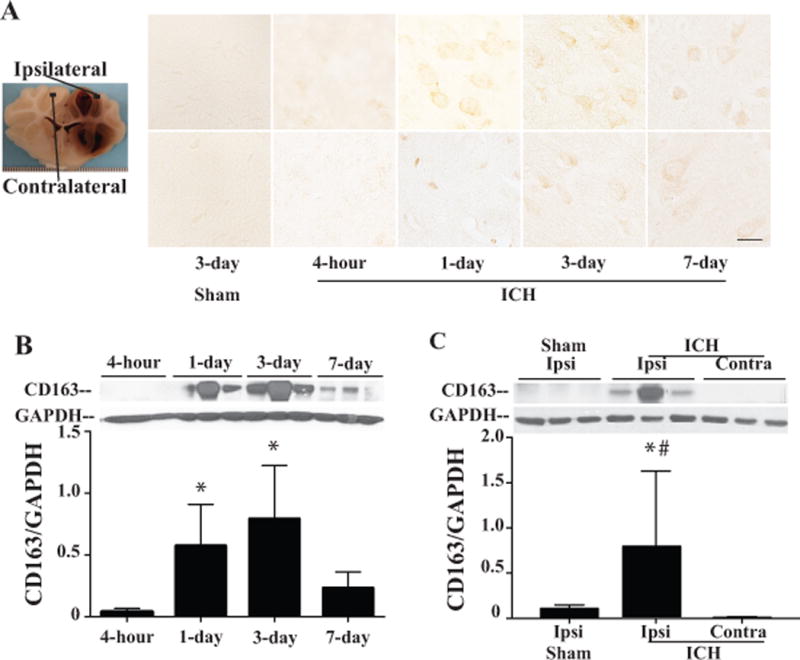
Time course of CD163 immunoreactivity (A) and protein levels (B) in the ipsilateral and contralateral grey matter after 2.5ml of autologous blood injected into the right frontal lobe. Scale bar=50μm. Values are mean ±SD, * p<0.05 vs. 4 hours. (C) Protein levels of CD163 in the ipsi- and contralateral grey matter after ICH, and in ipsilateral grey matter after sham operation at day 3. Values are mean ±SD, *p<0.05, vs. the ipsilateral side of sham, # p<0.01 vs. the contralateral side of ICH.
Figure 2
Figure 2
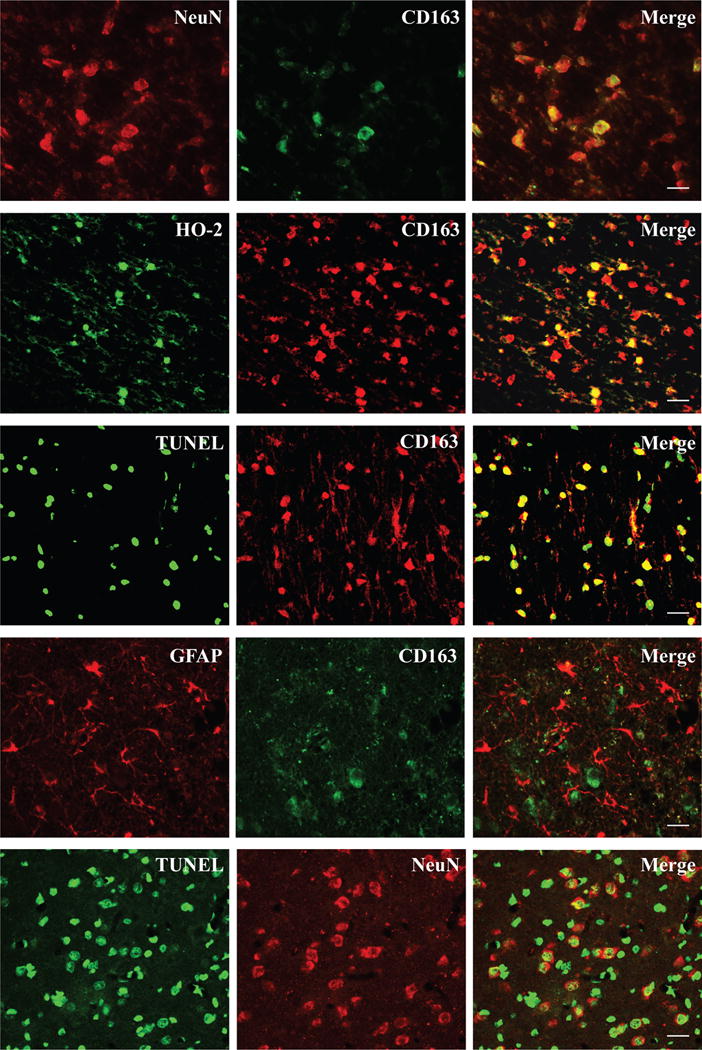
Double labeling of CD163 immunoreactivity with NeuN, HO-2, TUNEL, and GFAP positive cells in the perihematoma area at 24 hours after blood injection. Double labeling was also performed for TUNEL and NeuN. Scale bar= 50μm.
Figure 3
Figure 3
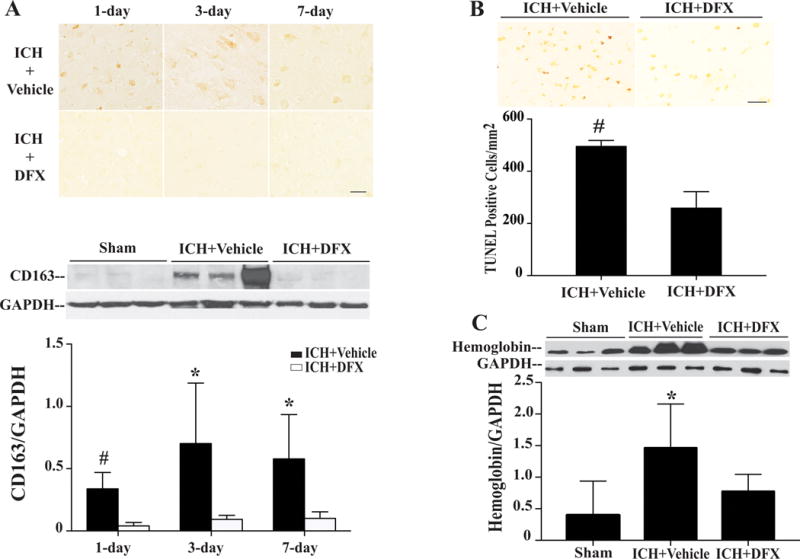
CD163 immunoreactivity and protein levels in the ipsilateral grey matter of piglets treated with deferoxamine or vehicle after ICH (A); numbers of TUNEL positive cells in the perihematoma cortex of piglets treated with deferoxamine or vehicle at day 1 after ICH (B); levels of hemoglobin in the ipsilateral grey matter of piglets at day 3 after ICH or sham operation treated with deferoxamine or vehicle (C). Scale bar= 50μm, values are mean ±SD, #p<0.01, *p<0.05 vs. the DFX-treated group.
Figure 4
Figure 4
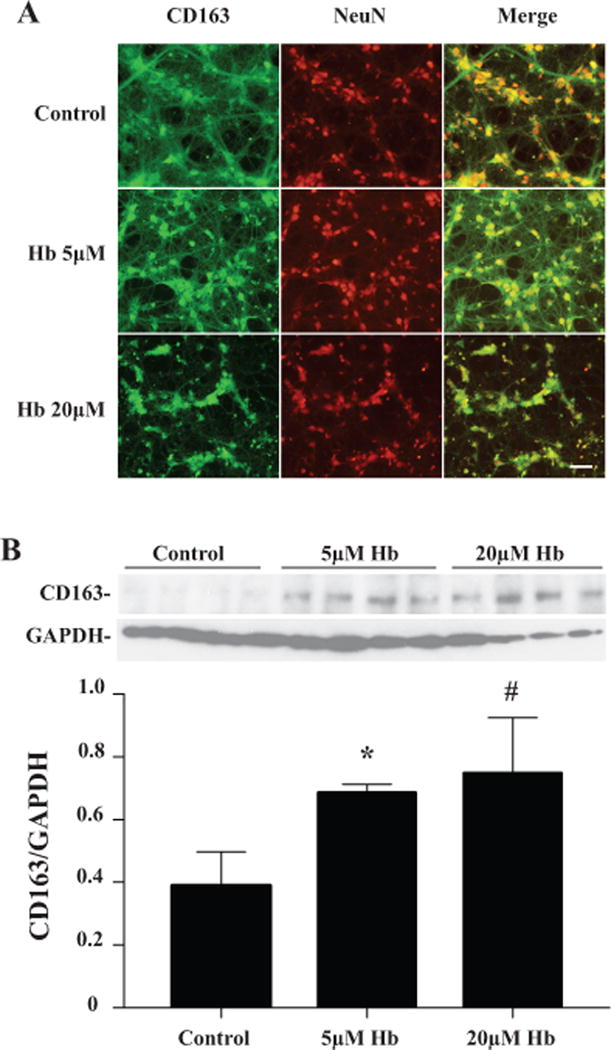
(A) Double labeling of CD163 and NeuN in primary cultured neuron treated with 0 (control), 5 or 20μM hemoglobin for 24 hours. Scale bar = 50μm. (B) Quantification of CD163 protein levels after hemoglobin exposure by Western blot. Values are mean ±SD, n=4, *p<0.05, #p<0.01 vs. the control.
Figure 5
Figure 5
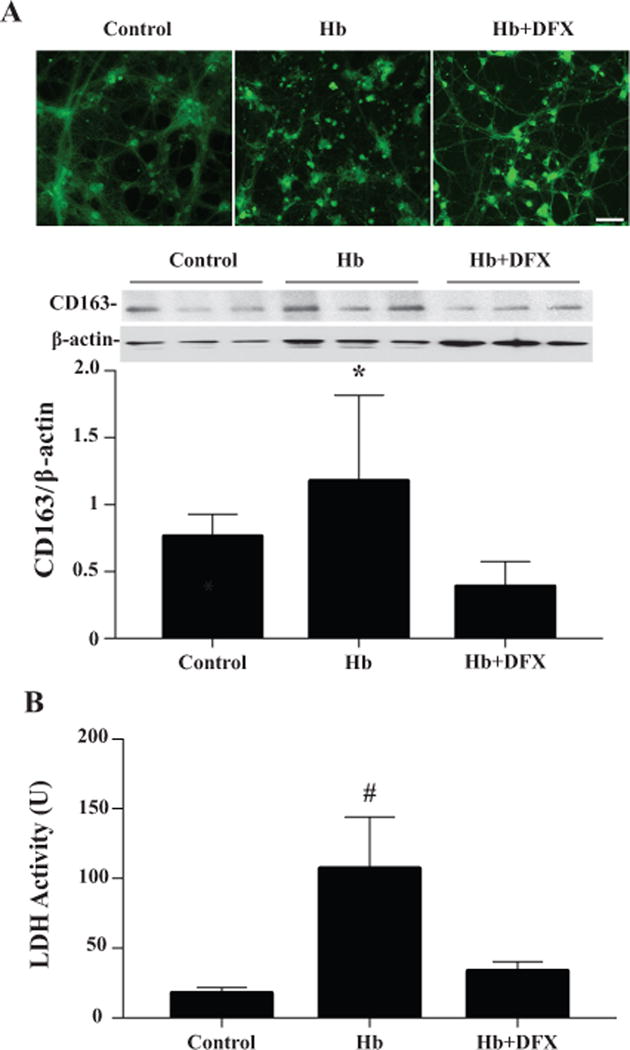
(A) CD163 immunoreactivity and protein levels in primary cultured neurons treated with hemoglobin (0 or 20μM) with or without deferoxamine (5μM) pretreatment. Scale bar= 50μm. (B) Media LDH levels 24 hours after the treatment of hemoglobin (0 or 20μM) with or without deferoxamine (5μM). Values are mean ± SD, *p<0.05, # p<0.01 vs. the other groups.
Figure 6
Figure 6
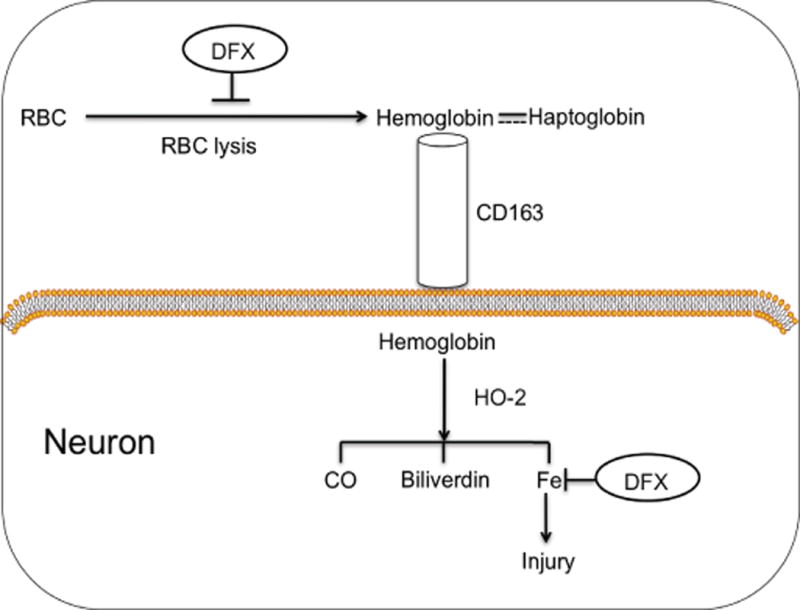
Model of the role of neuronal CD163 in relation to ICH and the effects of deferoxamine (DFX). Lysis or red blood cells (RBCs) in the clot leads to hemoglobin release into the extracellular space, which may be taken up into neurons via CD163 either alone or as part of a haptoglobin complex. Intracellularly, hemoglobin is degraded by heme oxygenase-2 (HO-2), producing iron, carbon monoxide and biliverdin. Deferoxamine may exert the neuroprotective effect by attenuating red blood cell lysis and iron chelation.

References

    1. Xi G, Keep RF, Hoff JT. Erythrocytes and delayed brain edema formation following intracerebral hemorrhage in rats. J Neurosurg. 1998;89:991–996. - PubMed
    1. Thomsen JH, Etzerodt A, Svendsen P, Moestrup SK. The haptoglobin-cd163-heme oxygenase-1 pathway for hemoglobin scavenging. Oxid Med Cell Longev. 2013:523652. - PMC - PubMed
    1. Zhao X, Song S, Sun G, Strong R, Zhang J, Grotta JC, et al. Neuroprotective role of haptoglobin after intracerebral hemorrhage. The Journal of Neuroscience. 2009;29:15819–15827. - PMC - PubMed
    1. Madsen M, Graversen JH, Moestrup SK. Haptoglobin and cd163: Captor and receptor gating hemoglobin to macrophage lysosomes. Redox Rep. 2001;6:386–388. - PubMed
    1. Chen-Roetling J, Lu X, Regan RF. Targeting heme oxygenase after intracerebral hemorrhage. Ther Targets Neurol Dis. 2015;2:e474. - PMC - PubMed

Publication types