


Forty years on: clathrin-coated pits continue to fascinate
- PMID: 28360213
- PMCID: PMC5385932
- DOI: 10.1091/mbc.E16-04-0213
Forty years on: clathrin-coated pits continue to fascinate
Abstract
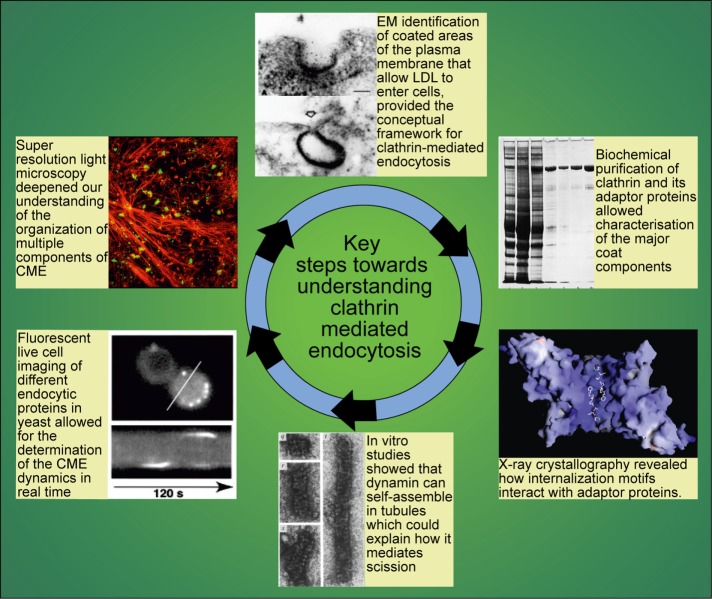
Clathrin-mediated endocytosis (CME) is a fundamental process in cell biology and has been extensively investigated over the past several decades. Every cell biologist learns about it at some point during his or her education, and the beauty of this process has led many of us to go deeper and make it the topic of our research. Great progress has been made toward elucidating the mechanisms of CME, and the field is becoming increasingly complex, with several hundred new publications every year. This makes it easy to get lost in the vast amount of literature and forget about the fundamentals of the field, which are based on the careful interpretation of simple observations made >40 years ago, as exemplified by a study performed by Anderson, Brown, and Goldstein in 1977. We examine how this seminal study was pivotal to our understanding of CME and its progression into ever-increasing complexity over the past four decades.
© 2017 Maib et al. This article is distributed by The American Society for Cell Biology under license from the author(s). Two months after publication it is available to the public under an Attribution–Noncommercial–Share Alike 3.0 Unported Creative Commons License (http://creativecommons.org/licenses/by-nc-sa/3.0).
Figures
References
-
- Anderson RGW, Brown MS, Goldstein JL. Role of the coated endocytic vesicle in the uptake of receptor-bound low density lipoprotein in human fibroblasts. Cell. 1977a;10:351–364. - PubMed
-
- Anderson RGW, Goldstein JL, Brown MS. Mutation that impairs ability of lipoprotein receptors to localize in coated pits on cell-surface of human fibroblasts. Nature. 1977b;270:695–699. - PubMed
Publication types
MeSH terms
Substances
Grants and funding
LinkOut - more resources
Full Text Sources
Other Literature Sources
Miscellaneous
