


Greater dyspnea is associated with lower health-related quality of life among European patients with COPD
- PMID: 28360517
- PMCID: PMC5365328
- DOI: 10.2147/COPD.S123744
Greater dyspnea is associated with lower health-related quality of life among European patients with COPD
Abstract
Objective: Dyspnea is a defining symptom in the classification and treatment of chronic obstructive pulmonary disease (COPD). However, the degree of variation in burden among symptomatic COPD patients and the possible correlates of burden remain unclear. This study was conducted to characterize patients in Europe currently being treated for COPD according to the level of dyspnea in terms of sociodemographics, health-related quality of life, work productivity impairment, and health care resource use assessed by patient reports.
Methods: Data were derived from the 5-EU 2013 National Health and Wellness Survey (N=62,000). Respondents aged ≥40 years who reported currently using a prescription for COPD were grouped according to their level of dyspnea as per the Global Initiative for Chronic Obstructive Lung Disease guidelines and compared on health status (revised Short Form 36 [SF-36]v2), work impairment (Work Productivity and Activity Impairment questionnaire), and number of health care visits in the past 6 months using generalized linear models with appropriate distributions and link functions.
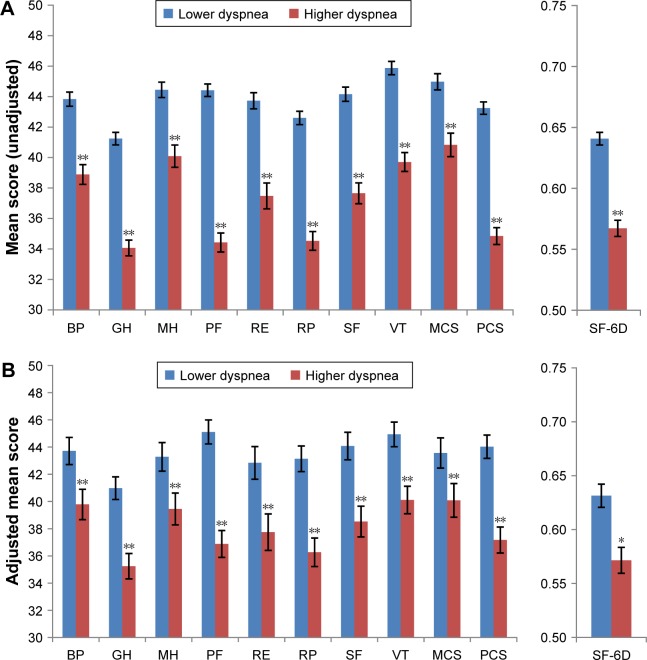
Results: Of the 768 respondents who met the inclusion criteria, 245 (32%) were considered to have higher dyspnea (equivalent to modified Medical Research Council score ≥2). Higher dyspnea was associated with decrements ranging from 3.9 to 8.2 points in all eight domains of the SF-36 health profile after adjustment for sociodemographics, general health characteristics, and length of COPD diagnosis; mental component summary scores and Short Form-6D health utility scores were lower by 3.5 and 0.06 points, respectively. Adjusted mean activity impairment (55% vs 37%, P<0.001) and number of emergency room visits (0.61 vs 0.40, P=0.030) were higher in patients with greater dyspnea.
Conclusion: Many European patients with COPD continue to experience dyspnea despite treatment and at levels associated with notable impairments in the patients' ability to function across a multitude of domains. These patients may benefit from more intense treatment of their symptoms.
Keywords: COPD; activity impairment; dyspnea; health-related quality of life; symptoms.
Conflict of interest statement
Disclosure Novartis paid fees to Kantar Health for access to survey data, analysis, and reporting. Jean-Bernard Gruenberger and Dorothy Keininger are employees of Novartis. Jeffrey Vietri is an employee of Kantar Health. Donald A Mahler has received consulting fees for advisory boards from Boehringer Ingelheim, GlaxoSmithKline (GSK), Novartis, Sunovion, and Theravance and is on Speaker’s Bureaus of Boehringer Ingelheim, GSK, and Sunovion. The authors report no other conflicts of interest in this work.
Figures
Similar articles
-
A cross-sectional assessment of the burden of COPD symptoms in the US and Europe using the National Health and Wellness Survey.Int J Chron Obstruct Pulmon Dis. 2017 Feb 7;12:529-539. doi: 10.2147/COPD.S114085. eCollection 2017. Int J Chron Obstruct Pulmon Dis. 2017. PMID: 28223793 Free PMC article.
-
Asthma-chronic obstructive pulmonary disease overlap syndrome in the urban Chinese population: prevalence and disease burden using the 2010, 2012, and 2013 China National Health and Wellness Surveys.Int J Chron Obstruct Pulmon Dis. 2016 Jun 9;11:1139-50. doi: 10.2147/COPD.S103873. eCollection 2016. Int J Chron Obstruct Pulmon Dis. 2016. PMID: 27354777 Free PMC article.
-
COPD symptom burden: impact on health care resource utilization, and work and activity impairment.Int J Chron Obstruct Pulmon Dis. 2017 Feb 21;12:677-689. doi: 10.2147/COPD.S123896. eCollection 2017. Int J Chron Obstruct Pulmon Dis. 2017. PMID: 28260874 Free PMC article.
-
COPD management: role of symptom assessment in routine clinical practice.Int J Chron Obstruct Pulmon Dis. 2013;8:461-71. doi: 10.2147/COPD.S49392. Epub 2013 Oct 14. Int J Chron Obstruct Pulmon Dis. 2013. PMID: 24143085 Free PMC article. Review.
-
Development of a Standard Set of Outcome Domains and Proposed Measures for Chronic Obstructive Pulmonary Disease in Primary Care Physical Therapy Practice in the Netherlands: a Modified RAND/UCLA Appropriateness Method.Int J Chron Obstruct Pulmon Dis. 2019 Nov 28;14:2649-2661. doi: 10.2147/COPD.S219851. eCollection 2019. Int J Chron Obstruct Pulmon Dis. 2019. PMID: 31819398 Free PMC article. Review.
Cited by
-
Population norms in France with EQ-5D-5L: health states, value indexes, and VAS.Eur J Health Econ. 2023 Dec;24(9):1517-1530. doi: 10.1007/s10198-022-01559-2. Epub 2023 Jan 10. Eur J Health Econ. 2023. PMID: 36625971
-
To live a life with COPD - the consequences of symptom burden.Int J Chron Obstruct Pulmon Dis. 2019 Apr 29;14:905-909. doi: 10.2147/COPD.S192280. eCollection 2019. Int J Chron Obstruct Pulmon Dis. 2019. PMID: 31114186 Free PMC article.
-
Effect of COPD on Health-Related Quality of Life; Results from the BOLD Study in Iran.Tanaffos. 2021 Jan;20(1):51-58. Tanaffos. 2021. PMID: 34394370 Free PMC article.
-
Phosphodiesterase Inhibition as a Therapeutic Strategy for Chronic Obstructive Pulmonary Disease: Where We Have Been and What Lies Ahead.Chronic Obstr Pulm Dis. 2025 Jan 29;12(1):82-92. doi: 10.15326/jcopdf.2024.0559. Chronic Obstr Pulm Dis. 2025. PMID: 39688360 Free PMC article.
-
Characteristics associated with SF-36 in alpha-1 antitrypsin deficiency-associated COPD: a cross-sectional analysis.BMC Pulm Med. 2024 Mar 18;24(1):138. doi: 10.1186/s12890-024-02953-7. BMC Pulm Med. 2024. PMID: 38500152 Free PMC article.
References
-
- Joshi M, Joshi A, Bartter T. Symptom burden in chronic obstructive pulmonary disease and cancer. Curr Opin Pulm Med. 2012;18(2):97–103. - PubMed
-
- Ferrer M, Alonso J, Morera J, et al. Chronic obstructive pulmonary disease stage and health-related quality of life. Ann Intern Med. 1997;127(12):1072–1079. - PubMed
-
- Stahl E, Wadbo M, Bengtsson T, Strom K, Lofdahl C-G. Health-related quality of life, symptoms, exercise capacity and lung function during treatment for moderate to severe COPD. J DRUG Assess. 2002;5(1):81–94.
-
- Miravitlles M, Alvarez-Sala JL, Lamarca R, et al. IMPAC Study Group Treatment and quality of life in patients with chronic obstructive pulmonary disease. Qual Life Res. 2002;11(4):329–338. - PubMed
MeSH terms
LinkOut - more resources
Full Text Sources
Other Literature Sources
Medical
Miscellaneous
