


Correlation of Fatigue with Depression, Disability Level and Quality of Life in Patients with Multiple Sclerosis
- PMID: 28360718
- PMCID: PMC5353056
- DOI: 10.5152/npa.2015.8714
Correlation of Fatigue with Depression, Disability Level and Quality of Life in Patients with Multiple Sclerosis
Abstract
Introduction: Fatigue is a subjective and non-specific symptom; therefore, evaluation of fatigue is quite difficult. Fatigue has been reported in 75%-87% of patients with multiple sclerosis (MS) and two-thirds of these patients indicated fatigue as one of the worst three common symptoms that they experienced. This study was conducted to measure the intensity, frequency and the characteristics of fatigue in patients with MS. Moreover, the effect of fatigue on the quality of life and its association with depression and disability were evaluated.
Methods: One hundred and twenty patients with multiple sclerosis (84 women and 36 men) were included in our study. The patients' sociodemographic characteristics and their experiences on symptoms of fatigue were questioned. Presence and degree of fatigue were assessed using the fatigue severity scale (FSS). Disability status was detected with expanded disability status scale (EDSS). The Multiple Sclerosis Quality of Life (MSQoL-54) survey was conducted to evaluate the quality of life of patients and Beck Depression Inventory (BDI) was used to determine the current depression status. Patients were grouped into fatigue and non-fatigue groups based on FSS. Both groups were compared according to their age, sex, MS clinical types, course of the disease and scores of EDSS, BDI and MSQoL-54.
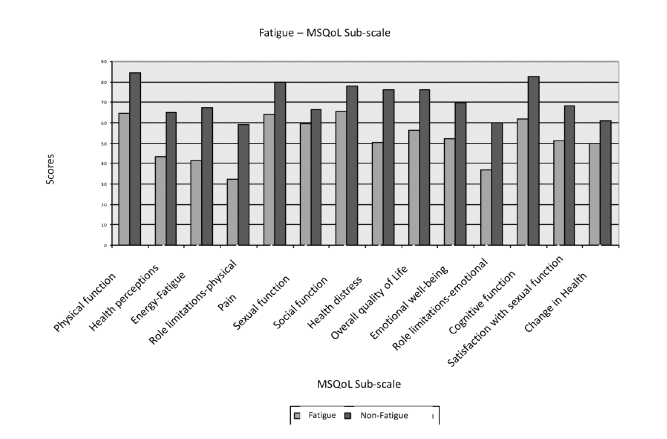
Results: Seventy percent of patients reported fatigue and 38% of these patients defined fatigue as their most disabling symptom. There was no correlation of fatigue with age, sex and disease duration. The correlation of fatigue and educational level was negative and weak (p<.05, r=-.214) and the correlation between fatigue and MS clinical types were significant but weak (p<.01, r=.228). Patients with fatigue had higher EDSS and BDI scores. In addition, FSS scores were found to be statistically meaningful and positively correlated with both EDSS and BDI scores (r=.404, r=.476, p<.01). Furthermore, our findings revealed that the quality of life in patients with MS and fatigue was poor (r=-.58 p<.01). Similarly, a negative connection was found between MSQoL-54 sub-scales and fatigue.
Conclusion: This study proved that fatigue has a positive correlation with depression and disability and a negative significant relation with the quality of life of patients with MS.
Keywords: Multiple sclerosis; depression; fatigue; quality of life.
Conflict of interest statement
Conflict of Interest: No conflict of interest was declared by the authors.
Figures
References
-
- Multiple Sclerosis Council for Clinical Practice Guidelines. Fatigue and Multiple Sclerosis Evidence-Based Management Strategies for Fatigue in Multiple Sclerosis. Washington: Paralyzed Veterans of America; 1998.
-
- Krupp LB, Alvarez LA, LaRocca NG, Scheinberg LC. Fatigue in multiple sclerosis. Arch Neurol. 1988;45:435–437. http://dx.doi.org/10.1001/archneur.1988.00520280085020. - DOI - PubMed
-
- Freal JE, Kraft GH, Coryell JK. Symptomatic fatigue in multiple sclerosis. Arch Phys Med Rehabil. 1984;65:135–138. - PubMed
-
- Murray TJ. Amantadine therapy for fatigue in multiple sclerosis. Can J Neurol Sci. 1985;12:251–254. - PubMed
-
- Comi G, Leocani L, Rossi P, Colombo B. Physiopathology and treatment of fatigue in multiple sclerosis. J Neurol. 2001;248:174–179. http://dx.doi.org/10.1007/s004150170222. - DOI - PubMed
LinkOut - more resources
Full Text Sources
Other Literature Sources