


Interaction of Cocaine- and Amphetamine-regulated Transcript and Neuropeptide Y on Behavior in the Central Nervous System
- PMID: 28360786
- PMCID: PMC5353018
- DOI: 10.5152/npa.2015.9952
Interaction of Cocaine- and Amphetamine-regulated Transcript and Neuropeptide Y on Behavior in the Central Nervous System
Abstract
Introduction: In the central nervous system, cocaine- and amphetamine-regulated transcript (CART) 55-102 peptide is localized in areas, such as the ventral tegmental area, amygdala, hypothalamus, and hippocampus, where emotional activity is regulated. Studies on the effects of the intracerebroventricular (ICV) administration of CART peptide on behavior remain limited. The findings from these studies suggest that this neuropeptide has anxiogenic-like effects. In the central nervous system, neuropeptide Y (NPY) has similar localization as CART. Previous behavioral studies have demonstrated that the ICV administration of NPY has anxiolytic-like effects.
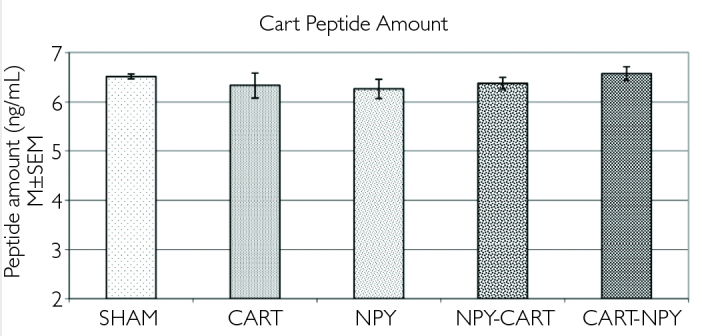
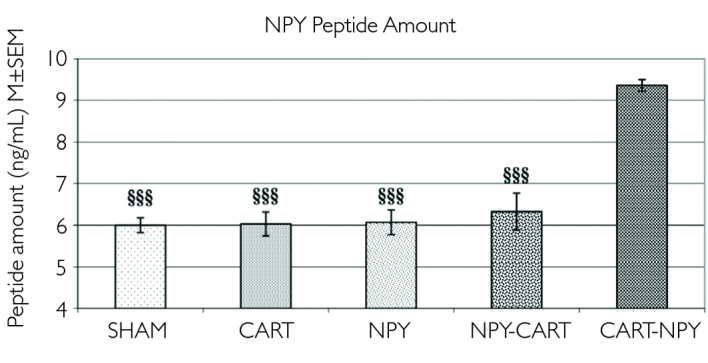
Methods: In our study, we established five experimental groups of male Wistar rats to study the competitive effects of NPY and CART peptide. These groups were sham (n=10), CART (n=10), NPY (n=10), CART-NPY (n=10), and NPY-CART (n=10). The open field test, elevated plus maze test, and Porsolt swim test were performed for behavioral analyses. Moreover, the rats were decapitated after the behavioral tests, and the amount of these two peptide in their brains was quantified.
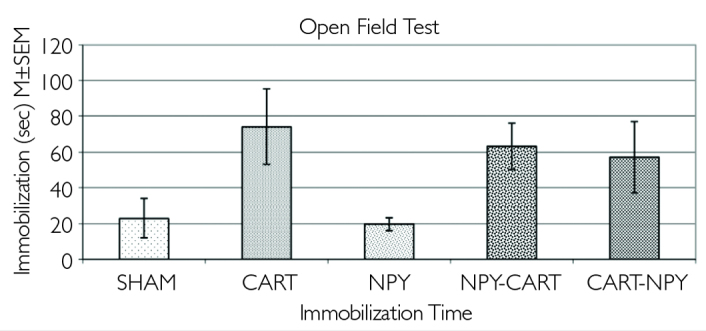
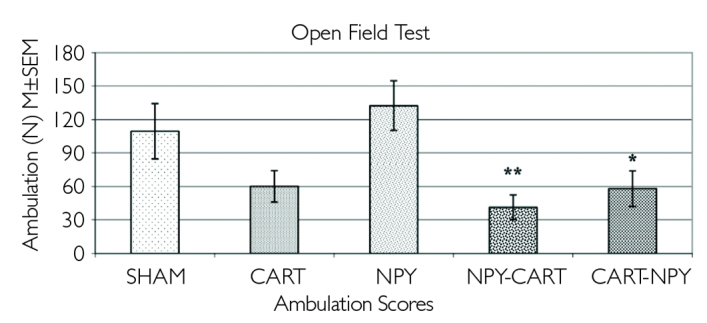
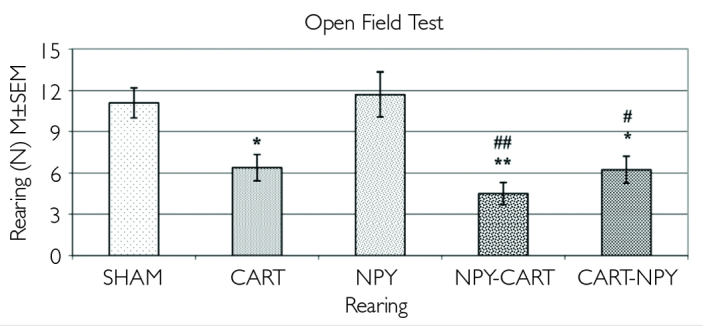
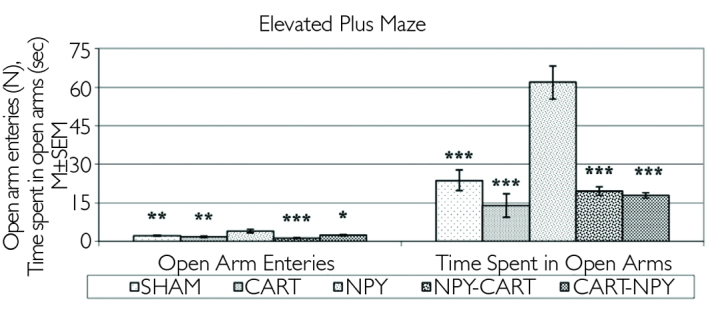
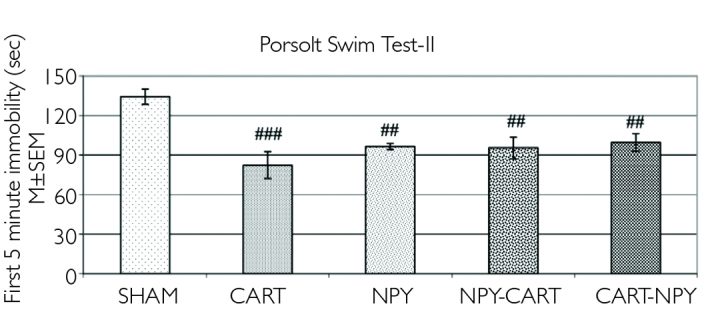
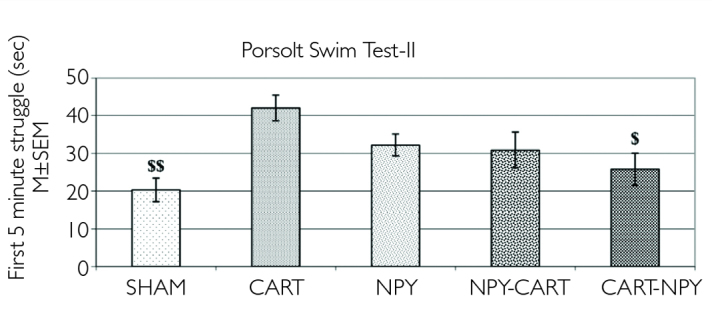
Results: Our study revealed that the ICV administration of CART peptide is anxiogenic and inhibits animals undergoing learned helplessness in the Porsolt swim test. When we evaluated the results of our study with respect to NPY, we observed its anxiolytic-like effects; in the Porsolt swim test, although it reduced the duration of immobilization, it did not affect the period of struggle.
Conclusion: Our results revealed that during the competitive interaction of these two peptides, anxiogenic CART peptide suppressed the anxiolytic effects of NPY.
Keywords: Cocaine- and amphetamine-regulated transcript; anxiety; behavior; neuropeptide Y; rat.
Conflict of interest statement
Conflict of Interest: No conflict of interest was declared by the authors.
Figures
References
-
- Lunberg JM, Tatemoto K. Pancreatic polypeptide family (APP, BPP, NPY and PYY) in relation to sympathetic vasoconstriction resistant to alpha-adrenoceptor blockade. Acta Physiol Scand. 1982;116:393–402. http://dx.doi.org/10.1111/j.1748-1716.1982.tb07157.x. - DOI - PubMed
-
- Clark JT, Sahu A, Kalra PS, Balasubramaniam A, Kalra AP. Neuropeptide Y (NPY)-induced feeding behavior in female rats: comparison with human NPY ((Met17]NPY), NPY analog ((norLeu4]NPY) and peptide YY,” Regulatory peptides. 1987;17:31–39. - PubMed
-
- Jolicoeur FB, Michaud JN, Rivest R, Menard D, Gaudin D, St-Pierre S. Neurobehavioral profile of neuropeptide Y. Brain Res Bull. 1991;26:265–268. http://dx.doi.org/10.1016/0361-9230(91)90237-E. - DOI - PubMed
-
- Westrin A, Engstöm G, Ekman R, Träskman-Bendz L. Correlations between plasma-neuropeptides and temperament dimensions differ between suicidal patients and healthy controls. J Affect Disord. 1998;49:45–54. http://dx.doi.org/10.1016/S0165-0327(97)00197-3. - DOI - PubMed
-
- Inui A, Okito M, Nakajima M, Momose K, Ueno N, Teranishi A, Miura M, Hirosue Y, Sano K, Sato M, Watanabe M, Sakai T, Watanabe T, Ishida K, Silver J, Baba S, Kasuga M. Anxiety-like behavior in transgenic mice with brain expression of neuropeptide Y. Proc Assoc Am Physicians. 1998;110:171–182. - PubMed
LinkOut - more resources
Full Text Sources
Other Literature Sources
Miscellaneous