


Economic evaluation of an exercise-counselling intervention to enhance smoking cessation outcomes: The Fit2Quit trial
- PMID: 28360828
- PMCID: PMC5371274
- DOI: 10.1186/s12971-017-0126-y
Economic evaluation of an exercise-counselling intervention to enhance smoking cessation outcomes: The Fit2Quit trial
Abstract
Background: In the Fit2Quit randomised controlled trial, insufficiently-active adult cigarette smokers who contacted Quitline for support to quit smoking were randomised to usual Quitline support or to also receive ≤10 face-to-face and telephone exercise-support sessions delivered by trained exercise facilitators over the 24-week trial. This paper aims to determine the cost-effectiveness of an exercise-counselling intervention added to Quitline compared to Quitline alone in the Fit2Quit trial.
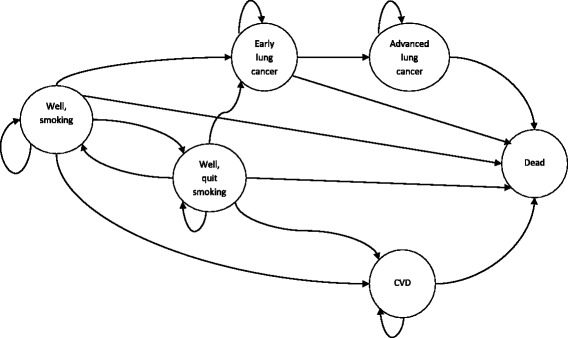
Methods: Within-trial and lifetime cost-effectiveness were assessed. A published Markov model was adapted, with smokers facing increased risks of lung cancer and cardiovascular disease.
Results: Over 24 weeks, the incremental programme cost per participant in the intervention was NZ$428 (US$289 or €226; purchasing power parity-adjusted [PPP]). The incremental cost-effectiveness ratio (ICER) for seven-day point prevalence measured at 24-week follow-up was NZ$31,733 (US$21,432 or €16,737 PPP-adjusted) per smoker abstaining. However, for the 52% who adhered to the intervention (≥7 contacts), the ICER for point prevalence was NZ$3,991 (US$2,695 or €2,105 PPP-adjusted). In this adherent subgroup, the Markov model estimated 0.057 and 0.068 discounted quality-adjusted life-year gains over the lifetime of 40-year-old males (ICER: NZ$4,431; US$2,993 or €2,337 PPP-adjusted) and females (ICER: NZ$2,909; US$1,965 or €1,534 PPP-adjusted).
Conclusions: The exercise-counselling intervention will only be cost-effective if adherence is a minimum of ≥7 intervention calls, which in turn leads to a sufficient number of quitters for health gains.
Trial registration: Australasian Clinical Trials Registry Number ACTRN12609000637246.
Keywords: Economic evaluation; Exercise; Randomised controlled trial; Smoking cessation.
References
-
- Ng M, Freeman MK, Fleming TD, Robinson M, Dwyer-Lindgren L, Thomson B, Wollum A, Sanman E, Wulf S, Lopez AD. Smoking prevalence and cigarette consumption in 187 countries, 1980–2012. JAMA. 2014;311(2):183–92. - PubMed
-
- Ussher MH, Taylor AH, Faulkner G. Exercise interventions for smoking cessation. Cochrane Database Syst Rev. 2014;8:CD002295. doi:10.1002/14651858.CD002295.pub5. - PubMed
-
- Maddison R, Roberts V, Bullen C, McRobbie H, Jiang Y, Prapavessis H, Glover M, Taylor S, Brown P. Design and conduct of a pragmatic randomized controlled trial to enhance smoking-cessation outcomes with exercise: the Fit2Quit study. Ment Health and Phys Act. 2010;3(2):92–101. doi: 10.1016/j.mhpa.2010.09.003. - DOI
LinkOut - more resources
Full Text Sources
Other Literature Sources
