


Endoluminal solutions to bariatric surgery complications: A review with a focus on technical aspects and results
- PMID: 28360973
- PMCID: PMC5355758
- DOI: 10.4253/wjge.v9.i3.105
Endoluminal solutions to bariatric surgery complications: A review with a focus on technical aspects and results
Abstract
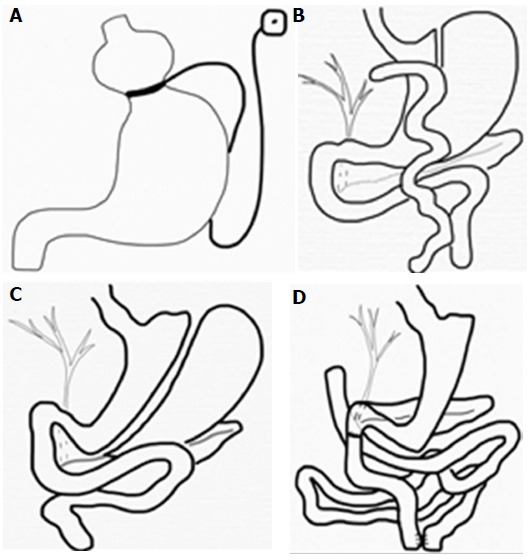
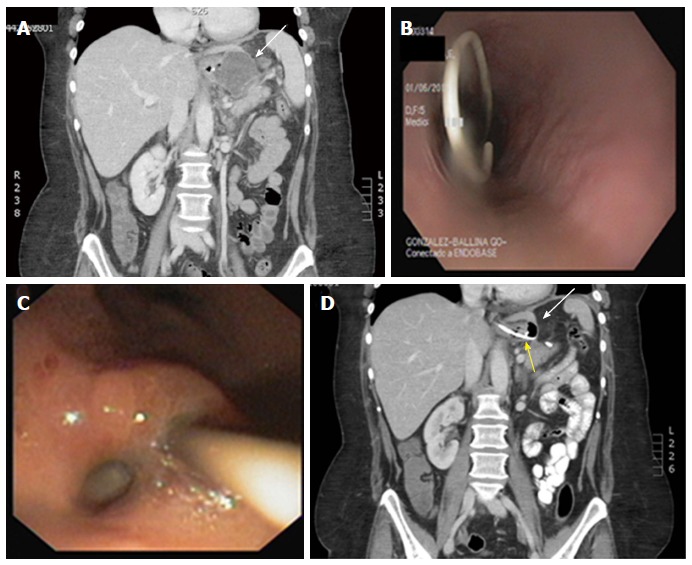
Obesity is a growing problem in developed countries, and surgery is the most effective treatment in terms of weight loss and improving medical comorbidity in a high proportion of obese patients. Despite the advances in surgical techniques, some patients still develop acute and late postoperative complications, and an endoscopic evaluation is often required for diagnosis. Moreover, the high morbidity related to surgical reintervention, the important enhancement of endoscopic procedures and technological innovations introduced in endoscopic equipment have made the endoscopic approach a minimally-invasive alternative to surgery, and, in many cases, a suitable first-line treatment of bariatric surgery complications. There is now evidence in the literature supporting endoscopic management for some of these complications, such as gastrointestinal bleeding, stomal and marginal ulcers, stomal stenosis, leaks and fistulas or pancreatobiliary disorders. However, endoscopic treatment in this setting is not standardized, and there is no consensus on its optimal timing. In this article, we aim to analyze the secondary complications of the most expanded techniques of bariatric surgery with special emphasis on those where more solid evidence exists in favor of the endoscopic treatment. Based on a thorough review of the literature, we evaluated the performance and safety of different endoscopic options for every type of complication, highlighting the most recent innovations and including comparative data with surgical alternatives whenever feasible.
Keywords: Bariatric complications; Bariatric surgery; Endoscopic treatment; Gastric Roux-en-Y bypass; Leaks; Sleeve gastrectomy; Stenosis.
Conflict of interest statement
Conflict-of-interest statement: No potential conflicts of interest. No financial support.
Figures
References
-
- Ng M, Fleming T, Robinson M, Thomson B, Graetz N, Margono C, Mullany EC, Biryukov S, Abbafati C, Abera SF, et al. Global, regional, and national prevalence of overweight and obesity in children and adults during 1980-2013: a systematic analysis for the Global Burden of Disease Study 2013. Lancet. 2014;384:766–781. - PMC - PubMed
-
- American Society for Metabolic and Bariatric Surgery. Obesity in America (Fact sheet). asmbs.org. 2013. p. ([accessed 2016 Aug 22]). Available from: https://asmbs.org/wp/uploads/2014/05/Obesity-in-America.pdf.
-
- Buchwald H, Oien DM. Metabolic/bariatric surgery worldwide 2011. Obes Surg. 2013;23:427–436. - PubMed
-
- Buchwald H, Avidor Y, Braunwald E, Jensen MD, Pories W, Fahrbach K, Schoelles K. Bariatric surgery: a systematic review and meta-analysis. JAMA. 2004;292:1724–1737. - PubMed
-
- Huang CS, Forse RA, Jacobson BC, Farraye FA. Endoscopic findings and their clinical correlations in patients with symptoms after gastric bypass surgery. Gastrointest Endosc. 2003;58:859–866. - PubMed
Publication types
LinkOut - more resources
Full Text Sources
Other Literature Sources
Research Materials
