. 2017 Apr 11;56(14):2010-2023.
doi: 10.1021/acs.biochem.7b00137. Epub 2017 Mar 31.

Exploring the Influence of Domain Architecture on the Catalytic Function of Diterpene Synthases

Affiliations

Exploring the Influence of Domain Architecture on the Catalytic Function of Diterpene Synthases

Travis A Pemberton et al. Biochemistry. .

Abstract

Terpenoid synthases catalyze isoprenoid cyclization reactions underlying the generation of more than 80,000 natural products. Such dramatic chemodiversity belies the fact that these enzymes generally consist of only three domain folds designated as α, β, and γ. Catalysis by class I terpenoid synthases occurs exclusively in the α domain, which is found with α, αα, αβ, and αβγ domain architectures. Here, we explore the influence of domain architecture on catalysis by taxadiene synthase from Taxus brevifolia (TbTS, αβγ), fusicoccadiene synthase from Phomopsis amygdali (PaFS, (αα)6), and ophiobolin F synthase from Aspergillus clavatus (AcOS, αα). We show that the cyclization fidelity and catalytic efficiency of the α domain of TbTS are severely compromised by deletion of the βγ domains; however, retention of the β domain preserves significant cyclization fidelity. In PaFS, we previously demonstrated that one α domain similarly influences catalysis by the other α domain [ Chen , M. , Chou , W. K. W. , Toyomasu , T. , Cane , D. E. , and Christianson , D. W. ( 2016 ) ACS Chem. Biol. 11 , 889 - 899 ]. Here, we show that the hexameric quaternary structure of PaFS enables cluster channeling. We also show that the α domains of PaFS and AcOS can be swapped so as to make functional chimeric αα synthases. Notably, both cyclization fidelity and catalytic efficiency are altered in all chimeric synthases. Twelve newly formed and uncharacterized C20 diterpene products and three C25 sesterterpene products are generated by these chimeras. Thus, engineered αβγ and αα terpenoid cyclases promise to generate chemodiversity in the greater family of terpenoid natural products.


Figures
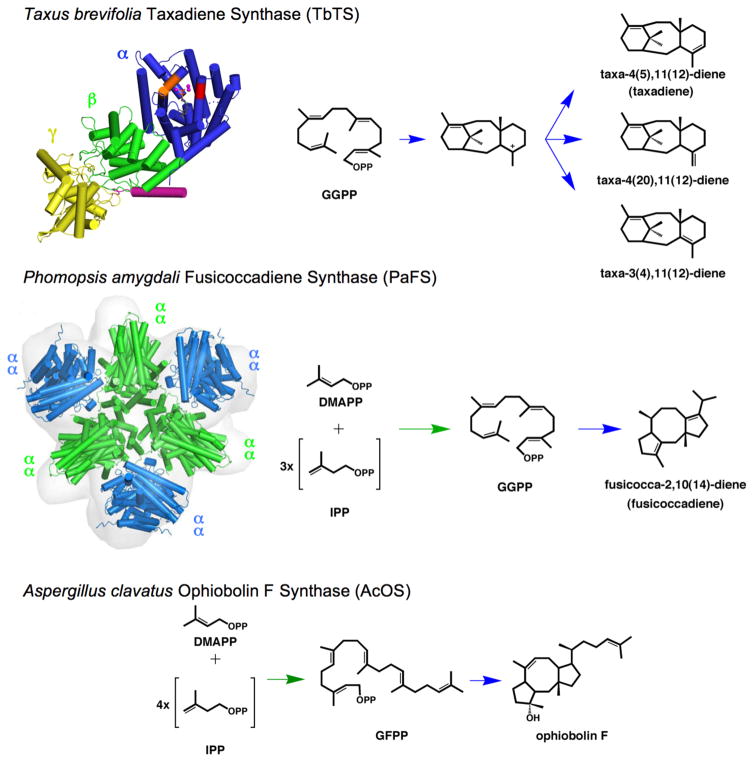
Figure 1
Figure 1. Domain architecture in αβγ and αα diterpene synthases
Taxadiene synthase from Taxus brevifolia (TbTS) catalyzes the cyclization of GGPP to form taxa-4(5),11(12)-diene as the major product (henceforth designated simply “taxadiene”). Alternative proton elimination steps yield taxa-4(20),11(12)-diene and taxa-3(4),11(12)-diene as minor products. This cyclization occurs exclusively in the α domain (blue); neither the β domain (green) nor the γ domain (yellow) contain a functional active site. A polypeptide segment connected to the N-terminal helix of the β-domain (magenta) is believed to help cap the active site in the α domain during catalysis. Fusicoccadiene synthase from Phomopsis amygdali (PaFS) is a hexamer of subunits with αα domain architecture. The chain elongation reaction of DMAPP and 3 IPP molecules is catalyzed in the C-terminal GGPP synthase α domain (green), and the GGPP cyclization reaction forming fusicoccadiene is catalyzed in the N-terminal cyclase α domain (blue). Although neither the tertiary structure nor the quaternary structure of ophiobolin F synthase from Aspergillus clavatus (AcOS) are known, this bifunctional sesterterpene synthase also adopts an αα domain architecture in which the chain elongation reaction of DMAPP and 4 IPP molecules is catalyzed in the C-terminal α domain to form GFPP, which then undergoes cyclization in the N-terminal α domain to form ophiobolin F. Detailed catalytic mechanisms for each enzyme are found in Figure S1.
Figure 2
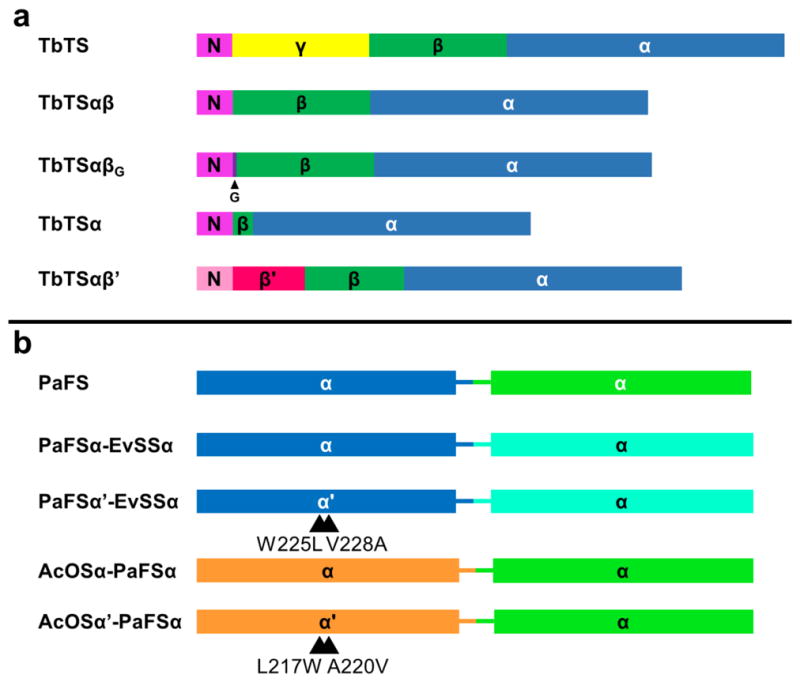
Figure 2. Primary structure of truncated and chimeric terpenoid synthases
(a) For the class I diterpene synthase taxadiene synthase (TbTS), four engineered domain constructs successively downsized the αβγ domain architecture, color-coded as follows: α domain, blue; β domain, green; γ domain, yellow; N-terminal segment, magenta. The location of the single inserted glycine residue (G) in TbTSαβG is indicated by an arrow. The TbTSαβ′ is a chimera containing the N-terminal segment (pink) and part of the β domain (β′, red) of isoprene synthase. (b) Engineered bifunctional class I diterpene and sesterterpene synthases with αα domain architecture are color-coded as follows: dark blue, cyclization α domain of fusicoccadiene synthase (PaFS); orange, cyclization α domain of ophiobolin F synthase (AcOS); aquamarine, GFPP synthase α domain of stellatatriene synthase (EvSS); green, GGPP synthase α domain of fusicoccadiene synthase (PaFS).
Figure 3
Figure 3. Catalytic activity measurements
(a) The cyclization of GGPP by full-length TbTS exhibits Michaelis-Menten kinetics with kcat = 0.16 s−1, KM = 2.9 μM, and kcat/KM = 5.5 × 10⁴ M−1s−1. The highest concentrations of GGPP are not included in the final curve due to substrate inhibition. (b) The cyclization of GGPP by TbTSαβG exhibits Michaelis-Menten kinetics with kcat = 0.000019 s−1, KM = 0.96 μM, and kcat/KM = 20 M−1s−1.
Figure 4
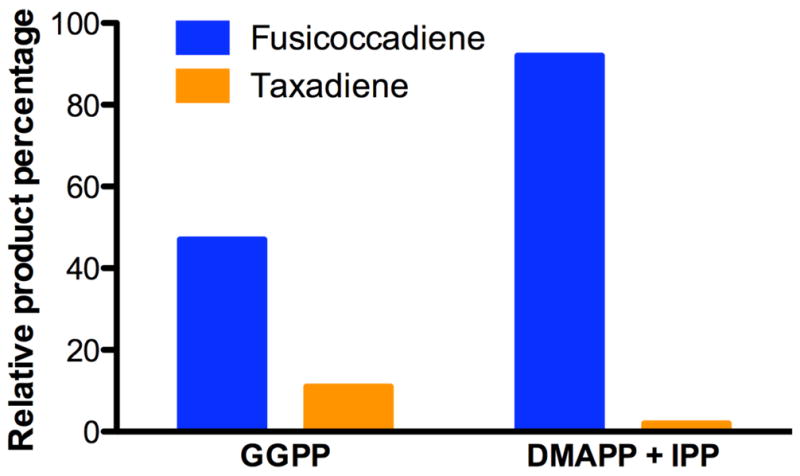
Figure 4. Substrate competition between PaFS and TbTS
Relative product percentages for the generation of fusicoccadiene and taxadiene in reaction mixtures containing equimolar PaFS and TbTS. When the enzyme mixture is incubated with exogenous GGPP, the fusicoccadiene:taxadiene product ratio is 4.3:1. When the enzyme mixture is incubated with DMAPP and IPP, the only source of cyclization substrate GGPP is that generated by the C-terminal α domain of PaFS and the resulting fusicoccadiene:taxadiene product ratio increases to 46:1. That very little taxadiene is generated in this experiment strongly suggests a cluster channeling model for bifunctional catalysis, in which most of the GGPP generated remains bound in the PaFS hexamer to be utilized for cyclization to fusicoccadiene.
Figure 5
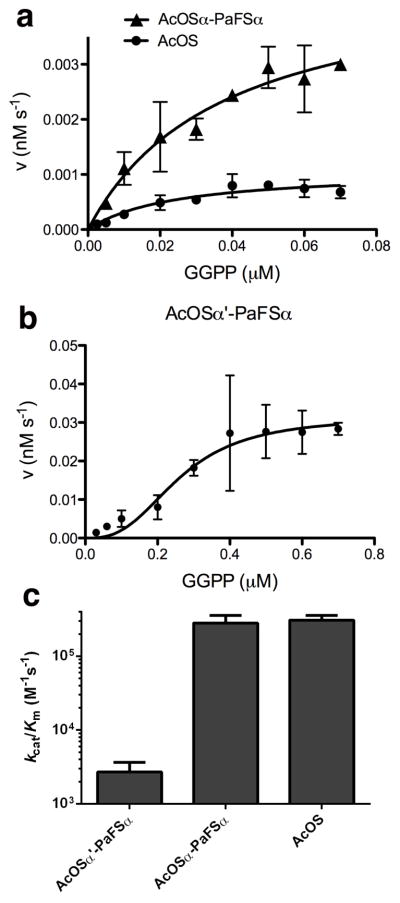
Figure 5. Steady-state kinetics
(a) AcOS and AcOSα-PaFSα exhibit Michaelis-Menten kinetics for GGPP utilization. (b) AcOSα′-PaFSα exhibits sigmoidal kinetics for GGPP utilization. (c) Comparison of catalytic efficiencies for AcOS, AcOSα-PaFSα, and AcOSα′-PaFSα.
Figure 6
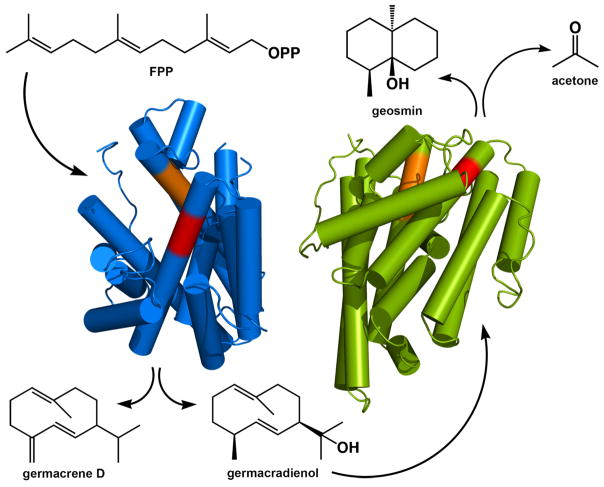
Figure 6. Geosmin synthase
Geosmin synthase is a bifunctional enzyme with αα domain architecture that catalyzes FPP cyclization in the N-terminal domain (blue) to generate germacrene D and germacradienol, the latter of which undergoes a cyclization and fragmentation reaction in the C-terminal domain (green) to yield geosmin and acetone. The structure of the N-terminal domain was determined by X-ray crystallographic methods, and the structure of the C-terminal domain was generated through homology modeling. The domain assembly shown is based on the best fit of small-angle X-ray scattering data (the 41-residue interdomain linker is not shown).

References

    1. Dolara P, Luceri C, Ghelardini C, Monserrat C, Aiolli S, Luceri F, Lodovici M, Menichetti S, Romanelli MN. Analgesic effects of myrrh. Nature. 1996;379:29. - PubMed
    1. Patel T, Ishiuji Y, Yosipovitch G. Menthol: a refreshing look at this ancient compound. J Am Acad Dermatol. 2007;57:873–878. - PubMed
    1. Gershenzon J, Dudareva N. The function of terpene natural products in the natural world. Nat Chem Biol. 2008;3:408–414. - PubMed
    1. Baeten J, Deforce K, Challe S, De Vos D, Degryse P. Holy smoke in medieval funerary rites: chemical fingerprints of frankincense in southern Belgian incense burners. PLoS One. 2014;9(11):e113142. - PMC - PubMed
    1. Pichersky E, Raguso RA. Why do plants produce so many terpenoid compounds? New Phytol. 2016 doi: 10.1111/nph.14178. in press. - DOI - PubMed

Publication types

MeSH terms