. 2017 Mar 31;12(3):e0174810.
doi: 10.1371/journal.pone.0174810. eCollection 2017.

Comparison of laser in situ ketatomileusis and photorefractive keratectomy for myopia using a mixed-effects model

Affiliations

Comparison of laser in situ ketatomileusis and photorefractive keratectomy for myopia using a mixed-effects model

Yosai Mori et al. PLoS One. .

Abstract

Purpose: To compare the results of laser in situ keratomileusis (LASIK) and photorefractive keratectomy (PRK) for myopia using a mixed-effects model.

Methods: This comparative retrospective study was conducted in 1,127 eyes of 579 patients after LASIK and 270 eyes of 144 patients after PRK who had two or more postoperative follow-ups after 3 months. Uncorrected visual acuity (UCVA), best spectacle-corrected visual acuity (BSCVA), manifest refractive spherical equivalent (MRSE), percentage of eyes within ± 0.5 diopters (D) and ± 1.0 D of targeted refraction, and central corneal thickness were compared between PRK and LASIK groups using a mixed-effects model.

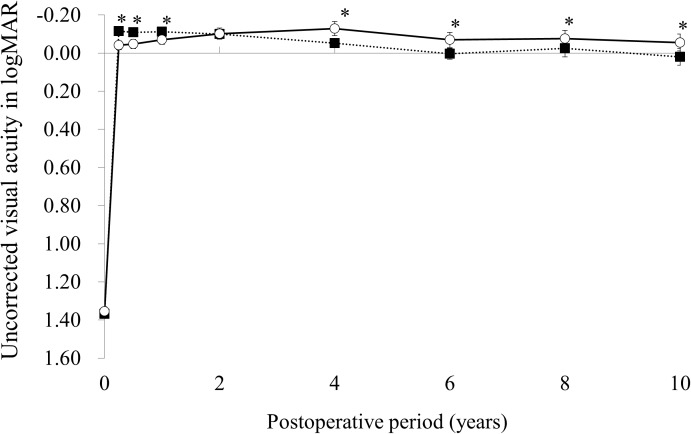
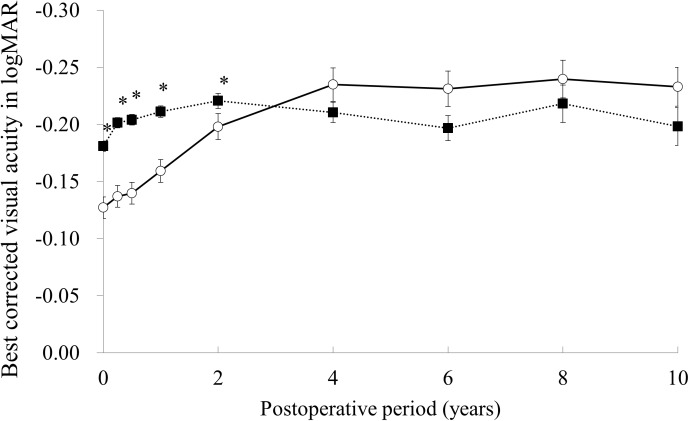
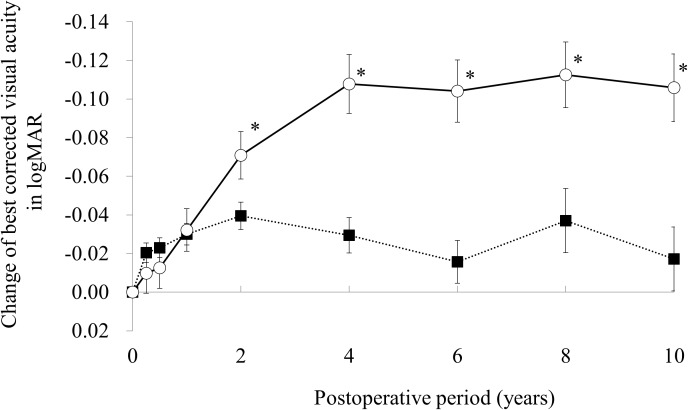
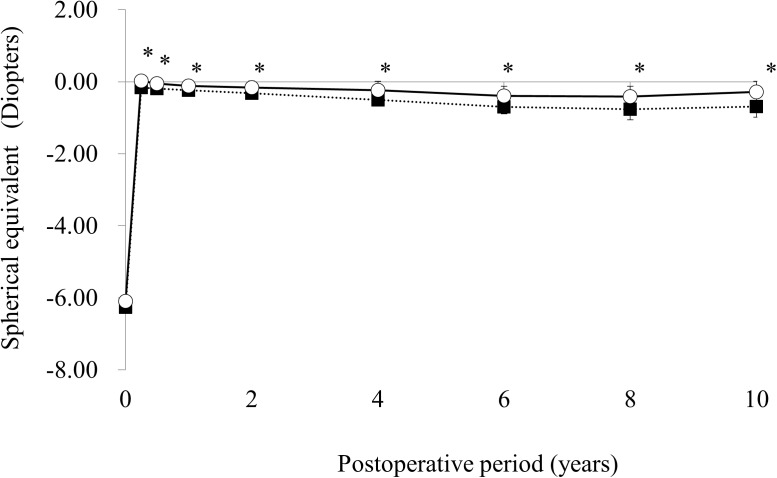
Results: Compared with the LASIK group, UCVA in the PRK group was significantly worse in the initial year but was significantly better after 4 years. The average BSCVA was not significantly different between the LASIK and PRK groups after 4 years. The average gain of BSCVA in the PRK group was significantly larger than that of the LASIK group after 2 years. MRSE in the LASIK and PRK groups showed a gradual myopic shift until 6 years after surgery. After 6 years, MRSE in the PRK group remained stable whereas MRSE in the LASIK group continued a myopic shift. The percentages of eyes within ± 0.5 D or ± 1.0 D in the LASIK group were significantly higher than those in the PRK group at 3 months but were significantly lower than those in the PRK group at 10 years.

Conclusions: PRK for myopia shows better efficacy than LASIK for myopia after 4 years.


Conflict of interest statement

Competing Interests: The authors have declared that no competing interests exist.

Figures

Fig 1
Fig 1. Time courses of the average and 95% confidence intervals of uncorrected visual acuity in the laser in situ keratomileusis (closed square) and photorefractive keratectomy (open square) groups.
* p< .05.
Fig 2
Fig 2. Time courses of the average and 95% confidence intervals of best spectacle-corrected visual acuity in the laser in situ keratomileusis (closed square) and photorefractive keratectomy (open square) groups.
* p< .05.
Fig 3
Fig 3. Time courses of the average and 95% confidence intervals of change of best spectacle-corrected visual acuity in the laser in situ keratomileusis (closed square) and photorefractive keratectomy (open square) groups.
* p< .05.
Fig 4
Fig 4. Time courses of the average and 95% confidence intervals of manifest refractive spherical equivalent in the laser in situ keratomileusis (closed square) and photorefractive keratectomy (open square) groups.
* p< .05.
Fig 5
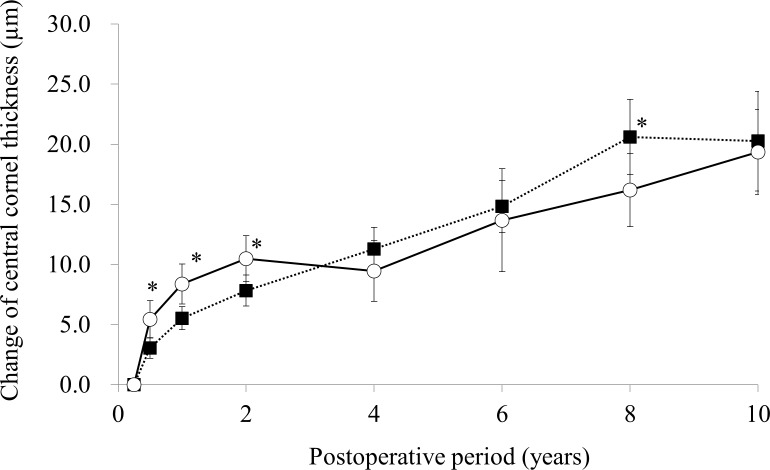
Fig 5. Time courses of the average and 95% confidence intervals of change of central corneal thickness from 3 months in the laser in situ keratomileusis (closed square) and photorefractive keratectomy (open square) groups.
* p< .05.

Similar articles

References

    1. Alió JL, Ortiz D, Muftuoglu O, Garcia MJ (2009) Ten years after photorefractive keratectomy (PRK) and laser in situ keratomileusis (LASIK) for moderate to high myopia (control-matched study). Br J Ophthalmol.; 93:1313–1318. 10.1136/bjo.2007.131748 - DOI - PubMed
    1. Rosman M, Alió JL, Ortiz D, Perez-Santonja JJ (2010) Comparison of LASIK and photorefractive keratectomy for myopia from -10.00 to -18.00 diopters 10 years after surgery. J Refract Surg.; 26:168–176. 10.3928/1081597X-20100224-02 - DOI - PubMed
    1. Dirani M, Couper T, Yau J, Ang EK, Islam FM, Snibson GR, et al. (2010) Long-term refractive outcomes and stability after excimer laser surgery for myopia. J Cataract Refract Surg.; 36:1709–1717. 10.1016/j.jcrs.2010.04.041 - DOI - PubMed
    1. Alió JL, Muftuoglu O, Ortiz D, Pérez-Santonja JJ, Artola A, Ayala MJ, et al. (2008) Ten-year follow-up of laser in situ keratomileusis for myopia of up to -10 diopters. Am J Ophthalmol.; 145:46–54. 10.1016/j.ajo.2007.09.010 - DOI - PubMed
    1. Alió JL, Muftuoglu O, Ortiz D, Pérez-Santonja JJ, Artola A, Ayala MJ, et al. (2008) Ten-year follow-up of laser in situ keratomileusis for high myopia. Am J Ophthalmol.; 145:55–64. 10.1016/j.ajo.2007.08.035 - DOI - PubMed

LinkOut - more resources