Review
. 2017 Apr 1;64(7):823-828.
doi: 10.1093/cid/cix067.

Crisis in Infectious Diseases: 2 Decades Later

Affiliations
Review

Crisis in Infectious Diseases: 2 Decades Later

Arturo Casadevall. Clin Infect Dis. .

Abstract

The development of nontoxic broad-spectrum antimicrobial drugs in the mid-20th century led to a culture of empiricism, underdevelopment of diagnostics, neglect of immunotherapy, and selection for drug resistance, which together created the conditions that underlie the current crisis.

In 1996 an article in this journal predicted a crisis in infectious diseases, which subsequently unfolded with a paucity of new drugs, increases in antimicrobial resistance, and underdevelopment in both immunotherapy and diagnostics. This article argues that the root cause of the current-day problems lies in the enormous success of the mid-20th century antibiotic revolution. The availability of low-toxicity broad-spectrum drugs fostered a culture of empiricism and widespread use, which in turn stunted the development of both the specialty and rapid diagnostics while promoting increases in resistance. Two decades later, there are promising signs that widespread recognition of these problems is leading to fundamental changes in the approach to the therapy of infectious diseases. Ultimately, a concerted effort to simultaneously develop pathogen-specific drugs, immunotherapy, and improved diagnostics could provide a qualitatively new platform for confronting the challenge of infectious diseases, which now also includes host dysbiosis.

Keywords: Immunotherapy; antimicrobial therapy; immunosuppressed hosts.; microbial resistance.


Figures
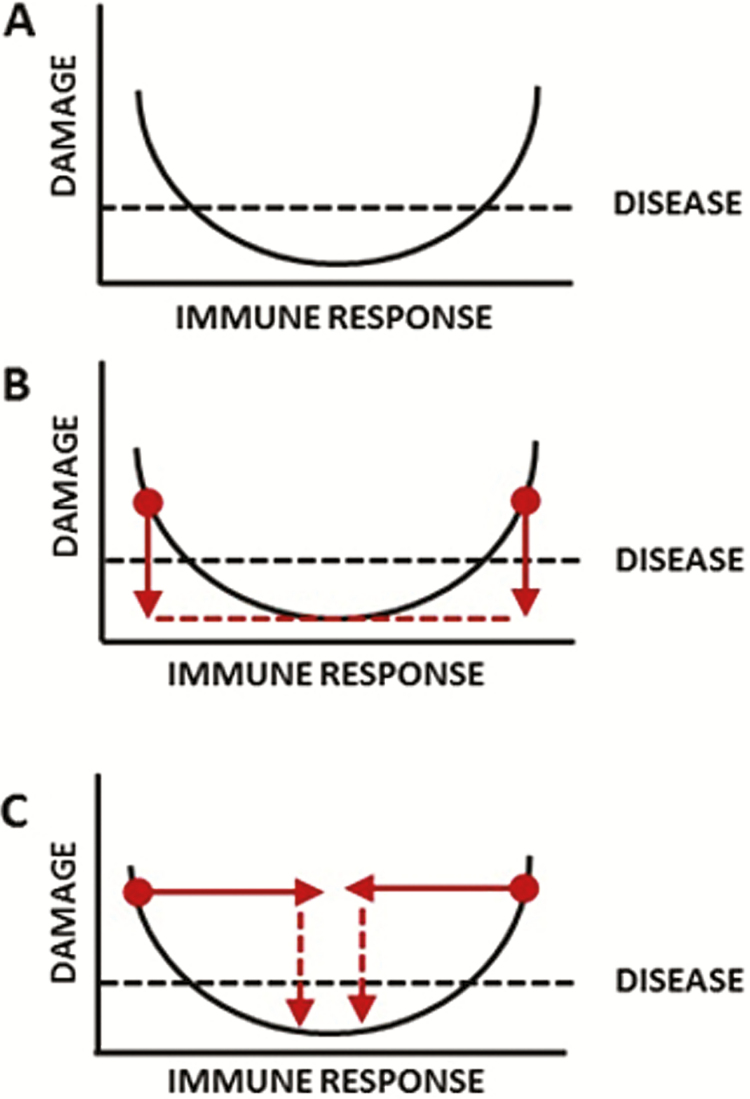
Figure 1.
Figure 1.
Therapy against infectious diseases as viewed through the prism of the “damage response framework” of microbial pathogenesis [5]. A, The basic relationship between a host and a pathogenic microbe is posited to be a parabolic function where damage is a function of the host response. Disease occurs when sufficient damage is accrued from a host–microbe interaction to affect homeostasis, which manifests as clinical symptoms. Disease can occur in settings of both inappropriately weak and exuberant immune responses. B, The administration of antimicrobial drugs meditates a therapeutic effect primarily by reducing microbial burden, which in turn reduces damage, and cure results when the damage is reduced beyond that which affects homeostasis. C, The administration of immunotherapy mediates a therapeutic effect by shifting the position of the immune response to a point where it can reduce damage through reducing the inoculum and/or reducing tissue-damaging inflammatory response. Serum therapy contained antibodies that served both functions through their effects on complement activation, phagocytosis, and regulation of the inflammatory response. Hence, from the viewpoint of the damage-response framework, the shift from serum therapy to antimicrobial drugs was a shift from x- to the y-axis as the mode to control infectious diseases. Today the field of infectious diseases is focused primarily on the y-axis and there are very few immunotherapies available for microbial diseases.

References

    1. Casadevall A. Crisis in infectious diseases: time for a new paradigm? Clin Infect Dis 1996; 23:790–4. - PubMed
    1. Casadevall A, Scharff MD. Serum therapy revisited: animal models of infection and development of passive antibody therapy. Antimicrob Agents Chemother 1994; 38:1695–702. - PMC - PubMed
    1. Casadevall A, Scharff MD. Return to the past: the case for antibody-based therapies in infectious diseases. Clin Infect Dis 1995; 21:150–61. - PMC - PubMed
    1. Casadevall A. The third age of antimicrobial therapy. Clin Infect Dis 2006; 42:1414–6. - PubMed
    1. Casadevall A, Pirofski LA. The damage-response framework of microbial pathogenesis. Nat Rev Microbiol 2003; 1:17–24. - PMC - PubMed

Publication types

MeSH terms

Substances
