. 2017 May 15;77(10):2712-2721.
doi: 10.1158/0008-5472.CAN-16-3404. Epub 2017 Mar 31.

Response Heterogeneity of EGFR and HER2 Exon 20 Insertions to Covalent EGFR and HER2 Inhibitors

Affiliations

Response Heterogeneity of EGFR and HER2 Exon 20 Insertions to Covalent EGFR and HER2 Inhibitors

Takayuki Kosaka et al. Cancer Res. .

Abstract

Insertion mutations in EGFR and HER2 both occur at analogous positions in exon 20. Non-small cell lung cancer (NSCLC) patients with tumors harboring these mutations seldom achieve clinical responses to dacomitinib and afatinib, two covalent quinazoline-based inhibitors of EGFR or HER2, respectively. In this study, we investigated the effects of specific EGFR and HER2 exon 20 insertion mutations from NSCLC patients that had clinically achieved a partial response after dacomitinib treatment. We identified Gly770 as a common feature among the drug-sensitive mutations. Structural modeling suggested that this mutation may facilitate inhibitor binding to EGFR. Introduction of Gly770 into two dacomitinib-resistant EGFR exon 20 insertion mutants restored sensitivity to dacomitinib. Based on these findings, we used afatinib to treat an NSCLC patient whose tumor harbored the HER2 V777_G778insGSP mutation and achieved a durable partial response. We further identified secondary mutations in EGFR (T790M or C797S) and HER2 (C805S) that mediated acquired drug resistance in drug-sensitive EGFR or HER2 exon 20 insertion models. Overall, our findings identified a subset of EGFR and HER2 exon 20 insertion mutations that are sensitive to existing covalent quinazoline-based EGFR/HER2 inhibitors, with implications for current clinical treatment and next-generation small-molecule inhibitors. Cancer Res; 77(10); 2712-21. ©2017 AACR.


Figures

Figure 1
Figure 1
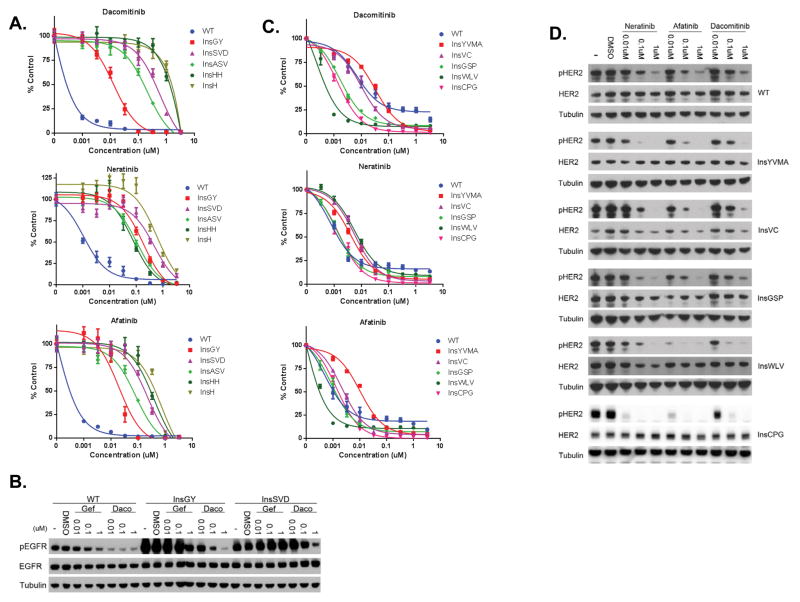
EGFR and ERBB2 exon 20 insertions and sensitivity to covalent quinazoline based EGFR inhibitors. A. Ba/F3 cells expressing wild type EGFR or different exon 20 insertion mutations. Cells were treated with different drugs at the indicated concentrations, and viable cells were measured after 72 hours of treatment and plotted relative to untreated controls. B. Ba/F3 cells expressing different EGFR exon 20 mutants were treated with gefitinib or dacomitinib at indicated concentrations for 6 hours. Cell extracts were immunoblotted to detect the indicated proteins. C. Ba/F3 cells expressing wild type HER2 or different exon 20 insertion mutations. Cells were treated with different drugs at the indicated concentrations, and viable cells were measured after 72 hours of treatment and plotted relative to untreated controls. D. Ba/F3 cells expressing different HER2 exon 20 mutants were treated with gefitinib or dacomitinib at indicated concentrations for 6 hours. Cell extracts were immunoblotted to detect the indicated proteins.
Figure 2
Figure 2
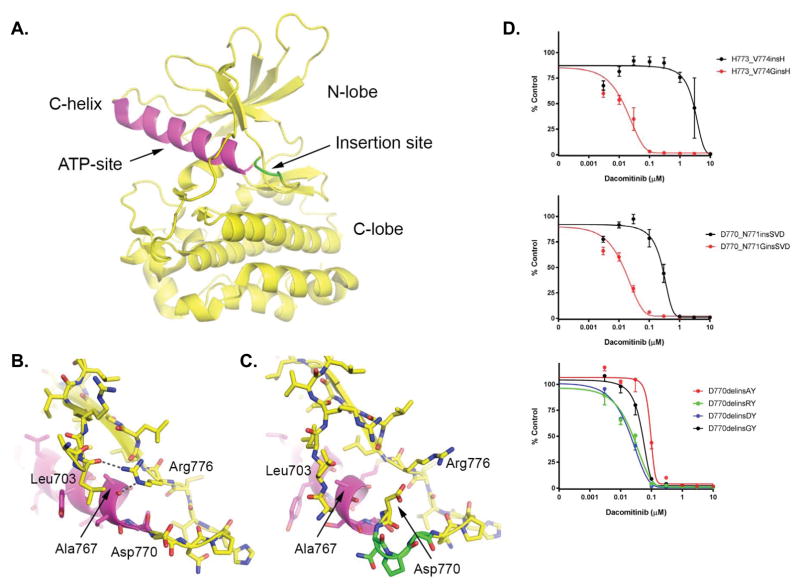
Structural context of exon20 insertion mutants and impact on dacomitinib sensitivity. A. Previously determined structure of the EGFR insNPG exon20 insertion mutant (PDB ID: 4LRM), highlighting the architecture of the kinase domains and the typical location of exon20 insertion mutants. The insNPG insertion is highlighted in green and the C-helix is shaded magenta. The ATP-site, which is also the site of binding of inhibitors, lies between the N- and C-lobes of the kinase as indicated. B. In the inactive conformation of the EGFR kinase, Arg 776 hydrogen bonds with the carbonyl of Ala767 at the end of the C-helix, and with Leu703 in the N-terminal portion of the kinase. We propose that this interaction is important for the stability of the inactive conformation of the kinase, as well for the transition between the inward (active) and outward (inactive) positions of the C-helix which may in turn control access of inhibitors to the adjacent ATP-site. (Panel drawn from PDB ID 1XKK.) C. Detailed view of the insertion site in the insNPG mutant (PDB ID 4LRM), colored as in panel A. The insertion reorients Asp770 such that it blocks access of Arg776 to the end of the C-helix. Other inhibitor-resistant mutants may have a similar effect on the position of Asp770, but at present crystal structures are available only for insNPG. In all of the inhibitor-sensitive insertion mutants studied here, a glycine residue is inserted in place of Asp770, potentially restoring the ability of Arg776 to rearrange in communication with the C-helix. D. Ba/F3 cells expressing different modified exon 20 insertion mutations. In the top two, Asp770 has ben replaced by a Gly. In the bottom, Gly770 has been replaced by either Asp, Ala or Arg. Cells were treated with dacomitinib at the indicated concentrations, and viable cells were measured after 72 hours of treatment and plotted relative to untreated controls.
Figure 3
Figure 3
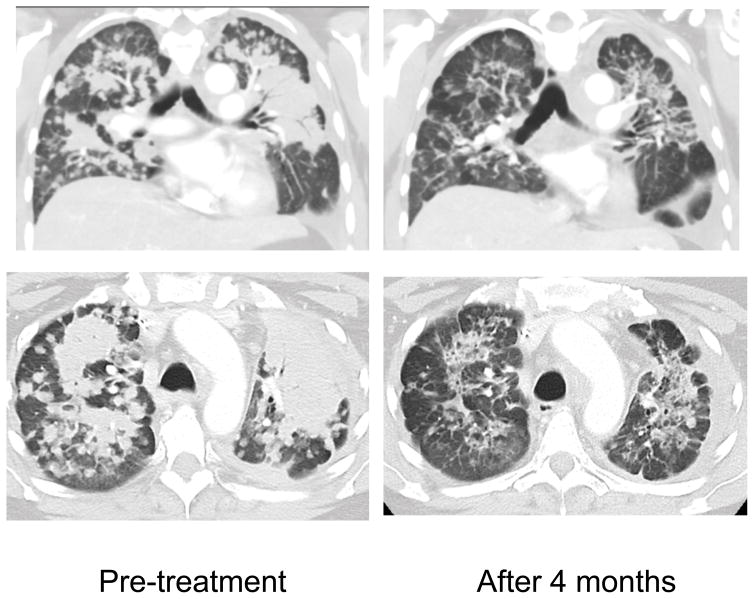
Treatment of a patient with ERBB2 V777_G778insGSP NSCLC with afatinib. Coronal and axial images obtained pre-treatment and following 4 months of afatinib treatment.
Figure 4
Figure 4
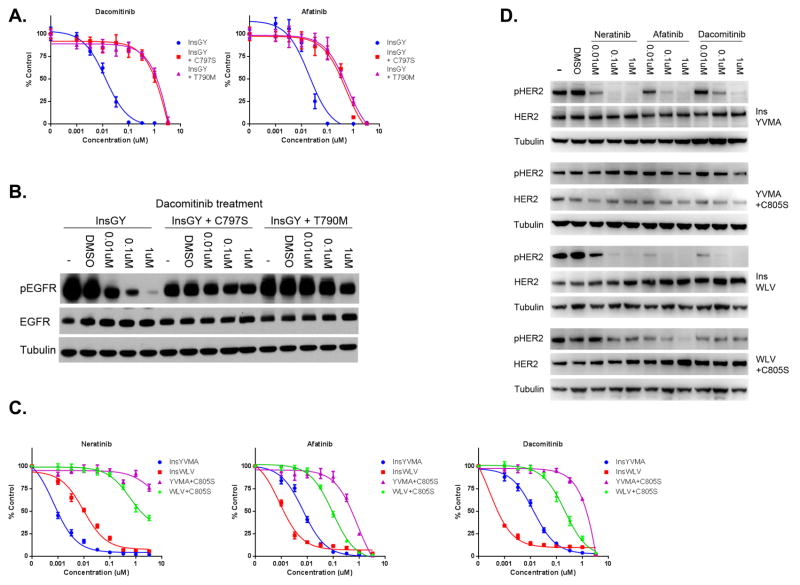
Mutations at the site of drug binding cause resistance in drug sensitive EGFR or HER2 exon 20 insertion mutant models. A. EGFR InsGY Ba/F3 cells harboring either a concurrent T790M or a C797S are resistant to dacomitinib or afatinib. Cells were treated with dacomitinib at the indicated concentrations, and viable cells were measured after 72 hours of treatment and plotted relative to untreated controls. B. Ba/F3 cells expressing the respective constructs from A. were treated with different drugs at indicated concentrations for 6 hours. Cell extracts were immunoblotted to detect the indicated proteins. C. HER2 InsYVMA or InsWLV Ba/F3 cells harboring a concomitant C805S mutation are resistant to neratinib, afatinib and dacomitinib. Cells were treated with different drugs at the indicated concentrations, and viable cells were measured after 72 hours of treatment and plotted relative to untreated controls. D. Ba/F3 cells expressing the respective constructs from A. were treated with different drugs at indicated concentrations for 6 hours. Cell extracts were immunoblotted to detect the indicated proteins.

References

    1. Mok TS, Wu YL, Thongprasert S, Yang CH, Chu DT, Saijo N, et al. Gefitinib or carboplatin-paclitaxel in pulmonary adenocarcinoma. N Engl J Med. 2009;361:947–57. - PubMed
    1. Maemondo M, Inoue A, Kobayashi K, Sugawara S, Oizumi S, Isobe H, et al. Gefitinib or chemotherapy for non-small-cell lung cancer with mutated EGFR. N Engl J Med. 2010;362:2380–8. - PubMed
    1. Solomon BJ, Mok T. First-line crizotinib in ALK-positive lung cancer. N Engl J Med. 2015;372:782. - PubMed
    1. Shaw AT, Kim DW, Nakagawa K, Seto T, Crino L, Ahn MJ, et al. Crizotinib versus chemotherapy in advanced ALK-positive lung cancer. N Engl J Med. 2013;368:2385–94. - PubMed
    1. Zhou C, Wu YL, Chen G, Feng J, Liu XQ, Wang C, et al. Erlotinib versus chemotherapy as first-line treatment for patients with advanced EGFR mutation-positive non-small-cell lung cancer (OPTIMAL, CTONG-0802): a multicentre, open-label, randomised, phase 3 study. Lancet Oncol. 2011;12:735–42. - PubMed

MeSH terms