


TRPV1 and TRPA1 in cutaneous neurogenic and chronic inflammation: pro-inflammatory response induced by their activation and their sensitization
- PMID: 28364279
- PMCID: PMC5563280
- DOI: 10.1007/s13238-017-0395-5
TRPV1 and TRPA1 in cutaneous neurogenic and chronic inflammation: pro-inflammatory response induced by their activation and their sensitization
Abstract
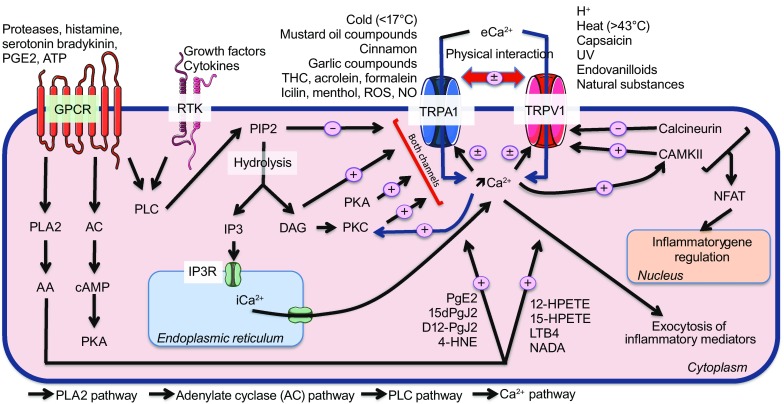
Cutaneous neurogenic inflammation (CNI) is inflammation that is induced (or enhanced) in the skin by the release of neuropeptides from sensory nerve endings. Clinical manifestations are mainly sensory and vascular disorders such as pruritus and erythema. Transient receptor potential vanilloid 1 and ankyrin 1 (TRPV1 and TRPA1, respectively) are non-selective cation channels known to specifically participate in pain and CNI. Both TRPV1 and TRPA1 are co-expressed in a large subset of sensory nerves, where they integrate numerous noxious stimuli. It is now clear that the expression of both channels also extends far beyond the sensory nerves in the skin, occuring also in keratinocytes, mast cells, dendritic cells, and endothelial cells. In these non-neuronal cells, TRPV1 and TRPA1 also act as nociceptive sensors and potentiate the inflammatory process. This review discusses the role of TRPV1 and TRPA1 in the modulation of inflammatory genes that leads to or maintains CNI in sensory neurons and non-neuronal skin cells. In addition, this review provides a summary of current research on the intracellular sensitization pathways of both TRP channels by other endogenous inflammatory mediators that promote the self-maintenance of CNI.
Keywords: inflammatory gene regulation; neurogenic skin inflammation; pruritus; sensory nerve.
Figures
References
-
- Ahn S, Siddiqi MH, Aceituno VC, et al. Ginsenoside Rg5:Rk1 attenuates TNF-α/IFN-γ-induced production of thymus- and activation-regulated chemokine (TARC/CCL17) and LPS-induced NO production via downregulation of NF-κB/p38 MAPK/STAT1 signaling in human keratinocytes and macrophages. In Vitro Cell Dev Biol Anim. 2016;52:287–295. doi: 10.1007/s11626-015-9983-y. - DOI - PubMed
Publication types
MeSH terms
Substances
LinkOut - more resources
Full Text Sources
Other Literature Sources
