


Estrogen and progesterone receptor expression levels do not differ between lobular and ductal carcinoma in patients with hormone receptor-positive tumors
- PMID: 28365833
- PMCID: PMC5487722
- DOI: 10.1007/s10549-017-4220-x
Estrogen and progesterone receptor expression levels do not differ between lobular and ductal carcinoma in patients with hormone receptor-positive tumors
Abstract
Background: Differences in estrogen (ER) and progesterone (PR) expression between invasive lobular carcinoma (ILC) and invasive ductal carcinoma (IDC) could be an underlying reason for the difference in chemo-sensitivity and response to hormonal therapy between ILC and IDC. The aim of this study was to investigate the differences in ER and PR expression levels between postmenopausal patients with hormonal receptor-positive ILC and IDC.
Methods: We included all ER and/or PR receptor-positive ILC and IDC, diagnosed between January 2011 and December 2013 from the population-based Netherlands Cancer Registry. A semi-quantitative classification was used to analyze differences in ER/PR expression, which consisted of three ER expression classes: 10-69, 70-89, and ≥90%. Differences in ER and PR expression levels between IDC and ILC were analyzed according to age group, tumor size, axillary nodal status, grade, and HER2 status.
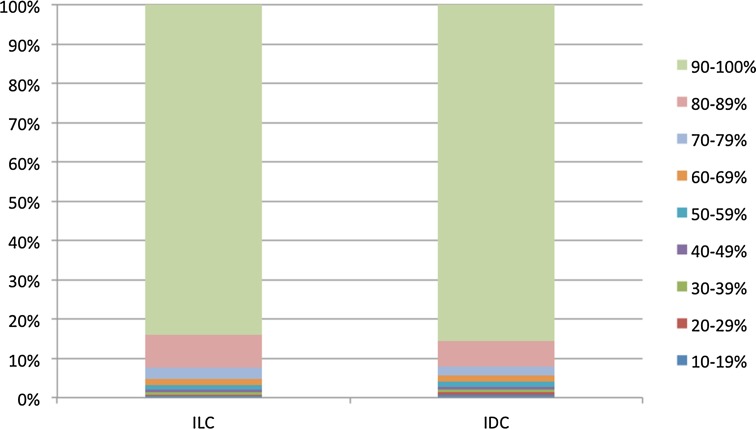
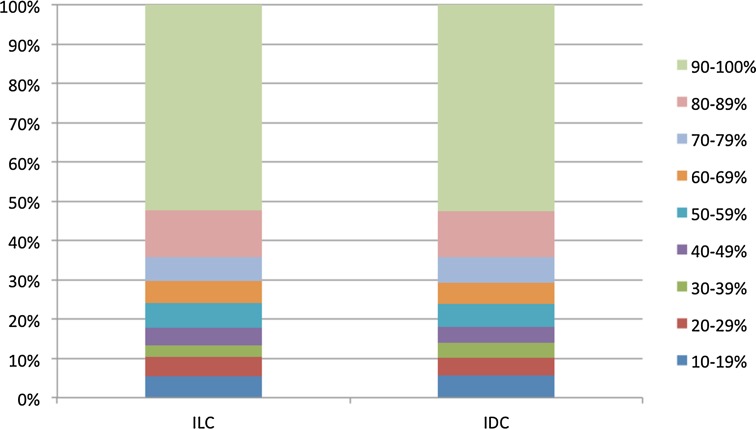
Results: In total, 26,339 ER and/or PR-positive breast cancers were included in the study, of which 17% were ILC and 83% IDC. In patients with IDC, 86% of the tumors showed an ER expression level of 90% or more, compared to 84% in those with ILC. In both IDC and ILC a PR expression level of 90% or more was observed in 54% of the tumors. In postmenopausal patients aged 50-69 years no significant differences could be observed in ER and PR expression levels between ILC and IDC.
Conclusion: Patients with ER and PR-positive ILC and IDC have similar quantitative ER and PR expression profiles, implicating that ER/PR expression is unlikely to be a confounding factor in studies concerning chemo-sensitivity of ILC and IDC.
Keywords: Estrogen receptor; Invasive ductal carcinoma; Invasive lobular carcinoma; Progesterone receptor.
Conflict of interest statement
Conflict of interest
The authors declare that there is no conflict of interest that could be perceived as prejudicing the impartiality of the research reported.
Funding
This research did not receive any specific grant from any funding agency in the public, commercial, or not-for-profit sector.
Figures
References
-
- Fortunato L, Mascaro A, Poccia I, et al. Lobular breast cancer: same survival and local control compared with ductal cancer, but should both be treated the same way? Analysis of an institutional database over a 10-year period. Ann Surg Oncol. 2012;19:1107–1114. doi: 10.1245/s10434-011-1907-9. - DOI - PubMed
MeSH terms
Substances
LinkOut - more resources
Full Text Sources
Other Literature Sources
Medical
Research Materials
Miscellaneous
