


Treatment duration of febrile urinary tract infection: a pragmatic randomized, double-blind, placebo-controlled non-inferiority trial in men and women
- PMID: 28366170
- PMCID: PMC5376681
- DOI: 10.1186/s12916-017-0835-3
Treatment duration of febrile urinary tract infection: a pragmatic randomized, double-blind, placebo-controlled non-inferiority trial in men and women
Abstract
Background: In adults with febrile urinary tract infection (fUTI), data on optimal treatment duration in patients other than non-pregnant women without comorbidities are lacking.
Methods: A randomized placebo-controlled, double-blind, non-inferiority trial among 35 primary care centers and 7 emergency departments of regional hospitals in the Netherlands. Women and men aged ≥ 18 years with a diagnosis of fUTI were randomly assigned to receive antibiotic treatment for 7 or 14 days (the second week being ciprofloxacin 500 mg or placebo orally twice daily). Patients indicated to receive antimicrobial treatment for at least 14 days were excluded from randomization. The primary endpoint was the clinical cure rate through the 10- to 18-day post-treatment visit with preset subgroup analysis including sex. Secondary endpoints were bacteriologic cure rate at 10-18 days post-treatment and clinical cure at 70-84 days post-treatment.
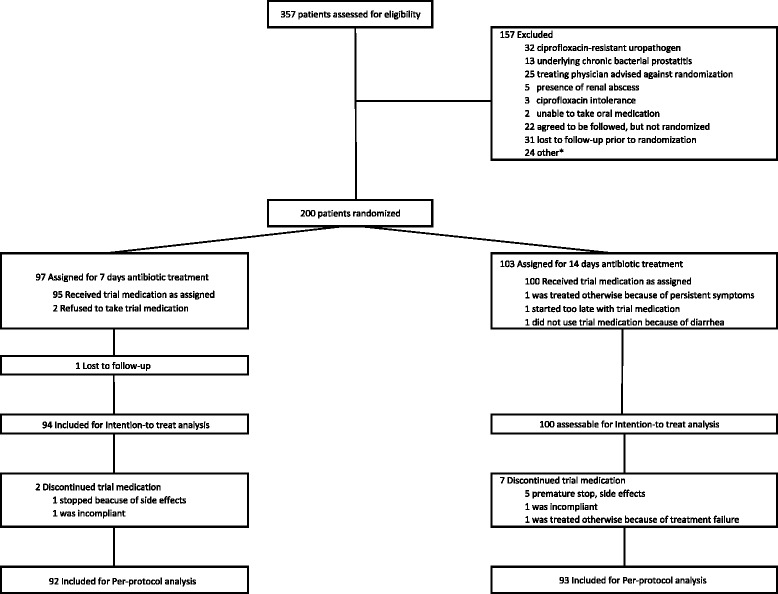
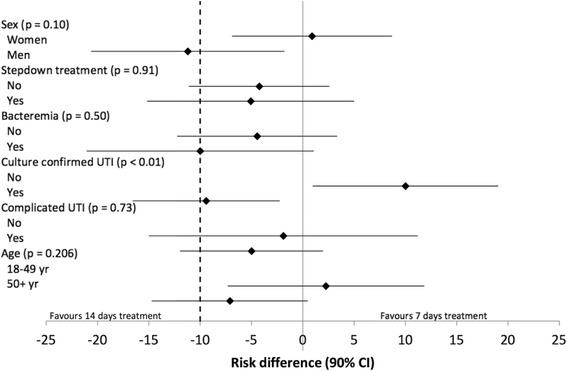
Results: Of 357 patients included, 200 were eligible for randomization; 97 patients were randomly assigned to 7 days and 103 patients to 14 days of treatment. Overall, short-term clinical cure occurred in 85 (90%) patients treated for 7 days and in 94 (95%) of those treated for 14 days (difference -4.5%; 90% CI, -10.7 to 1.7; P non-inferiority = 0.072, non-inferiority not confirmed). In women, clinical cure was 94% and 93% in those treated for 7 and 14 days, respectively (difference 0.9; 90% CI, -6.9 to 8.7, P non-inferiority = 0.011, non-inferiority confirmed) and, in men, this was 86% versus 98% (difference -11.2; 90% CI -20.6 to -1.8, P superiority = 0.025, inferiority confirmed). The bacteriologic cure rate was 93% versus 97% (difference -4.3%; 90% CI, -9.7 to 1.2, P non-inferiority = 0.041) and the long-term clinical cure rate was 92% versus 91% (difference 1.6%; 90% CI, -5.3 to 8.4; P non-inferiority = 0.005) for 7 days versus 14 days of treatment, respectively. In the subgroups of men and women, long-term clinical cure rates met the criteria for non-inferiority, indicating there was no difference in the need for antibiotic retreatment for UTI during 70-84 days follow-up post-treatment.
Conclusions: Women with fUTI can be treated successfully with antibiotics for 7 days. In men, 7 days of antibiotic treatment for fUTI is inferior to 14 days during short-term follow-up but it is non-inferior when looking at longer follow-up.
Trial registration: The study was registered at ClinicalTrials.gov [ NCT00809913 ; December 16, 2008] and trialregister.nl [ NTR1583 ; December 19, 2008].
Keywords: Antibiotic therapy; Pyelonephritis; Treatment duration; Urinary tract infection.
Figures
Comment in
-
Re: Treatment Duration of Febrile Urinary Tract Infection: A Pragmatic Randomized, Double-blind, Placebo-controlled Non-inferiority Trial in Men and Women.Eur Urol. 2017 Oct;72(4):652. doi: 10.1016/j.eururo.2017.05.042. Epub 2017 Jun 8. Eur Urol. 2017. PMID: 28602200 No abstract available.
References
-
- Eliakim-Raz N, Yahav D, Paul M, Leibovici L. Duration of antibiotic treatment for acute pyelonephritis and septic urinary tract infection-- 7 days or less versus longer treatment: systematic review and meta-analysis of randomized controlled trials. J Antimicrob Chemother. 2013;68(10):2183–91. - PubMed
Publication types
MeSH terms
Substances
Associated data
LinkOut - more resources
Full Text Sources
Other Literature Sources
Medical
Miscellaneous
