


The impact of endovascular repair on management and outcome of ruptured thoracic aortic aneurysms
- PMID: 28366304
- PMCID: PMC5524609
- DOI: 10.1016/j.jvs.2017.01.026
The impact of endovascular repair on management and outcome of ruptured thoracic aortic aneurysms
Abstract
Background: Thoracic endovascular aortic repair (TEVAR) has become an alternative to open repair for the treatment of ruptured thoracic aortic aneurysms (rTAAs). The aim of this study was to assess national trends in the use of TEVAR for the treatment of rTAA and to determine its impact on perioperative outcomes.
Methods: Patients admitted with an rTAA between 1993 and 2012 were identified from the National Inpatient Sample. Patients were grouped in accordance with their treatment: TEVAR, open repair, or nonoperative treatment. The primary outcomes were treatment trends over time and in-hospital death. Secondary outcomes included perioperative complications and length of stay. Trend analyses were performed using the Cochran-Armitage test for trend, and adjusted mortality risks were established using multivariable logistic regression analysis.
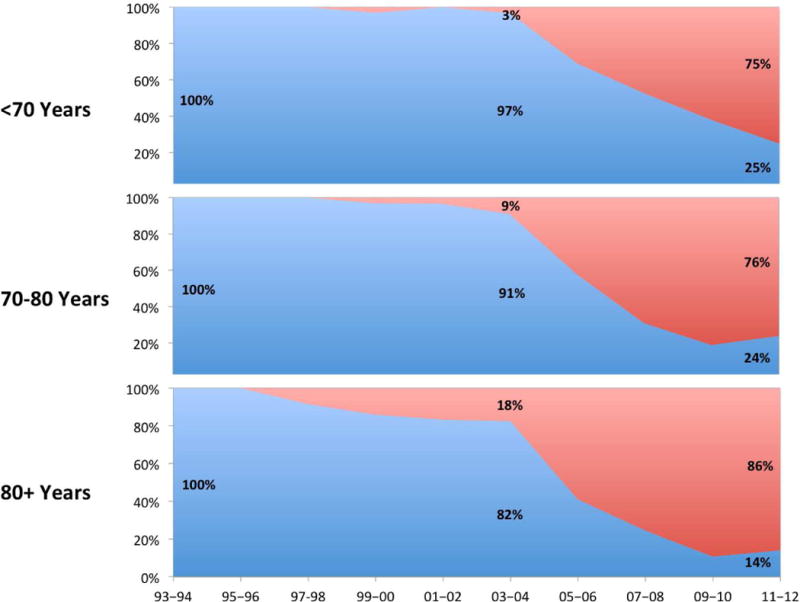
Results: A total of 12,399 patients were included, with 1622 (13%) undergoing TEVAR, 2808 (23%) undergoing open repair, and 7969 (64%) not undergoing surgical treatment. TEVAR has been increasingly used from 2% of total admissions in 2003-2004 to 43% in 2011-2012 (P < .001). Concurrently, there was a decline in the proportion of patients undergoing open repair (29% to 12%; P < .001) and nonoperative treatment (69% to 45%; P < .001). The proportion of patients undergoing surgical repair has increased for all age groups since 1993-1994 (P < .001 for all) but was most pronounced among those aged 80 years with a 7.5-fold increase. After TEVAR was introduced, procedural mortality decreased from 36% in 2003-2004 to 27% in 2011-2012 (P < .001); mortality among those undergoing nonoperative treatment remained stable between 63% and 60% (P = .167). Overall mortality after rTAA admission decreased from 55% to 42% (P < .001). Since 2005, mortality for open repair was 33% and 22% for TEVAR (P < .001). In adjusted analysis, open repair was associated with a twofold higher mortality than TEVAR (odds ratio, 2.0; 95% confidence interval, 1.7-2.5).
Conclusions: TEVAR has replaced open repair as primary surgical treatment for rTAA. The introduction of endovascular treatment appears to have broadened the eligibility of patients for surgical treatment, particularly among the elderly. Mortality after rTAA admission has declined since the introduction of TEVAR, which is the result of improved operative mortality as well as the increased proportion of patients undergoing surgical repair.
Copyright © 2017 Society for Vascular Surgery. Published by Elsevier Inc. All rights reserved.
Figures




Comment in
-
Invited commentary.J Vasc Surg. 2017 Aug;66(2):352-353. doi: 10.1016/j.jvs.2017.01.027. J Vasc Surg. 2017. PMID: 28735946 No abstract available.
References
-
- Johansson G, Markstrom U, Swedenborg J. Ruptured thoracic aortic aneurysms: a study of incidence and mortality rates. J Vasc Surg. 1995;21(6):985–8. - PubMed
-
- Schermerhorn ML, Giles KA, Hamdan AD, Dalhberg SE, Hagberg R, Pomposelli F. Population-based outcomes of open descending thoracic aortic aneurysm repair. J Vasc Surg. 2008;48(4):821–7. - PubMed
-
- Jonker FH, Verhagen HJ, Lin PH, Heijmen RH, Trimarchi S, Lee WA, et al. Open surgery versus endovascular repair of ruptured thoracic aortic aneurysms. J Vasc Surg. 2011;53(5):1210–6. - PubMed
-
- Girardi LN, Krieger KH, Altorki NK, Mack CA, Lee LY, Isom OW. Ruptured descending and thoracoabdominal aortic aneurysms. Ann Thorac Surg. 2002;74(4):1066–70. - PubMed
Publication types
MeSH terms
Grants and funding
LinkOut - more resources
Full Text Sources
Other Literature Sources
