


Gulf of Maine Harmful Algal Bloom in summer 2005 - Part 2: Coupled Bio-physical Numerical Modeling
- PMID: 28366964
- PMCID: PMC5374722
- DOI: 10.1029/2007JC004602
Gulf of Maine Harmful Algal Bloom in summer 2005 - Part 2: Coupled Bio-physical Numerical Modeling
Abstract
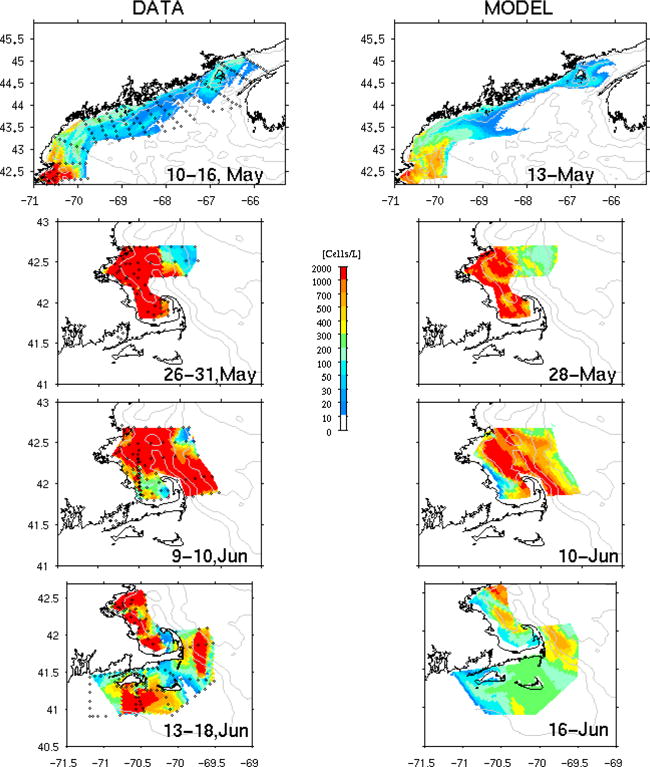
A coupled physical/biological modeling system was used to hindcast the 2005 Alexandrium fundyense bloom in the Gulf of Maine and investigate the relative importance of factors governing the bloom's initiation and development. The coupled system consists of a state-of-the-art, free-surface primitive equation Regional Ocean Modeling System (ROMS) tailored for the Gulf of Maine (GOM) using a multi-nested configuration, and a population dynamics model for A. fundyense. The system was forced by realistic momentum and buoyancy fluxes, tides, river runoff, observed A. fundyense benthic cyst abundance, and climatological nutrient fields. Extensive comparisons were made between simulated (both physical and biological) fields and in-situ observations, revealing that the hindcast model is capable of reproducing the temporal evolution and spatial distribution of the 2005 bloom. Sensitivity experiments were then performed to distinguish the roles of three major factors hypothesized to contribute to the bloom: 1) the high abundance of cysts in western GOM sediments; 2) strong northeaster storms with prevailing downwelling-favorable winds; and 3) a large amount of fresh water input due to abundant rainfall and heavy snowmelt. Results suggested that the high abundance of cysts in western GOM was the primary factor of the 2005 bloom. Wind forcing was an important regulator, as episodic bursts of northeast winds caused onshore advection of offshore populations. These downwelling favorable winds accelerated the alongshore flow, resulting in transport of high cell concentrations into Massachusetts Bay. A large regional bloom would still have happened, however, even with normal or typical winds for that period. Anomalously high river runoff in 2005 resulted in stronger buoyant plumes/currents, which facilitated the transport of cell population to the western GOM. While affecting nearshore cell abundance in Massachusetts Bay, the buoyant plumes were confined near to the coast, and had limited impact on the gulf-wide bloom distribution.
Keywords: Bio-physical Numerical Modeling; Coastal circulation; Harmful Algal Bloom.
Figures





References
-
- Anderson DM. Bloom dynamics of toxic Alexandrium species in the northeastern US. Limnology and Oceanography. 1997;42:1009–1022.
-
- Anderson DM. Physiology and bloom dynamics of toxic Alexandrium species, with emphasis on life cycle transitions. In: Anderson DM, Cembella AD, Hallegraeff GM, editors. Physiological Ecology of Harmful Algal Blooms. Springer-Verlag; Berlin: 1998. pp. 29–48. (NATO ASI series).
-
- Anderson DM, Keafer BA, McGillicuddy DJ, Mickelson MJ, Keay KE, Libby PS, Manning JP, Mayo CA, Whittaker DK, Hickey JM, He R, Lynch DR, Smith KW. Initial observation of the 2005 Alexandrium fundyense bloom in southern New England: General patterns and mechanism. Deep-Sea Research II. 2005;52:2856–2876.
-
- Dinniman MS, Klinck JM, Smith JWO. Cross shelf exchange in a model of the Ross Sea circulation and biogeochemistry. Deep Sea Research. 2003;50:3103–3120.
-
- Durbin EG, Durbin AG. Effects of temperature and food abundance on grazing and short-term weight change in the marine copepod Acartia hudsonica. Limnology and Oceanography. 1992;37(2):361–378.
Grants and funding
LinkOut - more resources
Full Text Sources