


Effectiveness of media awareness campaigns on the proportion of vehicles that give space to ambulances on roads: An observational study
- PMID: 28367204
- PMCID: PMC5368314
- DOI: 10.12669/pjms.331.12176
Effectiveness of media awareness campaigns on the proportion of vehicles that give space to ambulances on roads: An observational study
Abstract
Background and objective: The findings of the Health Care in Danger project in Karachi suggests that there is presence of behavioral negligence among vehicle operators on roads in regards to giving way to ambulances. A mass media campaign was conducted to raise people's awareness on the importance of giving way to ambulances. The main objective of this study was to determine the effectiveness of the campaign on increasing the proportion of vehicles that give way to ambulances.
Methods: This was a quasi-experimental study that was based on before and after design. Three observation surveys were carried out in different areas of the city in Karachi, Pakistan before, during and after the campaign by trained observers who recorded their findings on a checklist. Each observation was carried out at three different times of the day for at least two days on each road. The relationship of the media campaign with regards to a vehicle giving space to an ambulance was calculated by means of odds ratios and 95% confidence intervals using multivariate logistic regression.
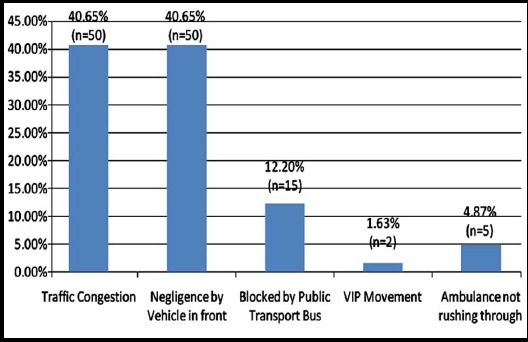
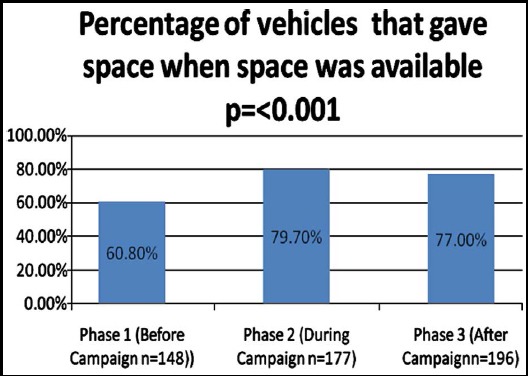
Results: Overall, 245 observations were included in the analysis. Traffic congestion and negligence/resistance, by vehicles operators who were in front of the ambulance, were the two main reasons why ambulances were not given way. Other reasons include: sudden stops by minibuses and in the process causing obstruction, ambulances not rushing through to alert vehicle operators to give way and traffic interruption by VIP movement. After adjustment for site, time of day, type of ambulance and number of cars in front of the ambulance, vehicles during (OR=2.13, 95% CI=1.22-3.71, p=0.007) and after the campaign (OR=1.73, 95% CI=1.02-2.95, p=0.042) were significantly more likely give space to ambulances.
Conclusion: Mass media campaigns can play a significant role in changing the negligent behavior of people, especially when the campaign conveys a humanitarian message such as: giving way to ambulances can save lives.
Keywords: Ambulances; Emergency care; Mass media campaign.
Conflict of interest statement
Declaration: The authors declare no competing interests.
Figures
References
-
- Rogers EM, Storey JD. Communication campaigns. In: Berger C. R, Chaffee S. H, editors. Handbook of communication science. Beverly Hills, CA: Sage; 1987. pp. 817–846.
-
- Allen JA, Duke JC, Davis KC, Kim AE, Nonnemaker JM, Farrelly MC. Using mass media campaigns to reduce youth tobacco use: a review. Am J Health Promot. 2015;30(2):71–82. - PubMed
-
- Brown DR, Soares J, Epping JM, Lankford TJ, Wallace JS, Hopkins D, et al. Stand-alone mass media campaigns to increase physical activity: a Community Guide updated review. Am J Prev Med. 2012;43(5):551–561. doi:10.1016/j.amepre.2012.07.035. - PubMed
-
- Sarrassat S, Meda N, Ouedraogo M, Some H, Bambara R, Head R, et al. Behavior Change After 20 Months of a Radio Campaign Addressing Key Lifesaving Family Behaviors for Child Survival: Midline Results from a Cluster Randomized Trial in Rural Burkina Faso. Glob Health Sci Pract. 2015;3(4):557–576. - PMC - PubMed
LinkOut - more resources
Full Text Sources
Other Literature Sources