


Self-Reported Ability to Walk, Run, and Lift Objects among Older Canadians
- PMID: 28367332
- PMCID: PMC5358458
- DOI: 10.1155/2017/1921740
Self-Reported Ability to Walk, Run, and Lift Objects among Older Canadians
Abstract
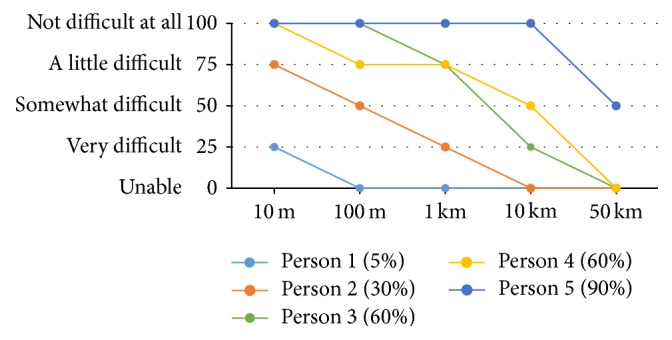
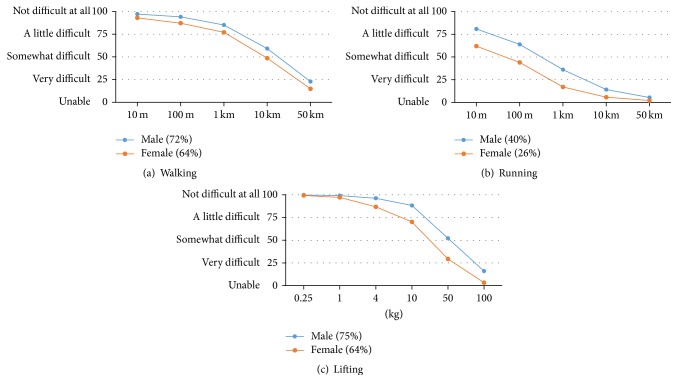
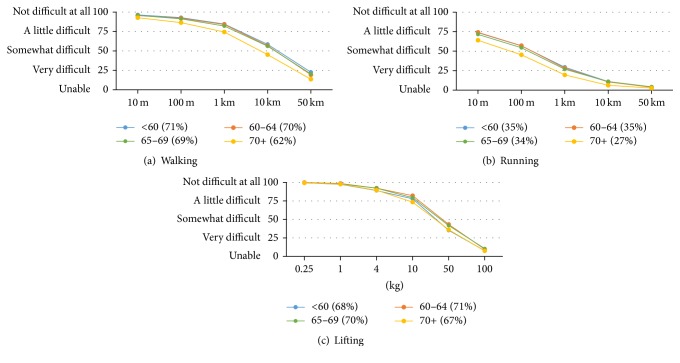
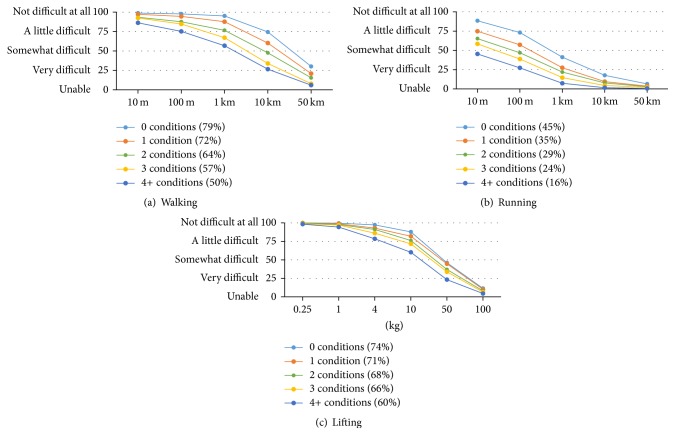
Aims. The purpose of the study was to develop new self-report instruments to measure the ability to walk, run, and lift objects and describe the distribution of these abilities among older Canadians. Methods. Questions were developed following a focus group. We carried out an online survey among members of the Canadian Association of Retired Persons. The distribution of each ability was described and presented graphically according to age, sex, and number of health conditions. We calculated summary scores for each ability and assessed their reliability and relationships with health status and use of health services. Results. 22% of the subjects reported difficulty walking 100 m, 15% were unable to run 10 m, and 50% had difficulty lifting 10 kg. Men reported higher abilities than women but differences according to age were small. Test-retest reliability ranged from 0.89 for walking to 0.88 for running and 0.81 for lifting. Scores for the three measures correlated with other measures of health status as expected. Conclusions. The study provided new data on self-reported walking, running, and lifting abilities among older Canadians. The new measures are valid, reliable, and easy to interpret. We expect these measures to be useful in clinical and research settings.
Conflict of interest statement
The authors report no conflict of interests. The study was funded by a grant from the Canadian Arthritis Network.
Figures
References
-
- Spilker B., editor. Quality of Life and Pharmacoeconomics in Clinical Trials. 2nd. New York, NY, USA: Lippincott-Raven; 1996.
-
- MacDowell I., Newell C. Measuring Health: A Guide to Rating Scales and Questionnaires. 3rd. New York, NY, USA: Oxford University Press; 2006.
LinkOut - more resources
Full Text Sources
Other Literature Sources
