A unified conceptual model for diagnostic errors: underdiagnosis, overdiagnosis, and misdiagnosis
- PMID: 28367397
- PMCID: PMC5373075
- DOI: 10.1515/dx-2013-0027
A unified conceptual model for diagnostic errors: underdiagnosis, overdiagnosis, and misdiagnosis
Abstract
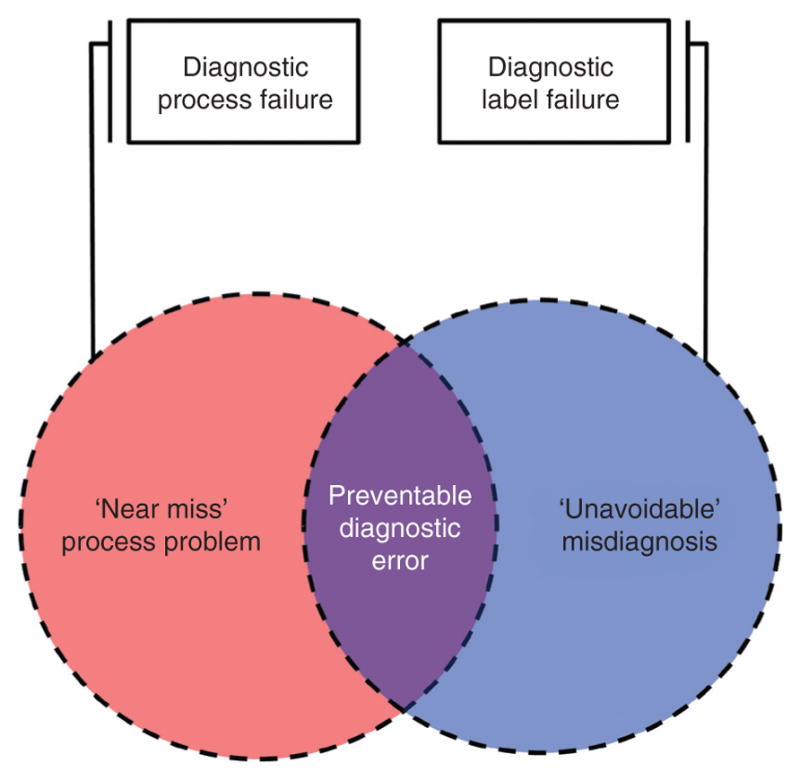
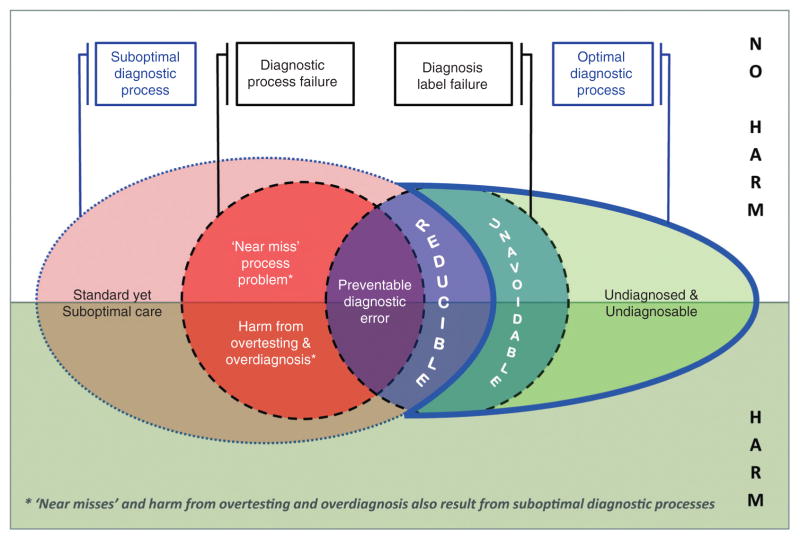
Progress in diagnostic error research has been hampered by a lack of unified terminology and definitions. This article proposes a novel framework for considering diagnostic errors, offering a unified conceptual model for underdiagnosis, overdiagnosis, and misdiagnosis. The model clarifies the critical separation between 'diagnostic process failures' (incorrect workups) and 'diagnosis label failures' (incorrect diagnoses). By dividing processes into those that are substandard, suboptimal, or optimal, important distinctions are drawn between 'preventable', 'reducible,' and 'unavoidable' diagnostic errors. The new model emphasizes the importance of mitigating diagnosis-related harms, regardless of whether the solutions require traditional safety strategies (preventable errors), more effective evidence dissemination (reducible errors; harms from overtesting and overdiagnosis), or new scientific discovery (currently unavoidable errors). Doing so maximizes our ability to prioritize solving various diagnosis-related problems from a societal value perspective. This model should serve as a foundation for developing consensus terminology and operationalized definitions for relevant diagnostic-error categories.
Keywords: diagnosis; diagnostic errors; misdiagnosis; overdiagnosis; patient safety; underdiagnosis.
Conflict of interest statement
Conflict of interest: No conflicts of interest. The author has no financial or personal relationships with other people or organizations that could inappropriately influence (bias) their work.
Figures
References
-
- Zwaan L, de Bruijne M, Wagner C, Thijs A, Smits M, van der Wal G, et al. Patient record review of the incidence, consequences, and causes of diagnostic adverse events. Arch Intern Med. 2010;170:1015–21. - PubMed
-
- Kassirer JP, Kopelman RI. Cognitive errors in diagnosis: instantiation, classification, and consequences. Am J Med. 1989;86:433–41. - PubMed
Grants and funding
LinkOut - more resources
Full Text Sources
Other Literature Sources