


Epidemics and aetiology of hand, foot and mouth disease in Xiamen, China, from 2008 to 2015
- PMID: 28367766
- PMCID: PMC9203317
- DOI: 10.1017/S0950268817000309
Epidemics and aetiology of hand, foot and mouth disease in Xiamen, China, from 2008 to 2015
Abstract
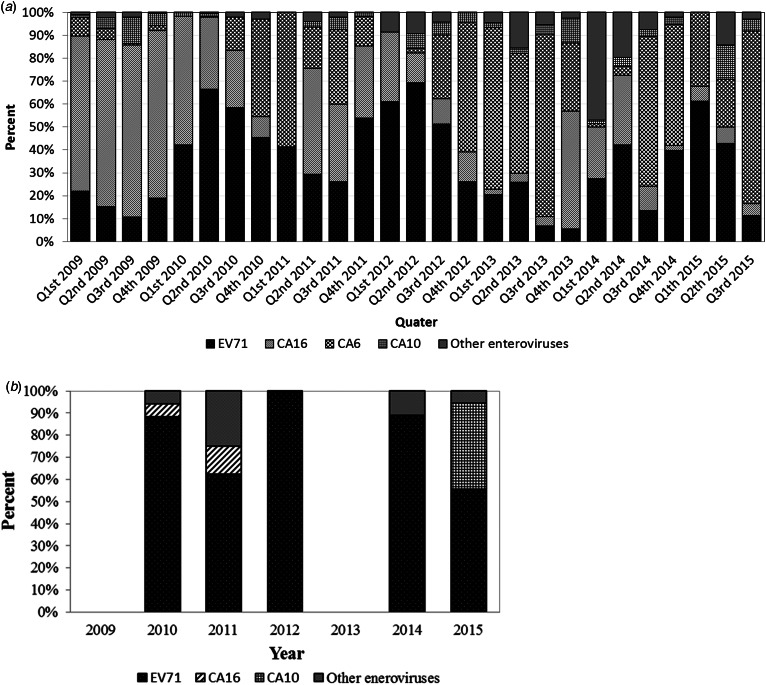
Over the past 8 years, human enteroviruses (HEVs) have caused 27 227 cases of hand, foot and mouth disease (HFMD) in Xiamen, including 99 severe cases and six deaths. We aimed to explore the molecular epidemiology of HFMD in Xiamen to inform the development of diagnostic assays, vaccines and other interventions. From January 2009 to September 2015, 5866 samples from sentinel hospitals were tested using nested reverse transcription PCR that targeted the HEV 5' untranslated region and viral protein 1 region. Of these samples, 4290 were tested positive for HEV and the amplicons were sequenced and genotyped. Twenty-two genotypes were identified. Enterovirus 71 (EV71) and coxsackieviruses A16, A6 and A10 (CA16, CA6 and CA10) were the most common genotypes, and there were no changes in the predominant lineages of these genotypes. EV71 became the most predominant genotype every 2 years. From 2013, CA6 replaced CA16 as one of the two most common genotypes. The results demonstrate the vast diversity of HFMD pathogens, and that minor genotypes are able to replace major genotypes. We recommend carrying-out long-term monitoring of the full spectrum of HFMD pathogens, which could facilitate epidemic prediction and the development of diagnostic assays and vaccines.
Keywords: Enterovirus; epidemiology; infectious disease epidemiology; surveillance.
Conflict of interest statement
None.
Figures
References
-
- Caro V, et al. Molecular strategy for ‘serotyping’ of human enteroviruses. Journal of General Virology 2001; 82: 79–91. - PubMed
-
- Ooi MH, et al. Clinical features, diagnosis, and management of enterovirus 71. Lancet Neurology 2010; 9: 1097–1105. - PubMed
-
- Weng KF, et al. Neural pathogenesis of enterovirus 71 infection. Microbes and Infection 2010; 12: 505–510. - PubMed
-
- Chen SC, et al. An eight-year study of epidemiologic features of enterovirus 71 infection in Taiwan. American Journal of Tropical Medicine and Hygiene 2007; 77: 188–191. - PubMed
Publication types
MeSH terms
LinkOut - more resources
Full Text Sources
Other Literature Sources
Research Materials
Miscellaneous
