. 2017 Apr 1;9(4):346.
doi: 10.3390/nu9040346.

Homocysteine Induces Hepatic Steatosis Involving ER Stress Response in High Methionine Diet-Fed Mice

Affiliations

Homocysteine Induces Hepatic Steatosis Involving ER Stress Response in High Methionine Diet-Fed Mice

Yanbiao Ai et al. Nutrients. .

Abstract

Elevated circulating homocysteine (Hcy) has been proposed to be associated with non-alcoholic fatty liver disease (NAFLD). It is also reported that Hcy causes protein misfolding in the endoplasmic reticulum (ER). In this study, we used a high methionine diet (HMD)-fed mouse model and cultured primary hepatocytes to investigate the effects of Hcy on hepatic lipids metabolism. C57BL/6J mice received either standard chow diet (CT, n = 10) or diet supplemented with 2% methionine (MET, n = 10) for 16 weeks. In in vitro experiments, cultured mouse primary hepatocytes were treated with Hcy, or Hcy combined with 4-phenylbutyric acid (4-PBA), or tunicamycin (TM), respectively. HMD-fed mice exhibited a mild increase in plasma Hcy level. There was no significant difference of body weight gain between the two groups. Nevertheless, HMD feeding increased epididymal fat/body weight ratio, elevated plasma triglyceride (TG) level, and decreased high-density lipoprotein cholesterol (HDL) level. Similarly, mice on HMD displayed higher liver/body weight ratio, plasma aspartate aminotransferase (AST) and its ratio to alanine aminotransferase (ALT), which was supported by the morphological observations of hepatic triglyceride accumulation in liver tissue as well as primary hepatocytes. Activation of the sterol response element-binding protein 1c (SREBP1c) in Hcy-treated hepatocytes with increased expression of genes involved in hepatic de novo lipogenesis was partially reduced by pretreatment of 4-PBA. Hcy-induced ER stress was also ameliorated by 4-PBA pretreatment, thus demonstrating an important role of Hcy-induced ER stress response in hepatic steatosis. These findings suggest that elevated Hcy was a critical factor in the pathogenesis of NAFLD. Activation of the ER stress response may be involved in Hcy-induced hepatic steatosis.

Keywords: ER stress; NAFLD; homocysteine; methionine.


Conflict of interest statement

The authors declare no conflict of interest.

Figures
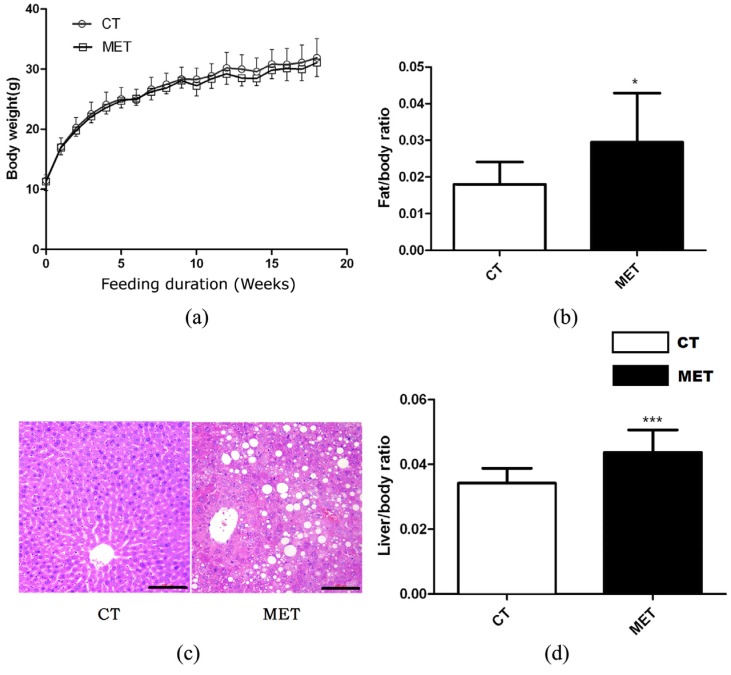
Figure 1
Figure 1
Effects of high methionine diet (HMD) feeding on: (a) Body weight gain; (b) Epididymal fat/body weight ratio; (c) Hematoxylin and eosin (H & E) staining of the liver (magnification 200×), scale bars, 100 μM; (d) Liver/body weight ratio. Data are presented as mean ± SD. * p < 0.05 and *** p < 0.001 vs. control (CT). CT: standard chow diet; MET: diet supplemented with 2% methionine.
Figure 2
Figure 2
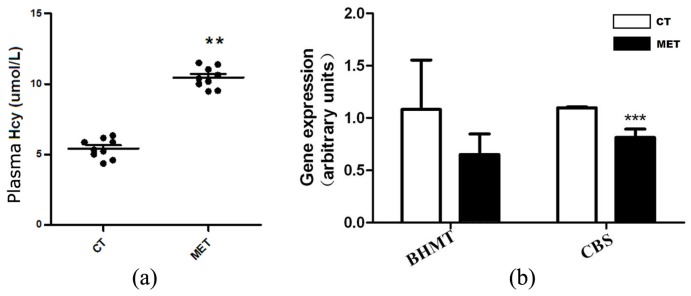
HMD feeding elevated plasma homocysteine (Hcy) level. (a) Plasma Hcy levels in mice fed with chow or high methionine diets; (b) The mRNA expression levels of betaine-methyltransferase (BHMT) and cystathionine-β-synthase (CBS) in the liver. Data are presented as mean ± SD. ** p < 0.015 and *** p < 0.001 vs. CT group.
Figure 3
Figure 3
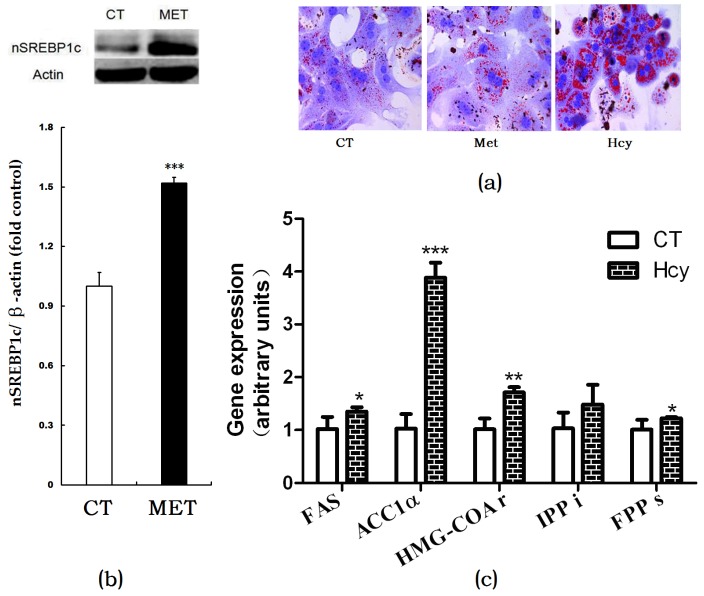
Effects of Hcy on hepatic lipogenesis. (a) Oil Red O staining of cultured primary hepatocytes treated with methionine or Hcy; (b) Protein expression of nSREBP1c in the liver; (c) Relative expression of genes involved in hepatic lipogenesis. The data are presented as mean ± SD. * p < 0.05, ** p < 0.015, and *** p < 0.001 vs. CT. FAS: fatty acid synthase; ACC1α: acetyl-CoA carboxylase 1α; HMG-COAr: hydroxymethylglutaryl CoA reductase; IPPi: isopentenylpyrophosphate isomerase; FPPs: farnesyl diphosphate synthase.
Figure 4
Figure 4
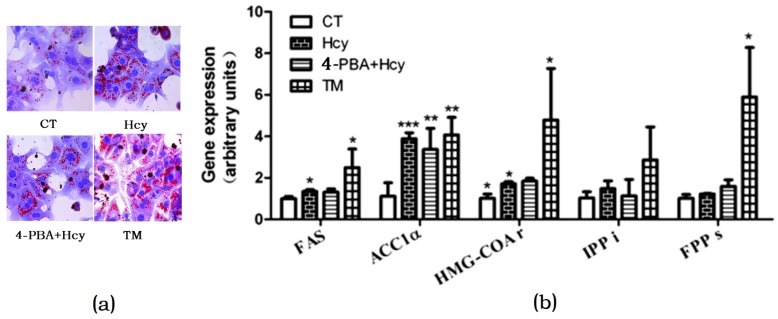
Endoplasmic reticulum (ER) stress response involved in hepatic steatosis. (a) Oil Red O staining of cultured primary hepatocytes; (b) Relative expression of genes involved in hepatic de novo lipogenesis. The data are presented as mean ± SD. * p < 0.05, ** p < 0.015, and *** p < 0.001 vs. CT. 4-PBA: 4-phyenylbutyric acid; TM: tunicamycin. FAS: fatty acid synthase; ACC1α: acetyl-CoA carboxylase 1α; HMG-COAr: hydroxymethylglutaryl CoA reductase; IPPi: isopentenylpyrophosphate isomerase; FPPs: farnesyl diphosphate synthase.
Figure 5
Figure 5
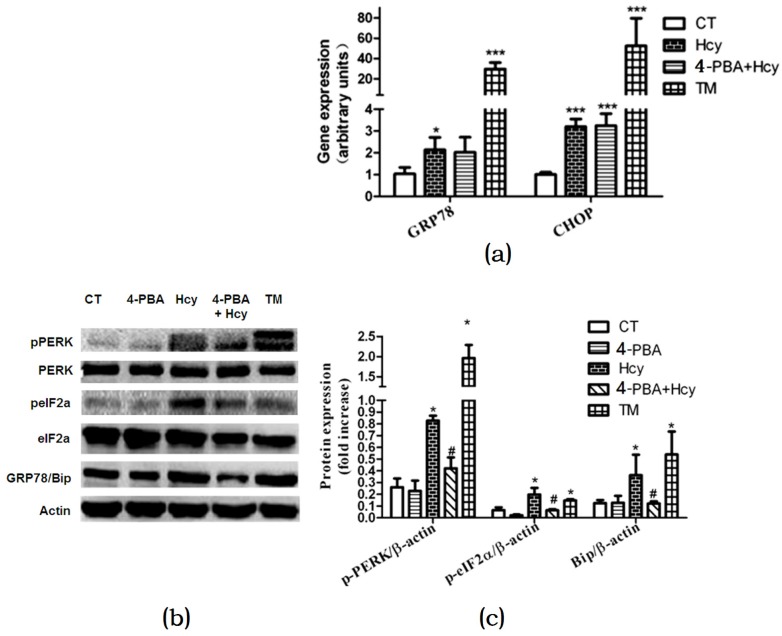
Effects of Hcy on ER stress response in primary hepatocytes: (a) Relative expression of genes of ER stress biomarkers; (b,c) Relative expression of proteins involved in ER stress pathway in primary hepatocytes. The data are presented as mean ± SD. * p < 0.05, ** p < 0.015 vs. CT, # p < 0.05 vs. Hcy and TM. GRP78: glucose regulated protein 78; Bip: binding immunoglobulin protein; CHOP: c/EBP homologous protein; p-PERK: phosphorylated protein kinase RNA-like ER kinase; p-eIF2α: phosphorylated eukaryotic initiation factor 2α.

References

    1. Younossi Z.M., Koenig A.B., Abdelatif D., Fazel Y., Henry L., Wymer M. Global epidemiology of nonalcoholic fatty liver disease-Meta-analytic assessment of prevalence, incidence, and outcomes. Hepatology. 2016;64:73–84. doi: 10.1002/hep.28431. - DOI - PubMed
    1. Gusdon A.M., Song K.X., Qu S. Nonalcoholic Fatty Liver Disease: Pathogenesis and Therapeutics from a Mitochondria-Centric Perspective. Oxid. Med. Cell. Longev. 2014;2014:637027. doi: 10.1155/2014/637027. - DOI - PMC - PubMed
    1. Streba L.A., Vere C.C., Rogoveanu I., Streba C.T. Nonalcoholic fatty liver disease, metabolic risk factors, and hepatocellular carcinoma: An open question. World J. Gastroenterol. 2015;21:4103–4110. doi: 10.3748/wjg.v21.i14.4103. - DOI - PMC - PubMed
    1. Mato J.M., Martínez-Chantar M.L., Lu S.C. Methionine metabolism and liver disease. Annu. Rev. Nutr. 2008;28:273–293. doi: 10.1146/annurev.nutr.28.061807.155438. - DOI - PubMed
    1. Škovierová H., Vidomanová E., Mahmood S., Sopková J., Drgová A., Červeňová T., Halašová E., Lehotský J. The Molecular and Cellular Effect of Homocysteine Metabolism Imbalance on Human Health. Int. J. Mol. Sci. 2016;17:1733. doi: 10.3390/ijms17101733. - DOI - PMC - PubMed

MeSH terms

LinkOut - more resources