. 2017 Apr 15;215(8):1245-1254.
doi: 10.1093/infdis/jix141.

Enteric Helminths Promote Salmonella Coinfection by Altering the Intestinal Metabolome

Affiliations

Enteric Helminths Promote Salmonella Coinfection by Altering the Intestinal Metabolome

Lisa A Reynolds et al. J Infect Dis. .

Abstract

Intestinal helminth infections occur predominantly in regions where exposure to enteric bacterial pathogens is also common. Helminth infections inhibit host immunity against microbial pathogens, which has largely been attributed to the induction of regulatory or type 2 (Th2) immune responses. Here we demonstrate an additional 3-way interaction in which helminth infection alters the metabolic environment of the host intestine to enhance bacterial pathogenicity. We show that an ongoing helminth infection increased colonization by Salmonella independently of T regulatory or Th2 cells. Instead, helminth infection altered the metabolic profile of the intestine, which directly enhanced bacterial expression of Salmonella pathogenicity island 1 (SPI-1) genes and increased intracellular invasion. These data reveal a novel mechanism by which a helminth-modified metabolome promotes susceptibility to bacterial coinfection.

Keywords: bacterial infection; co-infection; helminths; immunomodulation; intestinal metabolites..


Figures

Figure 1.
Figure 1.
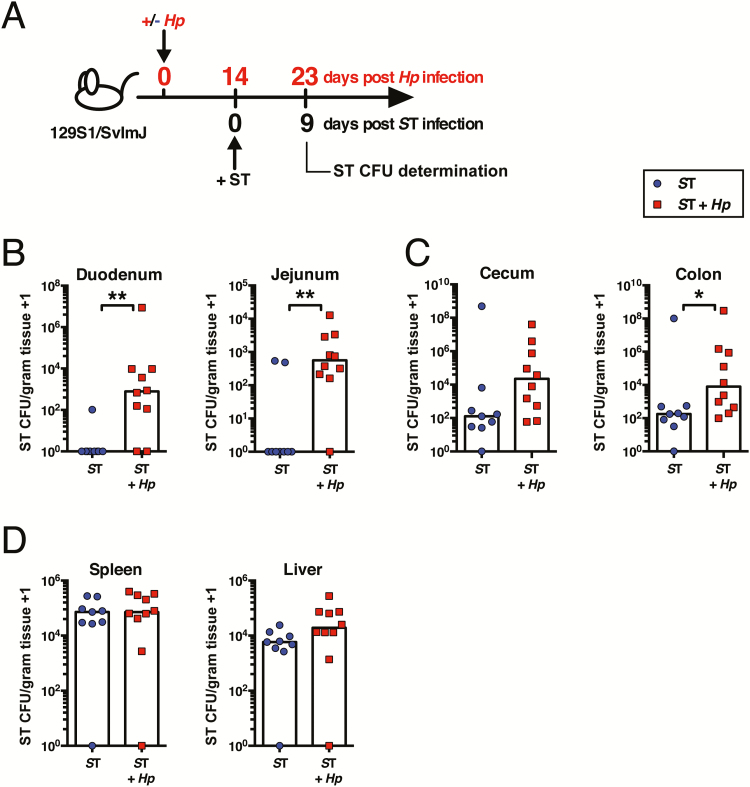
Helminth-coinfected 129S1/SvlmJ mice exhibit elevated Salmonella Typhimurium (ST) burdens in the small intestine. A, Experimental setup. 129S1/SvImJ mice were left naive or infected with Heligmosomoides polygyrus (Hp). Fourteen days later, all mice were orally infected with ST. Nine days later, ST colony-forming unit (CFU) counts were determined. ST CFU counts in the duodenum and jejunum (B), cecum and colon (C), and spleen and liver (D) are shown. Data shown are pooled from 2 independent experiments and are representative of the results from 3 independent experiments. *P ≤ .05; **P ≤ .01.
Figure 2.
Figure 2.
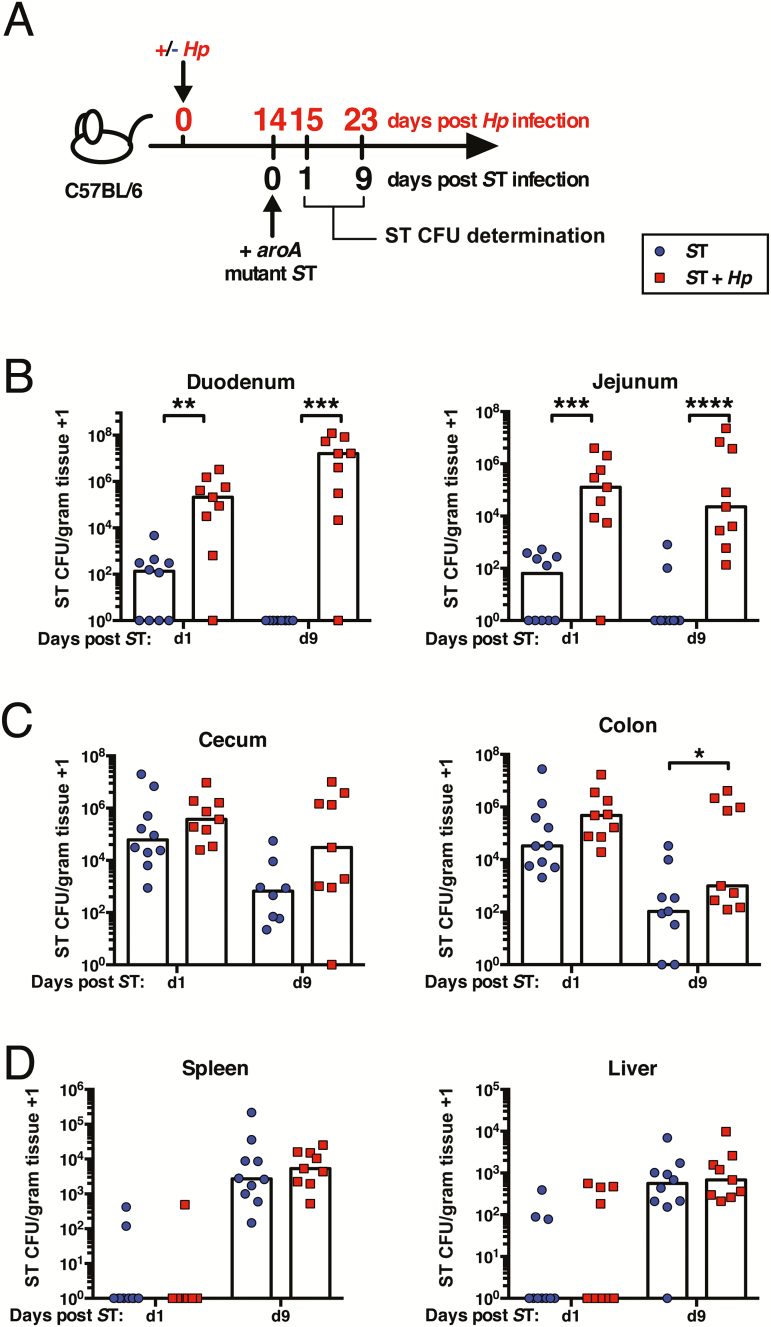
Helminth-coinfected C57BL/6 mice exhibit elevated Salmonella Typhimurium (ST) burdens in the small intestine. A, Experimental setup. C57BL/6 mice were left naive or infected with Heligmosomoides polygyrus (Hp). Fourteen days later, all mice were orally infected with aroA mutant ST. One and 9 days later, ST colony-forming unit (CFU) counts were determined. ST CFU counts in the duodenum and jejunum (B), cecum and colon (C), and spleen and liver (D) are shown. Data shown are pooled from 2 independent experiments and are representative of the results from 4 independent experiments. *P ≤ .05; **P ≤ .01; ***P ≤ .001; ****P ≤ .0001.
Figure 3.
Figure 3.
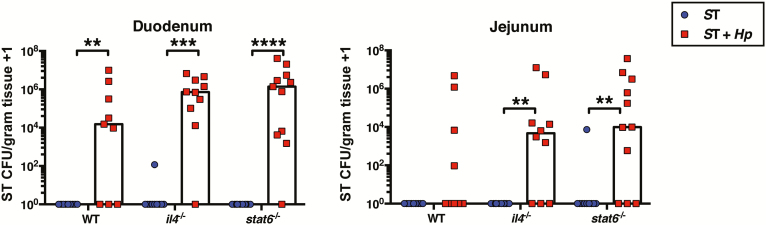
Elevated Salmonella Typhimurium (ST) burdens in helminth-coinfected mice are independent of induction of Th2 cells. C57BL/6 (wild-type [WT]), il4-/-, and stat6-/- mice were left naive or infected with Heligmosomoides polygyrus (Hp). Fourteen days later, all mice were orally infected with aroA mutant ST. Nine days later, ST colony-forming unit (CFU) counts were determined in the duodenum and jejunum. Data shown are pooled from 2 independent experiments. **P ≤ .01; ***P ≤ .001; ****P ≤ .0001.
Figure 4.
Figure 4.
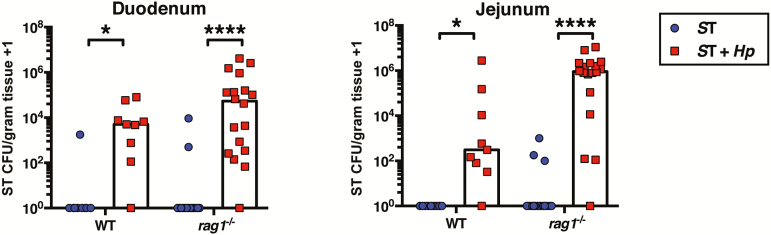
Elevated Salmonella Typhimurium (ST) burdens in helminth-coinfected mice are independent of induction of regulatory T cells. C57BL/6 and rag1-/- mice were left naive or infected with Heligmosomoides polygyrus (Hp). Fourteen days later, all mice were orally infected with aroA mutant ST. One day later, ST colony-forming unit (CFU) counts were determined in the duodenum and jejunum. Data shown are pooled from 3 independent experiments. *P ≤ .05; ****P ≤ .0001.
Figure 5.
Figure 5.
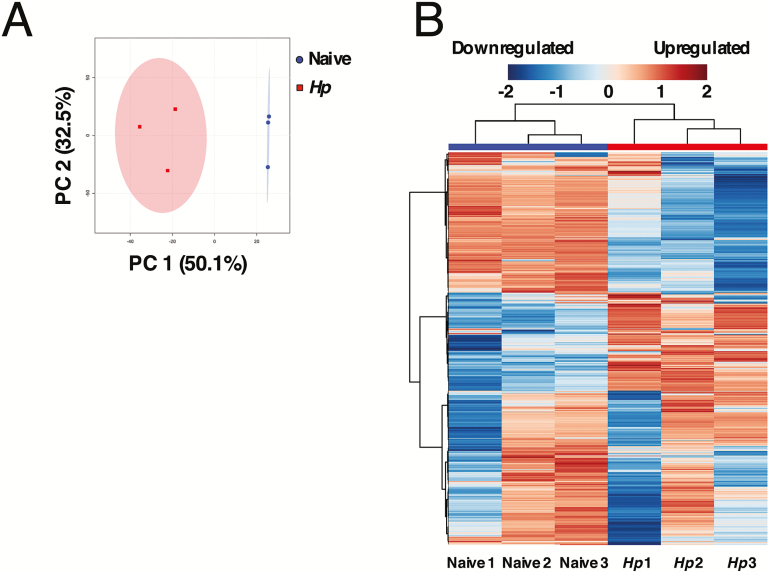
Helminth infection alters the metabolic profile of the small intestine. A, The differential abundance of small-intestinal metabolites from naive or day 14 Heligmosomoides polygyrus–infected (Hp) 129S1/SvImJ mice was determined by ultra-high-performance liquid chromatography–Fourier transform mass spectrometry. A principal components (PC) analysis plot was generated from metabolites detected in positive ion mode. B, Heatmap showing the relative abundance of all metabolites detected in naive and day 14 Hp-infected 129S1/SvImJ mice, detected in positive ion mode. Clustering of naive and Hp-infected mice is shown using a Euclidean distance and Ward clustering algorithm.
Figure 6.
Figure 6.
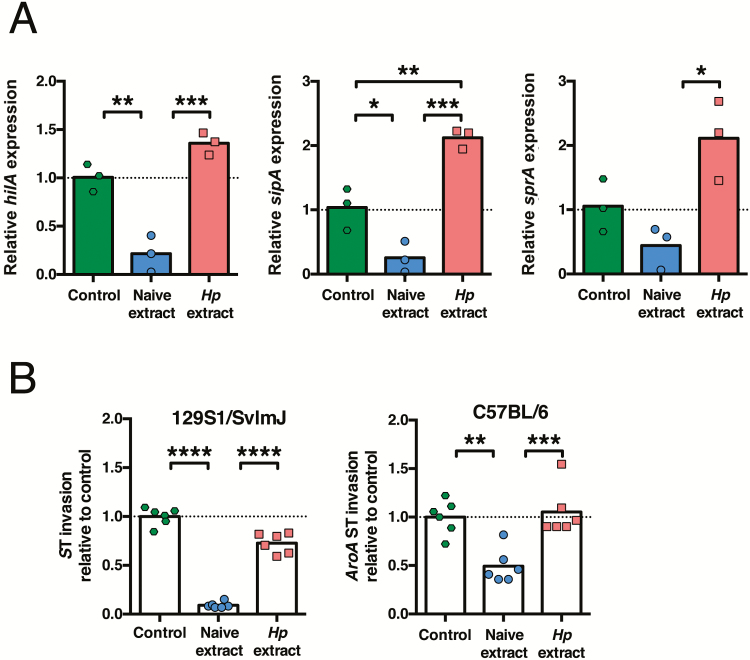
Helminth-modified small-intestinal metabolites promote intracellular invasion by Salmonella Typhimurium (ST). A, aroA mutant ST bacteria were cultured without metabolites (control) or with metabolites extracted from the small intestine of naive or Heligmosomoides polygyrus (Hp)infected C57BL/6 mice. Expression levels of ST hilA, sipA, and sprB were then determined. Each data point represents gene expression levels of 3 ST cultures that were split and cultured with metabolites from each group. Data shown are representative of results from 4 independent experiments that each used independent mice and ST cultures. B, Wild-type or aroA mutant ST bacteria were cultured without metabolites (control) or with metabolites extracted from the small intestine of naive or Hp–infected 129S1/SvImJ or C57BL/6 mice, prior to infection of HeLa cells. Each data point represents a technical replicate of HeLa cells infected with ST that had been cultured with metabolites pooled from 3–5 naive or 3 Hp-infected mice. Data are representative of results from 2 (129S1/SvImJ) or 3 (C57BL/6) independent experiments that each used independent mice and ST cultures. *P ≤ .05; **P ≤ .01; ***P ≤ .001; ****P ≤ .0001.

References

    1. Salgame P, Yap GS, Gause WC. Effect of helminth-induced immunity on infections with microbial pathogens. Nat Immunol 2013; 14:1118–26. - PMC - PubMed
    1. Chen CC, Louie S, McCormick B, Walker WA, Shi HN. Concurrent infection with an intestinal helminth parasite impairs host resistance to enteric Citrobacter rodentium and enhances Citrobacter-induced colitis in mice. Infect Immun 2005; 73:5468–81. - PMC - PubMed
    1. Osborne LC, Monticelli LA, Nice TJ, et al. Coinfection. Virus-helminth coinfection reveals a microbiota-independent mechanism of immunomodulation. Science 2014; 345:578–82. - PMC - PubMed
    1. Reese TA, Wakeman BS, Choi HS, et al. Helminth infection reactivates latent γ-herpesvirus via cytokine competition at a viral promoter. Science 2014; 345:573–7. - PMC - PubMed
    1. Hsieh YJ, Fu CL, Hsieh MH. Helminth-induced interleukin-4 abrogates invariant natural killer T cell activation-associated clearance of bacterial infection. Infect Immun 2014; 82:2087–97. - PMC - PubMed

Publication types

Supplementary concepts

Grants and funding