


Childhood Body Size and the Risk of Malignant Melanoma in Adulthood
- PMID: 28369155
- PMCID: PMC5394246
- DOI: 10.1093/aje/kww128
Childhood Body Size and the Risk of Malignant Melanoma in Adulthood
Abstract
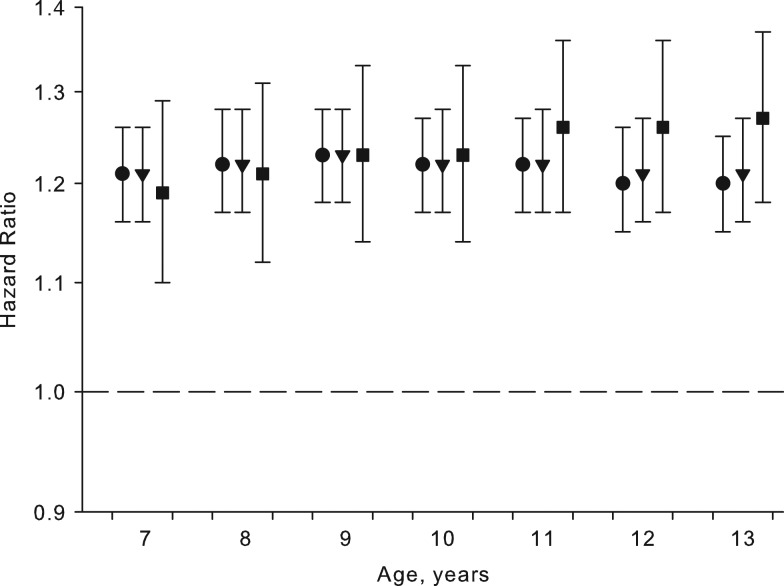
Malignant melanoma (MM) is the most aggressive form of skin cancer. Adult anthropometry influences MM development; however, associations between childhood body size and future melanomagenesis are largely unknown. We investigated whether height, body mass index (BMI; weight (kg)/height (m)2), and body surface area (BSA) at ages 7-13 years and birth weight are associated with adult MM. Data from the Copenhagen School Health Records Register, containing annual height and weight measurements of 372,636 Danish children born in 1930-1989, were linked with the Danish Cancer Registry. Cox regression analyses were performed. During follow-up, 2,329 MM cases occurred. Height at ages 7-13 years was significantly associated with MM, even after BMI and BSA adjustments. No significant BMI-MM or BSA-MM associations were detected when adjusting for height. Children who were persistently tall at both age 7 years and age 13 years had a significantly increased MM risk compared with children who grew taller between those ages. Birth weight was positively associated with MM. We conclude that associations between body size and MM originate early in life and are driven largely by height and birth weight, without any comparable influence of BMI or BSA. Melanoma transformation is unlikely to be due to height per se; however, height-regulating processes in childhood present new areas for mechanistic explorations of this disease.
Keywords: birth weight; body height; body mass index; body surface area; child; melanoma.
© The Author 2017. Published by Oxford University Press on behalf of the Johns Hopkins Bloomberg School of Public Health.
Figures
References
-
- Ferlay J, Soerjomataram I, Ervik M, et al. GLOBOCAN 2012: Estimated Cancer Incidence, Mortality, and Prevalence Worldwide in 2012.(IARC CancerBase no. 11, version 1.0). Lyon, France: International Agency for; Research on Cancer; 2013. http://globocan.iarc.fr. Accessed June 30, 2015.
-
- Berg P, Lindelof B. Differences in malignant melanoma between children and adolescents. A 35-year epidemiological study. Arch Dermatol. 1997;133(3):295–297. - PubMed
-
- Holly EA, Kelly JW, Shpall SN, et al. Number of melanocytic nevi as a major risk factor for malignant melanoma. J Am Acad Dermatol. 1987;17(3):459–468. - PubMed
-
- Meyle KD, Guldberg P. Genetic risk factors for melanoma. Hum Genet. 2009;126(4):499–510. - PubMed
-
- Autier P, Boyle P. Artificial ultraviolet sources and skin cancers: rationale for restricting access to sunbed use before 18 years of age. Nat Clin Pract Oncol. 2008;5(4):178–179. - PubMed
MeSH terms
Grants and funding
LinkOut - more resources
Full Text Sources
Other Literature Sources
Medical
