


Does exercise increase or decrease pain? Central mechanisms underlying these two phenomena
- PMID: 28369946
- PMCID: PMC5491894
- DOI: 10.1113/JP273355
Does exercise increase or decrease pain? Central mechanisms underlying these two phenomena
Abstract
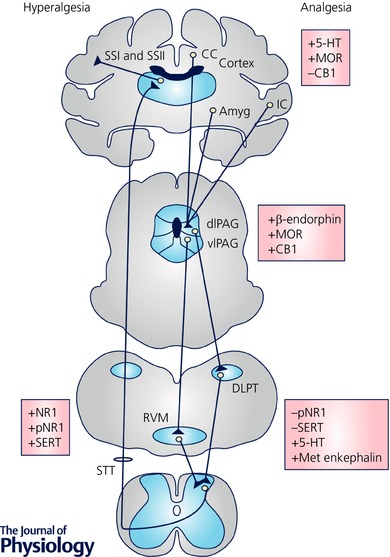
Exercise is an integral part of the rehabilitation of patients suffering a variety of chronic musculoskeletal conditions, such as fibromyalgia, chronic low back pain and myofascial pain. Regular physical activity is recommended for treatment of chronic pain and its effectiveness has been established in clinical trials for people with a variety of pain conditions. However, exercise can also increase pain making participation in rehabilitation challenging for the person with pain. Animal models of exercise-induced pain have been developed and point to central mechanisms underlying this phenomena, such as increased activation of NMDA receptors in pain-modulating areas. Meanwhile, a variety of basic science studies testing different exercise protocols, show exercise-induced analgesia involves activation of central inhibitory pathways. Opioid, serotonin and NMDA mechanisms acting in rostral ventromedial medulla promote analgesia associated with exercise. This review explores and discusses current evidence on central mechanisms underlying exercised-induced pain and analgesia.
Keywords: animal; central nervous system; exercise; glutamate; hyperalgesia; opioid; pain; physical activity; serotonin.
© 2017 The Authors. The Journal of Physiology © 2017 The Physiological Society.
Figures
Comment in
-
Top-down control of pain.J Physiol. 2017 Jul 1;595(13):4139-4140. doi: 10.1113/JP273361. J Physiol. 2017. PMID: 28664606 Free PMC article. No abstract available.
References
-
- Basbaum AI & Fields HL (1984). Endogenous pain control systems: brainstem spinal pathways and endorphin circuitry. Ann Rev Neuroscience 7, 309–338. - PubMed
-
- Bement MKH & Sluka KA (2005). Low‐intensity exercise reverses chronic muscle pain in the rat in a naloxone‐dependent manner. Arch Phys Med Rehabil 86, 1736–1740. - PubMed
-
- Bement MKH & Sluka KA (2016). Exercise‐induced analgesia: an evidence‐based review In Mechanisms and Management of Pain for the Physical Therapist, 2nd edn, ed. Sluka KA, Ch. 10. pp. 177–201. Wolters Kuwer, IASP Press, Seattle.
-
- Bement MKH, Weyer A, Hartley S, Yoon T & Hunter SK (2009). Fatiguing exercise attenuates pain‐induced corticomotor excitability. Neurosci Lett 452, 209–213. - PubMed
Publication types
MeSH terms
LinkOut - more resources
Full Text Sources
Other Literature Sources
Medical
